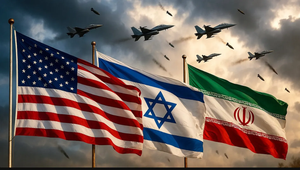
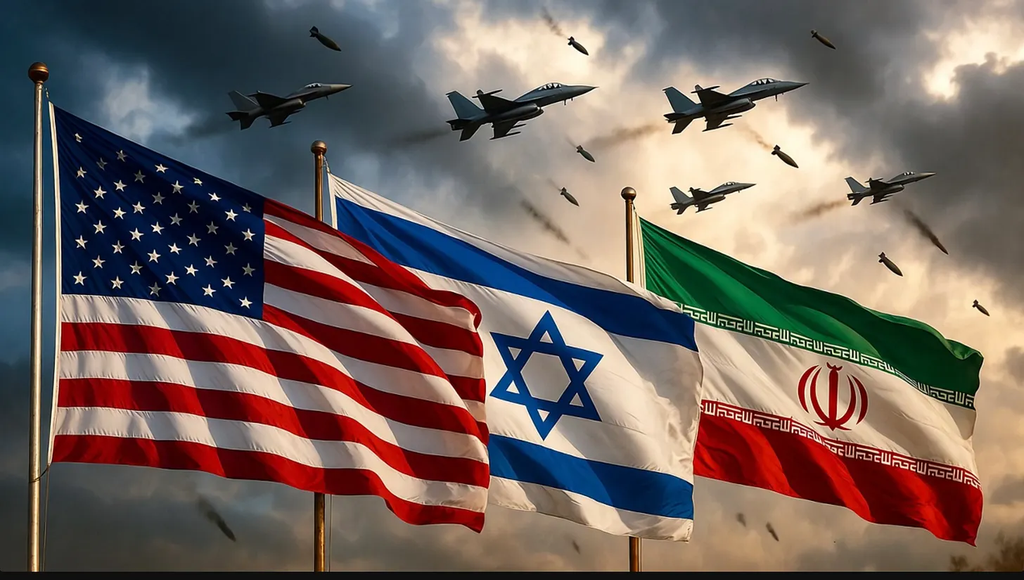
The objectives of the US in the US-Israel war on Iran were perceived as an easy task to achieve, but it has become an uphill battle. The US’s shifting objectives and approaches to acquire them are quite incoherent, and Iran’s resilience and endurance are obvious hindrances to acquiring them successfully.
The key objectives of the US in Operation Epic Fury were to destroy Iran’s nuclear facilities, eliminate the naval blockade, open the Strait of Hormuz, and disrupt the network of proxies. Whereas the US goal of regime change was not officially disclosed earlier, the political rhetoric employed by US President Trump heavily implied that regime change was one of their goals.
The constant shift in US objectives, such as from destroying nuclear sites to regime change and compliance with negotiation settlement, fails to materialise the US objectives effectively. The US strikes to destroy the nuclear facilities and air defence system have achieved military success; however, they failed to eliminate Iran’s nuclear programme. Regarding the elimination of the naval blockade, the mediation efforts were fruitful for temporarily eliminating the naval blockade and opening the Strait of Hormuz, but it remains unsuccessful in opening the Strait of Hormuz as a permanent transit passage.
In terms of disrupting the proxies’ network, the joint US-Israel strikes destroyed the military infrastructure and weakened the financial and logistical capacity of Hezbollah in Lebanon and other networks; however, their plans were miscarried to eliminate the network of proxies. The US objective of regime change, in which the US decapitated the top leadership of Iran, was meant to ignite an internal revolt to overthrow the theocratic government, but it too proved to be a miscalculation of Iran’s resilience.
Conversely, Iran’s core objectives are survival, preserving independence, maintaining regional hegemony in the Middle East, and control over the Strait of Hormuz. In pursuing its objectives, Iran’s strategy is well-planned and well-executed. Its decentralised military structure successfully acquired its core objective of regime survival and operational continuity. Regarding the domestic production of weapons, the dispersed and underground production facilities provided Iran the capacity to endure initial airstrike damage and constantly restock its exhausted weapons.
Iran’s asymmetric naval warfare has partially attained its objective of increasing the military and economic costs for the U.S. and Israel. It has effectively confined traffic through the Strait of Hormuz, although its conventional naval capabilities have been severely damaged. In terms of regional allies, the proxies efficiently shifted the war outside Iran’s borders, with Houthis disrupting Red Sea shipping and regional mercenaries targeting infrastructure in Gulf States, particularly the US bases. This indicates that Iran’s strategy empowers Iran to sustain and persist while imposing costs on the US.
However, the US means to ends are quite confusing. On a diplomatic front, the signing of an MOU brokered by Islamabad or a mediation effort via Oman rapidly collapsed back into hostilities. Furthermore, guaranteeing Lebanon in the mediation effort, which was not present in the mediation, also shows the weakness of diplomatic efforts. The information instrument was also misused as a result of rhetorical remarks by the leaders. Diplomats were engaged in negotiations to put an end to strikes and reopen the Strait of Hormuz, while US leaders took to social media, haranguing Iran, which resultantly undermined the negotiations’ credibility.
The economic tool was not utilised as leverage, including frozen assets, a naval blockade, and oil restrictions; in this domain, the US gave up its leverage in signing the MOU without any assurance of Iran’s compliance. So, with the breakdown of the ceasefire, the US had to rebuild its pressure; in doing so, it caused oil market instability and higher petrol prices, resulting in inflation within America.
This economic strategy fails in two ways: one, it gave up and lost its leverage, and another, it exposed the American economy to renewed costs. The kinetic approach used for regime change resulted in the decapitation of top leadership; however, it was a futile attempt. Despite US-Israel attacks on Iran, public sentiment strengthened towards its incumbent leadership, which underscores America’s miscalculation of Iran’s leadership.
Also Read: Uzbekistan Recalibrates Its Economic Ties With the CIS Amid Shifting Priorities
The US strategy in achieving its varying objectives clearly shows incoherence and a lack of mechanisms for enforcement and verification. If the mechanisms of verification and enforcement had been utilised effectively through economic and military tools, it would have produced different results. So, the geopolitical risk heightens when the gap between ends and means widens broadly.
The US must adopt a coherent strategic approach for obtaining clear political objectives. Diplomatically, the US should establish a direct channel without any third-party mediation. Informationally, the US should stop its officials from making rhetorical remarks that can weaken diplomacy, and designate a single official spokesperson for negotiation and settlement. Economically, the US should withhold its asset release, suspension of naval blockade, and sanctions relief until Iran’s compliance is ensured.
On the military front, the US should condition future strike authority on clearly defined compliance violations and ensure that military strategy reinforces the diplomacy rather than a retaliatory cycle. The US already has effective instruments; what it lacks is the integration of these instruments for desired political goals. Otherwise, economic and military stress may lead to another conflict rather than ending this one.
The views presented in this article are the author’s own and do not necessarily reflect the views of Global News Pakistan

Sadaf Rao
Sadaf Rao is a student of International Relations at Quaid-i-Azam University, Islamabad. Her areas of interest include security and strategic studies, as well as geopolitics, particularly the shifting dynamics of contemporary international affairs.