Good governance is Pakistan’s core issue. Among all the views and narratives about the governance crisis, Dr. Ishrat Hussain has undeniably revealed this harsh reality in his book “Governing the Ungovernable”.
Pakistan’s acute governance crisis is a persistent challenge and the biggest hurdle to its economic development and prosperity. Since Pakistan’s inception, whether through the One Unit scheme, the parliamentary system, or the 18th Amendment (2010) on provincial autonomy, none has addressed administrative shortcomings.
Therefore, the increasing governance crisis and administrative shortcomings are constantly raising the demands for new provinces.
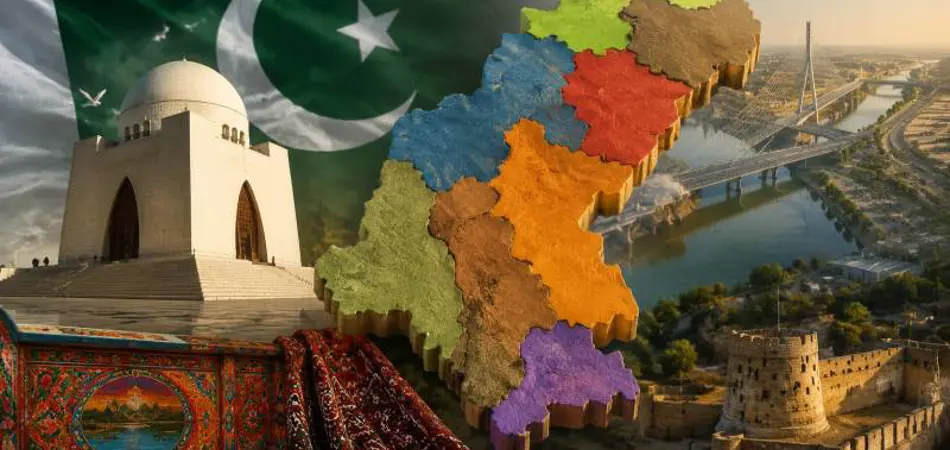
There are various demands for new provinces in Pakistan, but the reasons for them and the opposition to them are quite complex. The reasons for these demands can be administrative, population, geographical, ethnic, linguistic, developmental, economic, resource-based, and political factors, along with apprehensions about execution and cost.
Administratively, Pakistan’s provinces are large geographically and huge demographically, which makes it challenging for smaller administrative units to work effectively. The people of far-flung areas have to travel long distances to access government services and institutions.
The smaller administrative units do not get their fair economic share; hence, the voices rise for separate provinces.
The Pakistan’s demographic and geographic imbalance can be observed in its provincial structure. The massive population of Punjab 127 million increases a burden on its provincial administration, along with Baluchistan’s vast geographical area and disseminated population grow a different but equally serious issue of administrative distance.
These are not only number of differences; they ultimately shape how public experience the state. The huge demography of Punjab represents sufficiently, and Baluchistan’s huge territory makes provincial government inaccessible, hence the discussion on new provinces can eventually acquire political power.
The demand for smaller administrative units in Pakistan is profoundly rooted in the politics of identity. The territorial divisions of provinces are not only lines drawn on a map, but it decides particular groups’ linguistic, cultural and regional identities to acquire political representation.
Those societies with distinct cultural and linguistic identities, if neglected within large provinces, could turn their demand for recognition into a demand for separate political force. The Hazaras and Siraiki movements show that linguistic and cultural identity, if supplemented with political marginalization; it can be developed into a strong demand for political restructuring.
The loopholes in healthcare, education, and human development are due to the weak governance and provincial structure of Pakistan. Educational institutions’ proximity to provincial capitals performs better than those in distant areas; then education itself becomes a sign of regional inequality.
Educational inequalities can develop economic and political disparities. Lack of educational infrastructure provides fewer opportunities for obtaining skills, which resultantly affect employment and representation in institutions.
Healthcare disparities can further fuel demands for new provinces because healthcare facilities are close to capitals, and far-flung areas lack adequate hospital services; as a result, maternal, neonatal, and infant mortality rates remain high.
Consequently, healthcare inequality, educational deprivation, geographical isolation, economic disparities, and political marginalization it underpins the current provincial structure, has collapsed.
Comparing the Pakistan to the other states, India has 28 states, 8 territories, United States has 50 states, Nigeria has 36 states, and China has 34 provincial level divisions, the question is not whether the Pakistan should follow the United States, India, China or Nigeria, the actual question is that why state of more than 240 million population, with huge territory, economic, ethnic and linguistic diversity persists to depend on just four provinces.
International experience demonstrates that having more administrative units provides accountable governance, efficient representation, and meaningful contribution in the international system.
Consequently, the creation of new provinces in Pakistan is justifiable because creating smaller administrative units can increase governance efficiency, and it can also decrease the administrative burden on provincial governments. It could improve the delivery of education, health, local, and other essential services by giving earlier overshadowed regions more administrative focus and resources.
The smaller administrative unit could get more preference for the educational requirements of undeveloped regions. The new provinces can put more political pressure for investment in neglected areas, allowing developmental priorities to demonstrate public needs despite the interests of already developed regions.
There will be an effective distribution of resources across the smaller administrative units, and it would reduce the imbalance of economic resources. Direct and indirect tax collection will become effective as the government would be capable of keeping track records of activities around the states more effectively.
Administration’s proficiency will be increased; ultimately, it will lead to stronger accountability and transparency mechanisms that will reduce corruption as well.
Turning the new province demand into reality requires assessing this proposal through geographical cohesion, demographic size, economic viability, regional identity, public support, and administrative feasibility. A proficient independent and non-partisan commission must evaluate the demands and analyze whether the proposed demand for a province is genuinely feasible.
Also Read: Beyond’s the Bombing: The True Cost of Terrorism in Pakistan
It will lower the risk of provincial rearrangement becoming a political and electoral bargaining tool. Then a parliamentary committee should analyze the financial, political, constitutional and administrative impacts before authorizing any action.
The formation or reforms of territorial divisions of provinces should ultimately be decided through parliament and the required constitutional procedure.
The governance crisis of Pakistan does not unavoidably require more new provinces, because its current provinces are enormous in population and size; it needs provinces that are, administratively viable, economically sustainable and democratically legitimate.
Hence, the actual remedy is not indiscriminate division, but a criteria-driven, people-focused and transparent, procedure for evaluating where new provinces are genuinely required.

Sadaf Rao
Sadaf Rao is a student of International Relations at Quaid-i-Azam University, Islamabad. Her areas of interest include security and strategic studies, as well as geopolitics, particularly the shifting dynamics of contemporary international affairs.