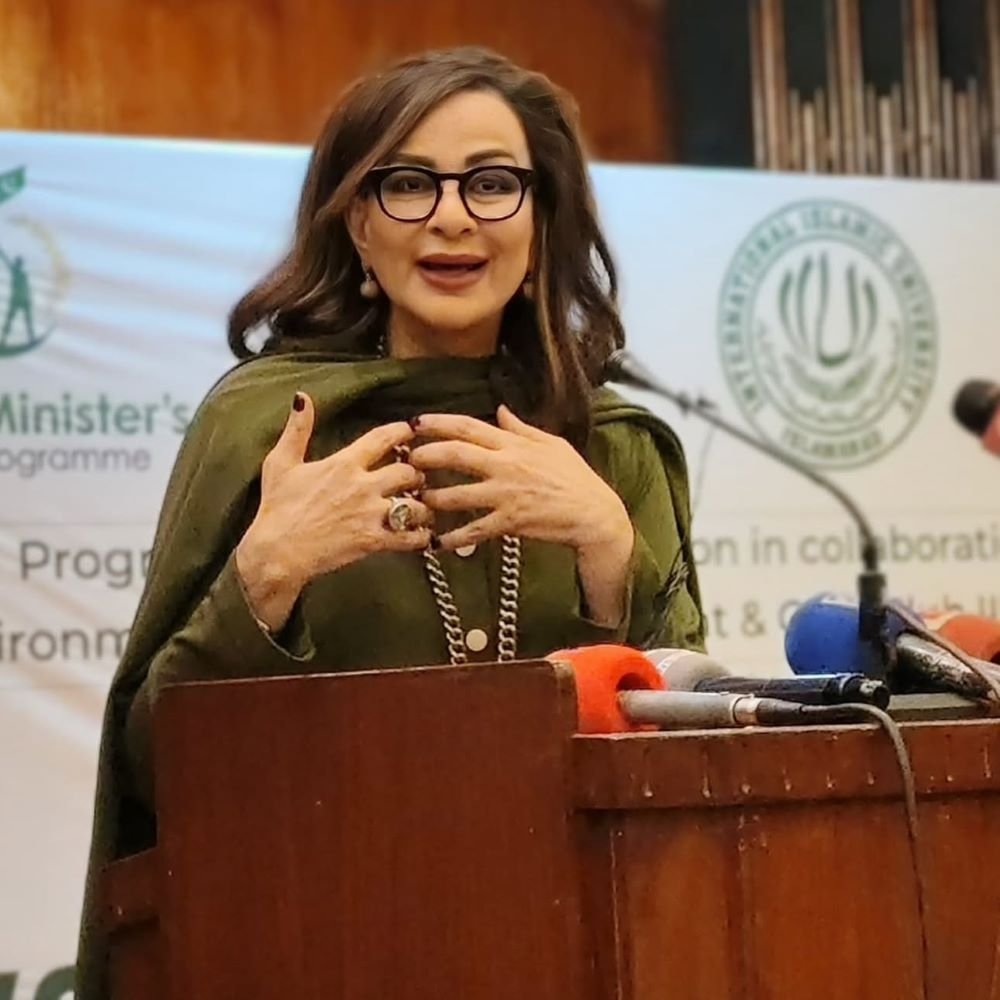
Islamabad (GNP): Senator Sherry Rehman, Chairperson of the Senate Standing Committee on Climate Change and Environmental Coordination, has called for the carbon levy to be restructured as a ring-fenced carbon tax dedicated exclusively to climate mitigation and climate action, questioning the use of approximately Rs50 billion collected under the levy and demanding transparent accounting of its allocations and disbursements.
The climate committee meeting discussed the carbon and climate levy, the functions and performance of the Pakistan Climate Change Authority (PCCA), and amendments to ICT Prohibition of Plastics Book Covers Act 2026.
“If we are collecting a carbon levy in the name of climate action, those funds must go directly into mitigation. There must be an audit, transparent allocations and a clear mechanism for disbursement in coordination with the Ministry of Climate Change. We were told that these funds were ring-fenced, but that is not what the information before us indicates,” Senator Rehman said.
She questioned why revenues collected under the levy appeared to be flowing into the federal consolidated budget rather than being demonstrably directed towards climate mitigation, adaptation or circularity. She stressed that the committee required disaggregated data on collections, allocations and actual disbursements.
“The levy cuts past all the provinces, the money is simply going into the federal budget without a dedicated climate purpose, then we need to ask what exactly we are collecting it for. Climate finance cannot be treated as another source of general budgetary support. I do not want to see a carbon levy in the next budget unless it is structured as a carbon tax that is ring-fenced for mitigation and climate action. There has to be accountability for every rupee collected.”
Senator Rehman also emphasised that climate-related revenues must translate into measurable action, rather than remain disconnected from the country’s climate financing needs and provincial vulnerabilities.
During the discussion on the PCCA, the Chairperson of the Authority said that the coming decade would be about moving from planning to implementation. The Authority briefed the committee on its efforts to pursue direct access to climate finance, including a proposal of US$3.5 million, two requests to the Loss and Damage Fund seeking US$40 million for Balochistan, and completed initiatives on smart solar irrigation and seed funding.
Senator Rehman questioned the Authority’s institutional value and the absence of a clear organogram, financing details and substantive evidence of provincial coordination.
“PCCA cannot keep presenting vision templates and broad institutional ambitions when we have no clear organogram, no funding numbers and no evidence of provincial coordination. This is the second presentation on this authority, and we are still unable to understand what value it is adding, what it is costing the exchequer and how it will enable the ministry to get its job done,” she said.
She pointed out that climate finance proposals and programmes must address the needs of all four provinces, particularly in the aftermath of the devastating 2022 floods and the establishment of the Loss and Damage Fund.
“Four provinces must be pitched equally. Every province has its own set of vulnerabilities and development priorities. It is not acceptable to approach climate finance as though only one province needs support. We need to see how this authority is coordinating with the provinces and what it is actually delivering on the ground.”
Senator Rehman stressed that the distinction between the Authority and existing institutions needed to be clearly established through tangible outputs and technical expertise.
“Papers and presentations cannot be shared with the committee the night before and then treated as a complete institutional briefing. The organogram was specifically requested and it was not presented. Any sanctioned post must have a purpose, and any authority created within the climate ministry must demonstrate that it is adding real technical and institutional capacity,” she said.
She further questioned whether climate finance accreditation alone could justify the Authority’s institutional structure, adding that the PCCA must demonstrate how it would support the ministry and provincial governments in accessing and deploying climate finance.
On the proposed amendments to Islamabad’s plastic regulations, Senator Rehman warned against allowing products marketed as biodegradable to undermine the prohibition on single-use plastics. She said plastic bags, bottles and packaging continued to clog waterways and drainage systems, while weak recycling infrastructure and the absence of affordable alternatives were making enforcement difficult.
“I appreciate the proactive engagement with stakeholders, because this is essential. But we cannot allow the word ‘biodegradable’ to become a loophole through which the same single-use plastics continue to enter the market. We have to be clear about what materials are permitted, what standards they must meet and how they will be independently verified.”
The Core Alliance, in its presentation to the committee, highlighted the sustainability credentials of PET bottles and argued that recyclable PET packaging complied with Islamabad’s Single-Use Plastics Prohibition Regulations 2023. It also informed the committee that approximately 500 tonnes had been recycled, with material transported to Lahore for processing due to the limited recycling facilities available in Islamabad.
Senator Rehman questioned the reliance on industry claims of recyclability, noting that Pakistan’s recycling rate stood at approximately one per cent, compared with the global rate of around nine per cent. She stressed that recycling could not be treated as a substitute for reducing plastic consumption, particularly when collection systems, recycling facilities and independent auditing remained inadequate.
“After decades of advertising recycling as the solution, the world is still recycling only a fraction of its plastic. We are not even achieving the global average. We need to reduce the plastic entering our environment in the first place, build collection systems where recycling is viable and ensure that companies are independently audited. We cannot place the entire responsibility on consumers while the infrastructure and alternatives remain missing.”
Senator Rehman called for affordable alternatives to plastic packaging, including in the milk and yoghurt sector, and urged greater engagement with businesses and start-ups developing reusable and non-plastic solutions. She emphasised that Islamabad could lead by example in reducing plastic pollution, while the climate ministry, Climate Change Authority and Environmental Protection Agency must develop a technically credible transition pathway with clear timelines, affordable alternatives and effective enforcement.
Senator Rehman reiterated that the government must move beyond discussions and institutional presentations towards transparent climate financing, measurable results and practical environmental reforms, with effective coordination across federal and provincial levels.
Also read: Dar Reaffirms Pakistan’s Commitment to UN Charter at UN Day 2026
The meeting was attended by Senator Bushra Anjum Butt, Senator Agha Shahzaib Durrani, Senator Syed Waqar Mehdi and Senator Khalida Ateeb, while Senator Sarmad Ali participated via Zoom. The Federal Minister for Climate Change, the Minister of State for Interior and senior officials of the relevant ministries were also in attendance.

Sohail Majeed is a Special Correspondent at The Diplomatic Insight. He has twelve plus years of experience in journalism & reporting. He covers International Affairs, Diplomacy, UN, Sports, Climate Change, Economy, Technology, and Health.