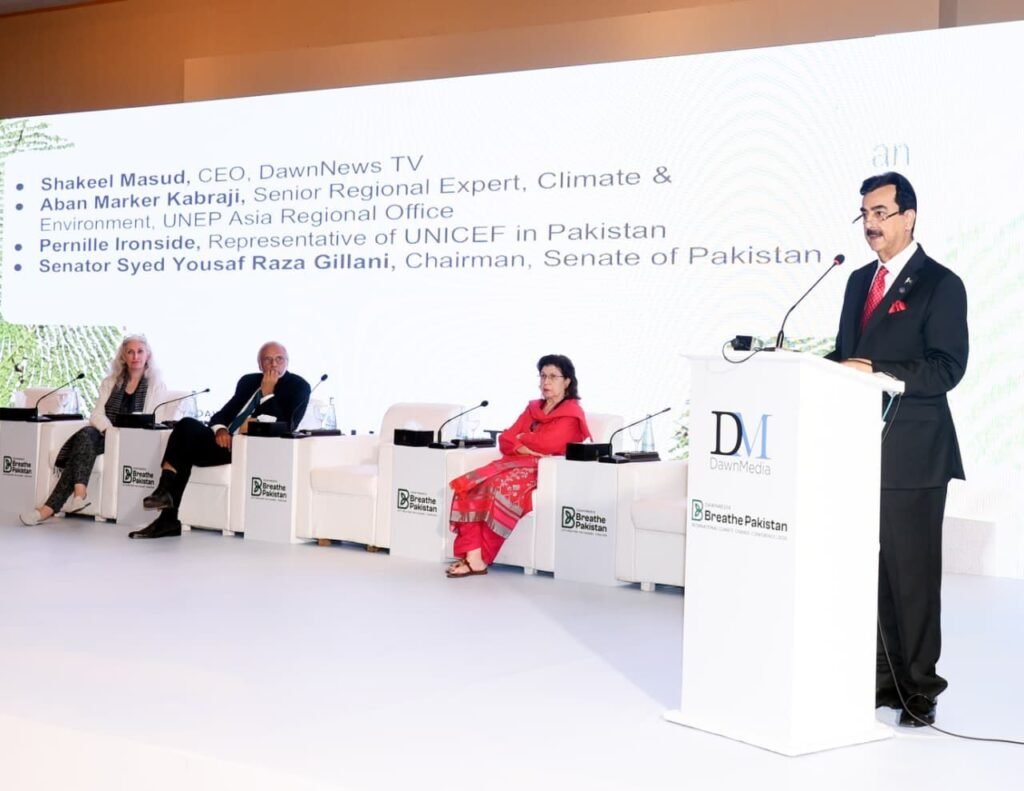
Islamabad (GNP): Chairman of the Senate, Syed Yousaf Raza Gilani, has emphasized that climate change poses a serious multidimensional threat impacting food security, water resources, agriculture, economic stability, and human survival. He stressed that peace, stability, and international cooperation are essential to ensure meaningful climate action.
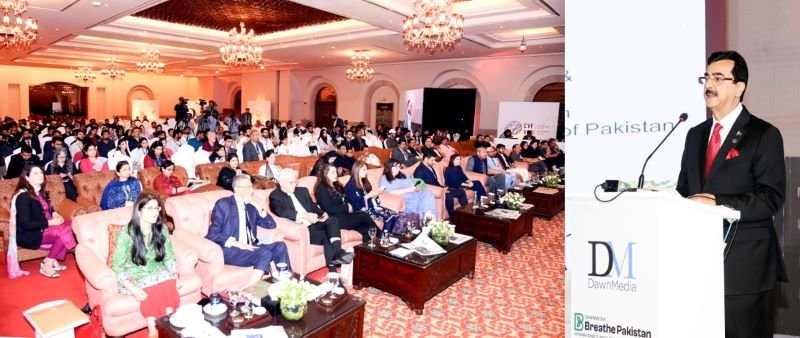
The Chairman of the Senate expressed these views while addressing the Breathe Pakistan Conference in Islamabad, organized by the Dawn Media Group. The conference was attended by parliamentarians, diplomats, representatives of international organizations, climate experts, academia, media professionals, civil society members, and private sector stakeholders.
The Chairman Senate highlighted that the impacts of climate change are already evident in rising temperatures, shrinking water reserves, stressed agriculture and increasing frequency of extreme weather events, including floods. He underlined that climate security is closely linked with peace and stability, adding that Pakistan is actively strengthening resilience in energy, agriculture, food and water sectors while mobilizing climate finance and enhancing global partnerships.
Referring to Pakistan’s role in regional peace, he said the country has consistently demonstrated restraint and responsibility in challenging situations while firmly safeguarding its sovereignty. He noted that operations such as Marka-e-Haq and Bunyan-un-Marsoos reflect national unity, discipline and resolve. He also highlighted Pakistan’s diplomatic efforts in easing tensions during recent global crises.
The Chairman Senate expressed concern that despite being among the most climate-vulnerable countries, Pakistan has received less than one billion dollars in climate financing over the past three decades. He termed current global commitments, including those under COP29, as insufficient and stressed that climate finance must be fair, predictable and timely.
Highlighting Pakistan’s climate initiatives, he referred to the Climate Change Act, afforestation drives, the Living Indus Initiative, the Green Pakistan Programme and Parliament’s transition to solar energy. He reaffirmed Pakistan’s strong advocacy for climate justice at international forums including COP27 and COP29. He noted that the pledged $300 billion annually by 2035 still falls short of the actual needs of vulnerable countries.
He further emphasized that the Loss and Damage Fund should be treated as a matter of justice rather than charity. He also called for enhanced regional cooperation in glacier preservation, water management and early warning systems.
Also Read: Punjab Launches 70 Midwifery Schools for Maternal Child Health
The Chairman Senate stressed that climate resilience efforts must directly benefit farmers and vulnerable communities. He called for stronger coordination among Parliament, government institutions, academia, media, civil society and the private sector, supported by improved data, effective planning and increased investment in climate adaptation.
He urged all stakeholders to translate conference discussions into concrete legislation, policy reforms and actionable strategies. He reiterated his commitment to strengthening climate governance and oversight.
“The future belongs to those who act with courage, unity and foresight,” he concluded, expressing confidence that Pakistan has the capacity and responsibility to lead by example.

Sohail Majeed is a Special Correspondent at The Diplomatic Insight. He has twelve plus years of experience in journalism & reporting. He covers International Affairs, Diplomacy, UN, Sports, Climate Change, Economy, Technology, and Health.