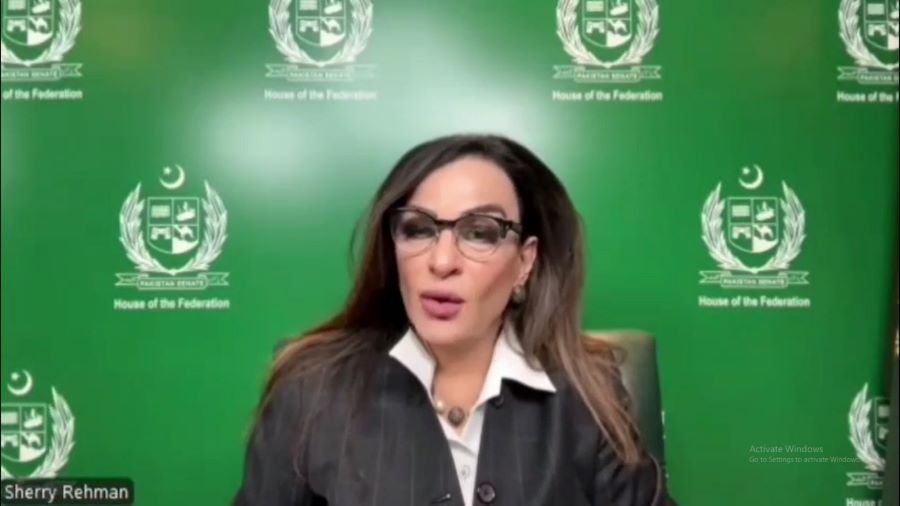
KARACHI (GNP): Senator Sherry Rehman has urged Pakistan to stop treating its Sustainable Development Goals (SDGs) agenda as a list of promises and to turn it into a practical investment framework that improves people’s lives in measurable ways. She cautioned that a fast-growing population, entrenched poverty, an education crisis, water insecurity and climate vulnerability leave no room for delay.
Speaking at the National SDGs Investment Fair 2026, she said several indicators show how large the challenge is. Some 26 million children are out of school, 39.5 percent of the population lives in multidimensional poverty, and 55 percent lack safe drinking water. Pakistan sits at 106th among 123 countries on the Global Hunger Index. Acute malnutrition, at 17.7 percent, is above the WHO emergency threshold, and about 40 percent of children under five are stunted. With more than 259 million people, Pakistan is the world’s fifth most populous country, and she said these numbers make it essential to shift from paper pledges to investments people can feel.
Rehman thanked UNDP for building an opportunity pipeline that connects prospective investors with development projects across jurisdictions. She said its value goes beyond raising funds, since it can help build the institutional, regulatory and financial structures needed to make development priorities bankable.
She said development goals are too often seen as boxes to tick, existing on paper without becoming real commitments where people can see change. Pakistan, she argued, should build sustainability into development planning from the start instead of treating it as an add-on.
She described public-private partnerships as one of the most important ways to move projects from design to delivery, especially while public finances are stretched. She said the Sindh government’s effort to bring the two sectors together had been recognised and praised by the Finance Minister, and that such partnerships can unlock investment, spread risk and produce projects that are financially and environmentally sound.
Pointing to Sindh’s new wastewater treatment and reuse plant in Karachi, she called it the kind of investment Pakistan needs as water pressures mount. Wastewater, she said, is a resource that can be recovered, recycled and put back to productive use, and scaling such solutions will matter for water security, urban resilience and the long-term viability of cities.
Rehman encouraged businesses to view these investments through an ESG lens instead of confining them to corporate social responsibility. Stronger ESG frameworks and suitable regulation, she said, could provide the “plumbing” for a steady flow of public-private partnerships. The aim, she explained, is not a bridge for a single project but the groundwork for future ones.
She added that the development gap is plain in basic indicators. With 26 million children out of school, she said, nobody can claim development is happening just because a policy paper exists. Development has to be felt in schools, hospitals, clean water, jobs, resilient infrastructure and families’ ability to withstand shocks.
She said Pakistan’s climate exposure adds to the urgency. The country is among the most climate-vulnerable in the world and suffered roughly $30 billion in damage in the 2022 floods. Climate change, she warned, brings instability just when markets want predictability, so federal and provincial governments must provide certainty through policy, regulation, financial modelling and genuine commitments.
Rehman said small projects and pilots deserve support, but should not stay pilots forever. She called for time-limited pilots that are assessed, shown to be viable and then moved into the mainstream, so that years are not spent proving what could already have been rolled out.
She asked development partners and investors to look past the initial round of funding and consider what projects will look like five or ten years on: whether they can earn revenue, maintain their infrastructure, withstand climate shocks and keep delivering social benefits, including after the original donor has left.
Also read: Pakistan, Germany Look to Widen Trade and Investment Ties
The fair’s success, she said, will depend on whether the showcased projects secure the institutional backing, financial structures and political ownership to outlast an announcement. Passion is needed to get projects started, but they must also become socially viable and financially credible, as investments in Pakistan’s social and environmental future.
Finally, she said development challenges should not be treated in isolation. Poverty, hunger, education, water, waste, energy, climate resilience and jobs are linked, and investment strategies should reflect those links.

Sohail Majeed is a Special Correspondent at The Diplomatic Insight. He has twelve plus years of experience in journalism & reporting. He covers International Affairs, Diplomacy, UN, Sports, Climate Change, Economy, Technology, and Health.