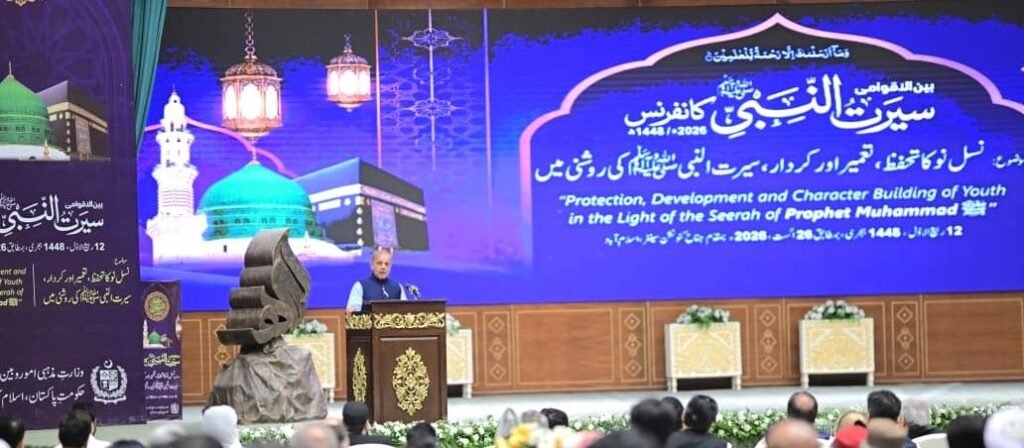
Islamabad (GNP): Prime Minister Muhammad Shehbaz Sharif stressed the importance of deepening unity and brotherhood among the nation and the wider Ummah by instilling the core teachings of the Seerah of the Holy Prophet Muhammad (PBUH) in younger generations, equipping them to face modern-day challenges.
Addressing the International Seerat (PBUH) Conference, the prime minister called on Ulema and religious scholars to use mosques and pulpits to promote unity, tolerance, compassion and interfaith harmony. He said the Holy Prophet (PBUH) exemplified peace, affection, truthfulness, integrity, honesty and forgiveness, and that these principles should guide the character development of Pakistan’s youth.
He recalled that during the movement for Pakistan’s creation, the entire nation stood united under the leadership of Quaid-e-Azam Muhammad Ali Jinnah, achieving what he described as a remarkable feat through unity and discipline — qualities he said remain embedded in the country’s Constitution.
He urged citizens to set aside their differences given the challenges of the modern era. Ministers, members of the diplomatic corps, religious scholars, media representatives, teachers and students attended the event.
Referring to the Gulf conflict and the armed confrontation with India in May 2025, the prime minister said the nation demonstrated unity during both crises. During the Gulf conflict, he said, Pakistan carefully balanced two objectives — preventing the war from spreading further in the region while working to unite the broader Ummah.
He praised Field Marshal Syed Asim Munir for playing a significant role throughout the crisis, staying engaged with both sides to help secure regional peace and stability, adding that those opposed to peace had failed in their efforts.
The prime minister also described the signing of the Makkah Agreement as a testament to enduring brotherhood and unity among Pakistan, Saudi Arabia and Turkiye, saying the leadership of both allied nations stood firmly behind Pakistan during the conflict with India, just as they had consistently done in the past. He reaffirmed that these bonds of friendship would only grow stronger.
He urged religious scholars to counter sectarianism and extremism by spreading the message of peace found in the Seerah of the Holy Prophet (PBUH), stressing that the Ummah must equip its youth with modern knowledge while grounding them in the Prophet’s universal message of peace.
He called for young people to be made aware of every aspect of the Prophet’s life, saying, “Our future depends upon what sort of future generation we prepare,” and describing youth as the country’s hope and a key priority for the future.
The prime minister described the Prophet’s Seerah as a guiding light for the entire Ummah, citing the events at Taif and the bond of brotherhood between the Muhajireen and Ansar of Madinah.
He noted that Rabi-ul-Awwal, the month of the Prophet’s birth, coincided this year with August — the same month in which Pakistan was created — and reflected on the shared identity of the Ummah. He also commended the role of Ulema, Mashaikh and religious leaders in shaping the thinking of the nation and its youth through the teachings of the Seerah.
Earlier in the program, Minister for Religious Affairs Sardar Muhammad Yousuf said the Seerah-e-Tayyaba offers genuine guidance for young people at a time when social media, distracting content, intolerance, materialism and other negative influences are taking their toll. He called for unity and the promotion of interfaith harmony, and urged citizens to combine loyalty to the state with allegiance to its principles, saying the two together create formidable strength and unity.
He added that the younger generation faces a wide range of intellectual, moral, social and digital challenges that make spreading the Prophet’s message all the more essential.
The prime minister also distributed awards to winners in various categories at the event.
Also read: Eid Milad-ul-Nabi Celebrated with Religious Fervor
Chairman of the Pakistan Ulema Council (PUC) and the PM’s Coordinator for Religious Harmony, Hafiz Muhammad Tahir Mehmood Ashrafi; Chairman of the Council of Islamic Ideology (CII), Allama Muhammad Raghib Naeemi; Chairman of the Ruet-i-Hilal Committee, Maulana Abdul Khabeer Azad; and other religious scholars also addressed the gathering.

Sohail Majeed is a Special Correspondent at The Diplomatic Insight. He has twelve plus years of experience in journalism & reporting. He covers International Affairs, Diplomacy, UN, Sports, Climate Change, Economy, Technology, and Health.