Islamabad (GNP): Pakistan Institute of Development Economics (PIDE), pursuant to the Prime Minister’s directive, undertook the study titled “Improving Governance and Accountability: Mechanisms for Separating Regulatory Functions from Ministries.” On review of the preliminary findings, the Honorable Minister for Planning, Development and Special Initiatives had advised that a stakeholders’ consultation be convened for feedback and collective ownership of the study.
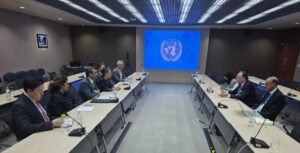
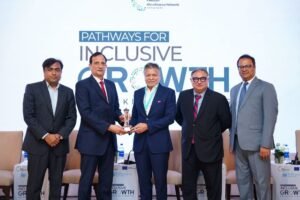
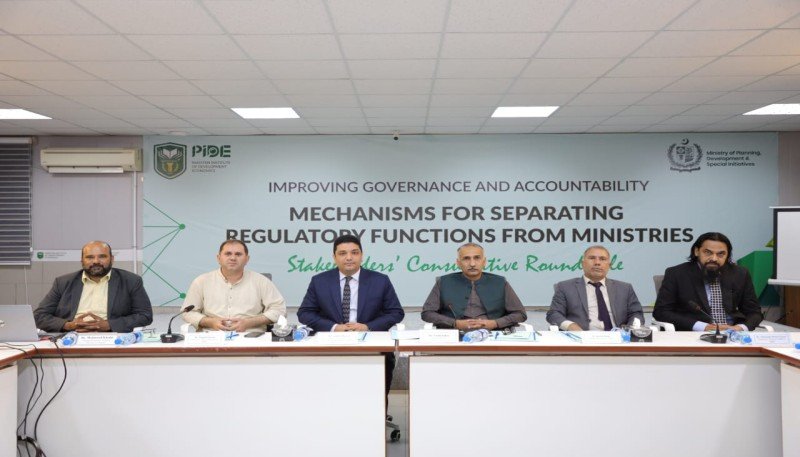
Thus, a Stakeholders’ Consultative Roundtable on the same was organized at PIDE, Islamabad. The event brought together senior representatives from regulatory authorities, federal ministries, the private sector, and academic institutions.
In the opening remarks, Dr. Nasir Iqbal, Professor at PIDE and also co-author of the report, drew attention to Pakistan’s persistently declining economic trajectory, noting that the country’s GDP growth rate has fallen from approximately five percent to three percent over the past three decades, barely keeping pace with population growth. “It is not about closing these entities. It is about empowering them while ensuring that they play a facilitative and not restrictive role for business activity,” he said, stressing that reforms must reduce the cost of doing business and eliminate regulatory sludge rather than create new layers of regulation.
Dr. Mahmood Khalid, Director Economic Analysis, Tax Policy Office at Ministry of Finance and co-author of the report, then presented the study’s findings.
The research examined five major ministry-regulator pairs – the Power Division and NEPRA, the Petroleum Division and OGRA, the Ministry of Aviation and the Civil Aviation Authority, the Ministry of Information and Broadcasting and PEMRA, and the Ministry of Education and ICT-PEIRA – to identify overlapping mandates and constraints on regulatory independence.
The study found that ministries retain pervasive de facto influence over their regulatory bodies through three primary channels: funding, appointments, and the issuance of policy guidelines.
Eligibility criteria for chief executives and board members were found to be vague, inconsistently applied, or entirely absent in several cases, while renewable tenure provisions created structural conflicts of interest.
Beyond the five case studies, a broader survey of 31 federal regulatory bodies revealed five systemic failure patterns.
The most critical was a structural conflict of interest where the regulator and the operator are the same entity – persisting in the cases of Pakistan Railways, the Special Technology Zones Authority, and the three major port trusts.
Further patterns included policy duplication between ministries and attached bodies, standards fragmentation across multiple agencies with no unified hierarchy, fiscal overreach by non-revenue bodies such as EPZA’s collection of one percent presumptive tax on exports, a function constitutionally reserved for FBR, and incomplete or misleading compliance in ministerial responses, with several departments claiming no overlap despite clear contradictions in their own enabling legislation.
The roundtable generated rich discussion among participants, moderated by Saddam Hussein, Director for the Center for Governance, Markets and Regulatory Analysis (CGMRA) and Deputy Chief Policy at PIDE. NEPRA’s representative advocated for the introduction of Regulatory Impact Assessment guidelines across all regulatory bodies to make regulators accountable for the measurable effect of their decisions on investment and ease of business.
Also Read: Government committed to support investment climate, Ali Pervaiz
ICT-PIERA’s official meanwhile highlighted that the legal framework of regulatory authorities predominantly was similar and not drawn up in accordance with the authority’s own aims and objectives.
Hussein while acknowledging the study’s findings on ministerial overreach also cautioned against swinging to the opposite extreme. “If regulatory bodies are given complete independence, the question of accountability still remains,” he observed. Representative from the Pakistan Business Council while sharing her views on the subject also lauded the efforts of PIDE to be researching upon and then consulting with stakeholders on such an important topic.
The consolidated feedback and written recommendations collected during the roundtable will be compiled by PIDE and submitted as a unified policy brief to the Prime Minister’s Office and the Ministry of Planning, Development and Special Initiatives.

Sohail Majeed is a Special Correspondent at The Diplomatic Insight. He has twelve plus years of experience in journalism & reporting. He covers International Affairs, Diplomacy, UN, Sports, Climate Change, Economy, Technology, and Health.