Vienna/New York (GNP): Pakistan has taken its position on the Indus Waters Treaty (IWT) to two international platforms. Deputy Prime Minister and Foreign Minister Muhammad Ishaq Dar addressed a symposium in Vienna, while a Pakistani diplomat spoke at the United Nations (UN) Human Rights Council in Geneva.
Both interventions carried the same message: shared rivers should be governed by law and cooperation, not pressure.
Dar Tells Vienna Symposium the Indus Waters Treaty Remains in Force
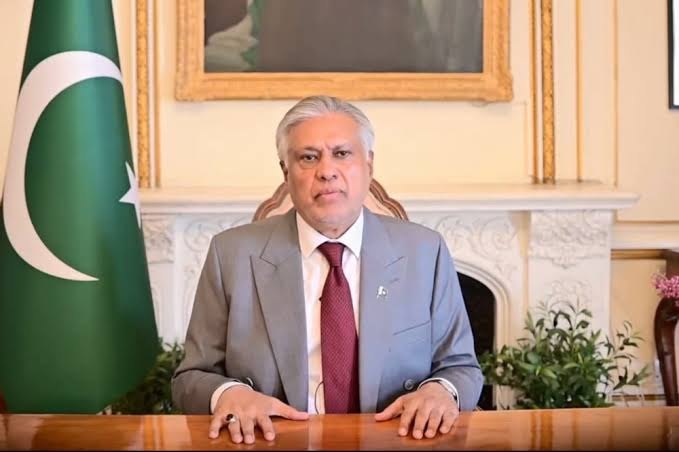
Dar delivered a keynote video message on Tuesday at the International Water Symposium. The event was organised by the Embassy of Pakistan in Austria in collaboration with the Diplomatic Academy of Vienna.
He said any attempt to deprive Pakistan of its allocated waters would have serious implications for regional peace and security. He urged India to resolve water-related differences through dialogue and established treaty mechanisms.
Dar explained why Islamabad treats the issue so seriously. The Indus River System supports more than 250 million people, and he described water security as inseparable from food security. He added that the river system is vital to agriculture, energy production and economic development.
Turning to the legal position, Dar noted that the treaty was signed in 1960 after a decade of negotiations. He said it replaced upstream discretion with binding obligations. India placed the treaty in abeyance in April 2025, and Dar pointed out that it contains no provision allowing either side to suspend it unilaterally.
He then cited the Permanent Court of Arbitration (PCA) ruling of August 31, which he said confirmed that the treaty remains fully in force and that India remains bound by it. India has rejected the ruling, saying it does not recognise the court. Dar added that Pakistan is also taking part in the Neutral Expert proceedings under the treaty, administered by the PCA’s Vienna Office.
Looking ahead, Dar outlined three principles. These are implementation of the treaty in letter and spirit, resolution of differences through its established mechanisms, and greater technical engagement, transparency and data-sharing between the two countries.
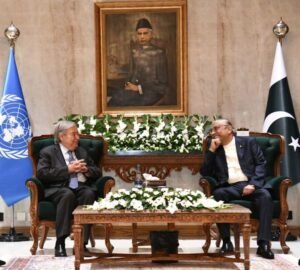
Also Read: DPM, UN Chief Review Regional and Global Issues
Pakistan Raises Weaponisation of Water at the UN in Geneva
The same argument was made at the multilateral level in Geneva. First Secretary Adeel Mumtaz Khokhar spoke during the 63rd session of the UN Human Rights Council, as members considered a resolution on the human rights to safe drinking water and sanitation.
The resolution, presented by Germany and Spain under the reference A/HRC/63/L.34, was adopted without a vote. Pakistan said it played an active role in keeping an explicit reference to transboundary water cooperation in the final text.
According to Pakistan, India had sought to remove that reference, arguing that the subject fell outside a human rights resolution. Pakistan maintained that cooperation over shared water is directly linked to the right to safe drinking water and sanitation.
Khokhar said, “Where water is shared, responsibilities are also shared.” He described cooperation between neighbours as a shared responsibility rather than a favour or concession. He also said no upstream country can use water as a tool of political pressure.
He called India’s unilateral action on the treaty a “weaponisation of water” and said water must never become an instrument of coercion, political leverage or war. Pakistan thanked the states that backed retaining the transboundary water reference. The council’s 63rd session ran from September 7 to October 7, 2026.
Background to the Dispute
The dispute intensified in April 2025, when India put its treaty obligations on hold after an attack in Pahalgam in Indian Illegally Occupied Jammu and Kashmir (IIOJK) killed 26 tourists. New Delhi blamed Pakistan, while Islamabad rejected the allegation and denied any involvement.
Pakistan has since warned that any attempt to stop its treaty-allocated water would amount to an act of war. It maintains that the treaty does not permit unilateral suspension.
Under the treaty, the eastern rivers (Ravi, Beas and Sutlej) are allocated to India. The western rivers (Indus, Jhelum and Chenab) are largely allocated to Pakistan. The treaty also provides mechanisms for information-sharing and dispute resolution.
Summing up Pakistan’s approach, Dar said, “Cooperation over coercion, dialogue over confrontation, and the rule of law over unilateralism.”

Managing Editor at Global News Pakistan (GNP), with a Bachelor's degree in International Relations from Riphah International University, graduated with a Gold Medal. Reach out at sabahtareengnp@gmail.com