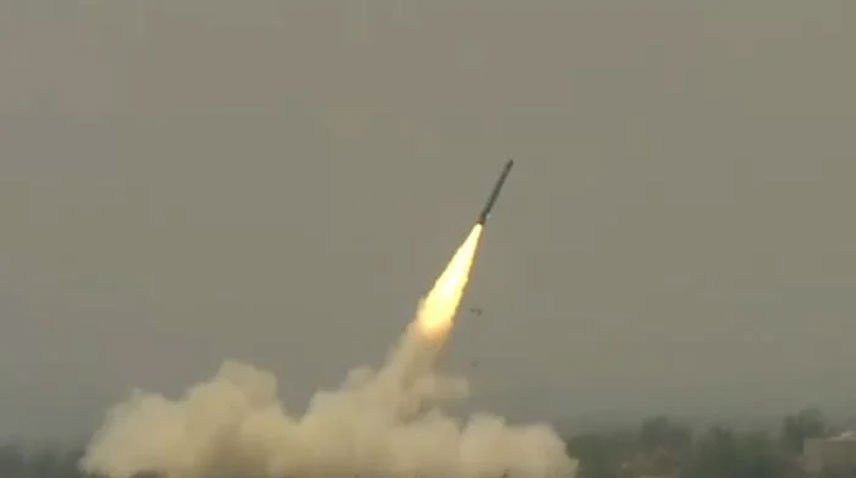
Rawalpindi (GNP): A successful training fire of the indigenously developed Fatah-4, Ground Launched Cruise Missile, was conducted today by the Army Rocket Force Command. Equipped with advanced avionics and state-of-the-art navigational aids, the weapon system is capable of engaging long-range targets with high precision.
The training fire was conducted to enhance the operational efficiency of the troops and validate technical parameters of various sub-systems incorporated for improved accuracy and enhanced survivability.
The training fire was witnessed by senior officers from Pakistan Army Rocket Force Command along with scientists and engineers of the developing agency.
The President of Pakistan, Asif Ali Zardari, the Prime Minister of Pakistan, Mian Muhammad Shehbaz Sharif, Chief of Army Staff and Chief of Defence Forces, Field Marshal Asim Munir, Chief of the Naval Staff, Admiral Naveed Ashraf, and Chief of the Air Staff, Air Chief Marshal Zaheer Ahmed Babar commended the successful training fire of Fatah-4 and appreciated the technical prowess, dedication, and commitment of all those who contributed towards the successful training fire of the F series missile.
The successful test once again reaffirmed Pakistan’s growing indigenous defence capabilities and the nation’s resolve to achieve self-reliance in strategic weapons development. The Fatah-4 milestone is a reflection of years of dedicated research, precision engineering and relentless effort by Pakistan’s scientific and military community. It sends a clear message that Pakistan continues to strengthen its deterrence posture through homegrown innovation, ensuring the country remains fully capable of defending its sovereignty with cutting-edge technology developed on its own soil.
Also Read: Atta Tarar Says Pakistan Remains Committed to Peace
A Legacy of Precision: Pakistan’s Journey With the Fateh Missile Series
Pakistan’s latest achievement with the Fatah-4 cruise missile does not stand alone; it is the most recent chapter in a carefully built legacy of homegrown missile development that has been years in the making. The Fateh series, developed entirely through domestic expertise and indigenous engineering, has come to represent Pakistan’s growing confidence in its own defence industrial base and its determination to reduce reliance on external sources for strategic weapons systems.
The journey of the Fateh series gained significant momentum with the development and testing of earlier variants, including the Fateh-II missile system, which was put through its paces by the Army Rocket Force Command.
That system was notably fitted with cutting-edge avionics and modern navigation technology, purpose-built to deliver greater strike accuracy while also improving the missile’s ability to survive in contested environments. The test was structured around clear operational objectives, sharpening troop readiness, confirming technical benchmarks, and assessing the reliability of newly integrated sub-systems.
What made those earlier tests particularly significant was not just the technology on display but the national collaboration behind it. Senior military officers, strategic planners, scientists and defence engineers came together to evaluate and validate each step of the process, reflecting a whole-of-institution approach to building Pakistan’s missile capability from the ground up.
That momentum carried forward into September 2025, when Pakistan successfully test-fired the Fatah-4 cruise missile to a range of 750 kilometres, a figure that marked a decisive jump in operational reach compared to its predecessors. The test demonstrated that the Fateh programme was not static but continuously evolving, with each new variant pushing the boundaries of what Pakistani engineers and scientists are capable of delivering.
Taken together, the progression of the Fateh series tells a compelling story of strategic vision, technical growth and national perseverance, one that continues to unfold with every successful launch.

Sohail Majeed is a Special Correspondent at The Diplomatic Insight. He has twelve plus years of experience in journalism & reporting. He covers International Affairs, Diplomacy, UN, Sports, Climate Change, Economy, Technology, and Health.