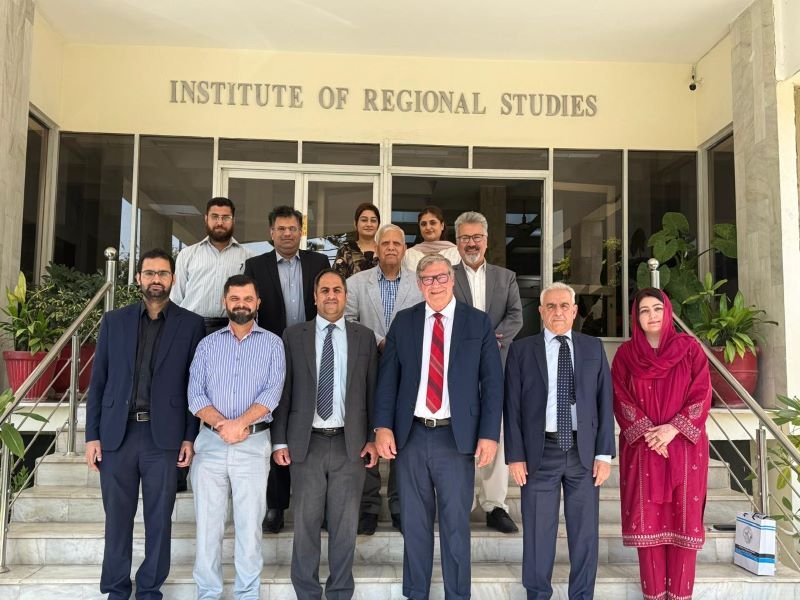
Islamabad (GNP): Trade, critical minerals and technology can give Pakistan-US relations a sturdier footing than the security-driven partnerships of the past, according to Professor Dr Kenneth M. Holland, a Fulbright Specialist and Adjunct Professor of Political Science at the University of Utah. He was speaking at the Institute of Regional Studies (IRS) in Islamabad at a session titled “Pakistan-US Relations in a Multipolar World,” hosted by the IRS China Program as part of its Eminent Speaker Series.
Research Analyst Nabila Jaffer opened the session by noting that one of Pakistan’s oldest foreign policy relationships is changing as the United States, China and Russia compete more intensely and middle powers play a larger role. She asked whether ties could rest more firmly on trade, investment, education and technology than on security alone.
Holland argued that shared interests can sustain cooperation while strategic differences must be carefully managed. A country working with several major powers at once faces competing pressures that it must balance, he said, and lasting cooperation depends on predictable institutions, not just access to leaders.
He compared the foreign policy styles of Presidents Joe Biden and Donald Trump. Biden, he said, continued the post-Second World War tradition of American leadership in promoting democracy and free markets, while Trump rejected nation-building in favour of a transactional “America First” approach. Drawing on his work in Afghanistan, Myanmar and elsewhere, he said the US record on nation-building is mixed, with Germany, Italy and Japan among the successes.
Holland placed the relationship within US-China strategic rivalry. Washington sees India as a key partner against China, he said, so Pakistan becomes more strategically relevant when US-India ties are strained. He pointed to 2026 tensions over tariffs, visa restrictions and market access as factors in that balance.
Counterterrorism remains one area of overlap, especially given the shared threat from ISIS-K. On the China-Pakistan Economic Corridor (CPEC), he said Washington does not object to its economic aims but is concerned about possible military uses.
Critical minerals and technology, he said, offer promising openings. Pakistan has substantial mineral resources, and US firms have begun work involving antimony and copper. Its educated, English-speaking young workforce also gives it potential in AI-related services. Together, he argued, these sectors could be a more sustainable basis for ties than the security partnerships of the Cold War, the Soviet war in Afghanistan and the post-9/11 era.
Like other middle powers, Pakistan seeks strategic autonomy, Holland said. Closer ties with the US, especially through private investment, could help Islamabad diversify its economic partnerships and avoid over-reliance on China.
He also described Russia’s interest in an energy corridor to South Asia through Central Asia, and regional connectivity projects such as the TAPI gas pipeline and the Trans-Afghan Railway. Central Asian states, he noted, are also trying to preserve their autonomy amid Chinese and Russian influence. Afghanistan’s growing engagement with India, including possible trade links through Iran’s Chabahar port, is a development Pakistan should watch closely.
Holland cited growing trust between Islamabad and Washington, pointing to Pakistan’s mediation between the US and Iran. He highlighted educational links as well: Pakistan hosts the world’s largest Fulbright programme, run with the Higher Education Commission, and the number of Fulbright PhD scholarships for Pakistanis has doubled from 33 to 66.
To realise the full potential of economic cooperation, he added, Pakistan will need to diversify exports toward higher-value products and strengthen its electricity and internet infrastructure.
Holland said the two countries share important interests but also have differing priorities, particularly regarding China and India, and that managing those differences while pursuing mutual benefit will take skilful diplomacy.
IRS Research Fellow Dr Usman Chohan pointed to emerging areas of economic cooperation, including digital assets and a liquidity arrangement under discussion between the two countries.
Also read: Qatar, Pakistan, Turkey and Indonesia Seal ‘Badr Defence Pact’
The session ended with a question-and-answer discussion on the long-term outlook for the relationship, regional connectivity initiatives such as CASA-1000, TAPI and the Trans-Afghan Railway, and Pakistan’s historic role in facilitating the opening of US-China relations in the 1970s.

Sohail Majeed is a Special Correspondent at The Diplomatic Insight. He has twelve plus years of experience in journalism & reporting. He covers International Affairs, Diplomacy, UN, Sports, Climate Change, Economy, Technology, and Health.