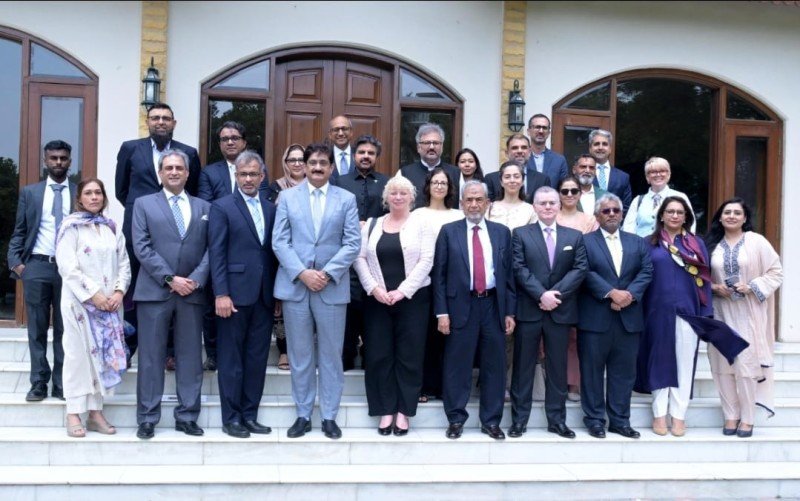
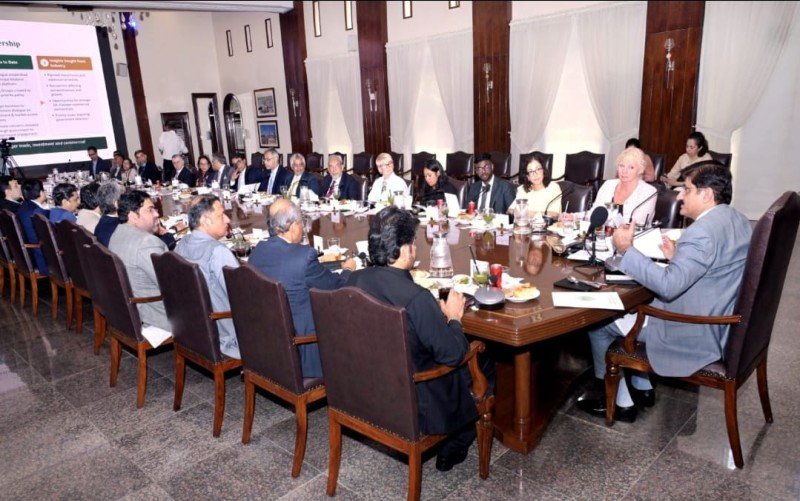
Karachi (GNP): The UK Government and Sindh Chief Minister Murad Ali Shah brought together British business, investors, and other multinational companies yesterday to discuss reforms aimed at improving Pakistan’s investment environment.
Organized by the UK Government in collaboration with the Sindh government, the roundtable sought to build investor confidence and support sustainable economic growth. Participants discussed the main factors influencing investment decisions, including policy consistency, taxation, regulatory systems, foreign exchange procedures, infrastructure, and the general business climate.
Deputy British High Commissioner Alison Blackburne noted that British firms have been investing in Pakistan for decades, generating employment, sharing expertise, and contributing to economic growth, and said the UK wants that partnership to keep expanding. She added that the UK is working with government partners in Pakistan to streamline regulations, build stronger institutions, and cut unnecessary obstacles for businesses.
Chief Minister Murad Ali Shah acknowledged the role British companies have played in Sindh’s economy and reaffirmed the provincial government’s commitment to supporting reforms in taxation, customs, regulation, digitalization, and investment facilitation.
With UK backing, more than 500 regulatory reforms have been approved over the past year, aimed at simplifying rules, improving governance, strengthening institutions, and easing unnecessary burdens on businesses.
The UK is also helping Karachi implement the World Bank’s Business Ready (B-READY) framework, which works to identify and address practical obstacles businesses face — covering areas such as starting a business, taxation, utilities, and resolving disputes.
Also read:https://globalnewspakistan.com/china-expands-traditional-medicine-access/
The World Bank introduced B-READY in 2024 as the successor to its earlier Doing Business index, initially covering 50 economies before expanding to 101 in a follow-up report released weeks later. The index takes a more layered approach than its predecessor, evaluating economies across three areas: the Regulatory Framework (formal rules), Public Services (infrastructure and digital tools), and Operational Efficiency (real-world experience gathered through firm surveys). Rather than producing a single overall ranking as Doing Business did, B-READY sorts economies into quintiles and assigns topic-based scores out of 100 across ten stages of a firm’s lifecycle, weighing business costs against broader social benefits like labor protections and environmental standards.
Pakistan features in both editions of the index and has consistently landed in the lower tiers — placing in the fourth quintile overall in 2024, reflecting weak regulatory frameworks and public services, with little improvement in 2025. This pattern points to what might be called “regulatory sludge” — excessive, overlapping, paperwork-heavy compliance requirements that drain time, money, and resources, ultimately discouraging investment, fueling informality, and holding back growth.
This analysis examines Pakistan’s B-READY results against its Doing Business track record, looks closely at the compliance friction across federal, provincial, and municipal levels, and outlines a way forward.
B-READY’s approach differs from Doing Business’s narrower, SME-focused case studies, instead drawing on roughly 1,200 indicators per economy for a broader, more balanced picture. In 2024, Pakistan’s fourth-quintile placement stemmed from a Regulatory Framework score of about 59.1 out of 100 and a Public Services score of roughly 44.97 (placing it in the bottom 40 percent), while Operational Efficiency scored 65.90 (third quintile). By 2025, the numbers improved slightly: Regulatory Framework rose to 62 (still in the bottom 40 percent), Public Services climbed to 55, and Operational Efficiency dipped to 60. While there’s no single overall ranking, the topic-level scores paint a picture of uneven progress on reform.

Sohail Majeed is a Special Correspondent at The Diplomatic Insight. He has twelve plus years of experience in journalism & reporting. He covers International Affairs, Diplomacy, UN, Sports, Climate Change, Economy, Technology, and Health.