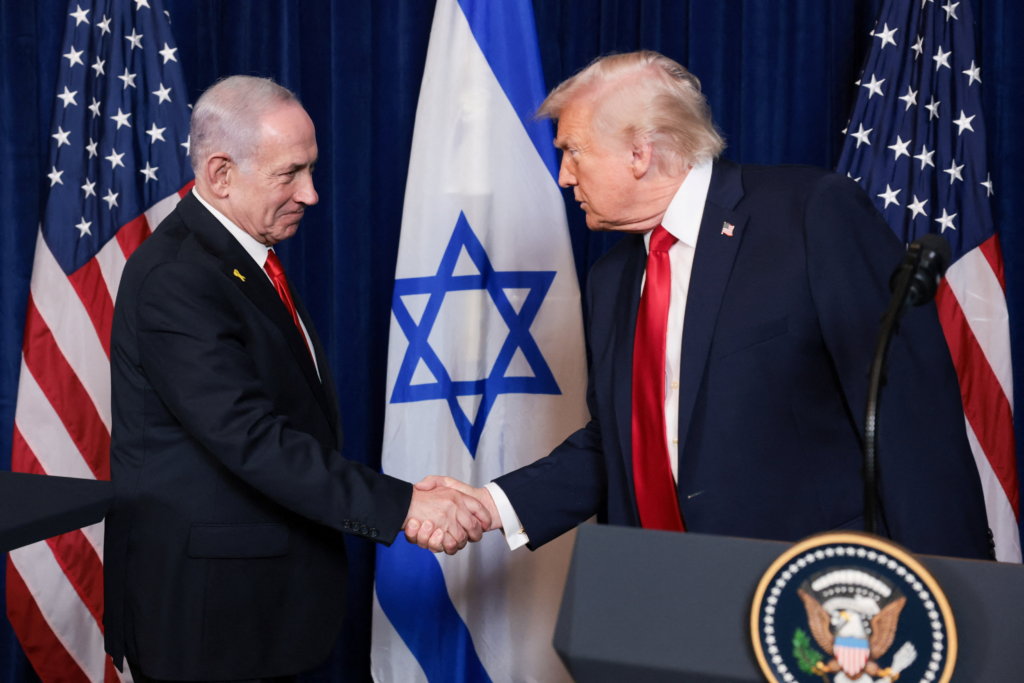
Washington (GNP): Israeli Prime Minister Benjamin Netanyahu has rejected a United States-backed 15-point of Gaza peace plan, marking a rare and public break with President Donald Trump. In a statement issued Sunday, Netanyahu said he was confronting what he described as a wave of rumours suggesting Israeli weakness and withdrawal across multiple fronts, while pushing back against US pressure to conclude conflicts in Gaza, Lebanon and Iran without Israeli input.
Addressing the Gaza plan directly, Netanyahu stated that Israel does not accept the 15-point document and that Israeli forces will not carry out any withdrawal until Hamas is fully disarmed. He clarified that disarmament, in Israel’s view, must include all categories of weaponry, from heavy to light, and stressed that discussions with US officials on the matter remain ongoing.
The 15-point plan was proposed in July by Trump’s Board of Peace, and called for Hamas to disarm in exchange for a full Israeli military withdrawal from Gaza, followed by an eventual transfer of governance to an independent Palestinian National Committee. While Trump had indicated the agreement would be implemented in phases, Netanyahu said Sunday that he wanted complete disarmament to occur first, before any further steps in the plan could proceed.
Israeli military operations in Gaza have continued despite a ceasefire brokered in October, with strikes reported to have killed eighteen people the previous Sunday. Netanyahu’s office had earlier signalled its opposition to the plan, stating that the publicly released version did not reflect Israel’s actual position. Sunday’s statement, however, represented a more direct and forceful rejection, appearing to be aimed squarely at the Trump administration as both leaders face upcoming elections.
Netanyahu emphasised that Israel would continue to act according to its own security assessments, stating that the country is prepared to stand firm even against close allies when necessary. In response, Nickolay Mladenov, high representative for Gaza at Trump’s Board of Peace, told Israeli television that the proposed plan remains the only viable path forward to prevent further tragedy in the region.
Also Read: DPM, Kuwaiti FM discuss regional situation
The rejection comes as the Trump administration seeks to position itself as a broker of peace across multiple Middle East conflicts ahead of the US midterm elections in November, with officials hoping that progress on Iran could help reopen the Strait of Hormuz and ease global oil prices. Parallel diplomatic efforts have also continued regarding Lebanon, where Israel maintains a military presence described as a buffer zone against Hezbollah, and Gaza, where allied Gulf states have raised concerns over the humanitarian impact of the ongoing conflict.
Netanyahu’s rejection of the plan adds to a long history of complex dynamics between Israeli and US leadership, with previous administrations having similarly navigated points of friction with Netanyahu despite maintaining broad support for Israel. Under the Trump administration, however, Netanyahu has generally been viewed as a close ally, having previously criticised political opponents in the United States for what he characterised as insufficient support for Israel.
At the same time, support for Israel’s continued military campaign in Gaza has shown signs of shifting within segments of the US political landscape, with debate expected to continue as both nations head into politically significant election periods in the months ahead.

Managing Editor at Global News Pakistan (GNP), with a Bachelor's degree in International Relations from Riphah International University, graduated with a Gold Medal. Reach out at sabahtareengnp@gmail.com