Amid the complex geopolitical changes of the contemporary world, preserving peace, strengthening mutual trust and developing regional cooperation have become increasingly important. These issues have particular significance for Central Asia, where the security and sustainable development of the region’s countries depend heavily on mutual understanding, good neighbourly relations and their ability to address cross-border challenges together.
Against this background, the emergence of the Fergana Peace Forum as a permanent space for dialogue is a notable development in regional cooperation in recent years. The initiative is particularly significant because the Fergana Valley, which links Tajikistan, Uzbekistan and Kyrgyzstan, is gradually moving from a setting associated with complex border issues towards one of cooperation, dialogue and joint initiatives.
According to accounts of the Forum’s origins, the idea of establishing the Fergana Peace Forum was put forward in Dushanbe in March 2024 by Rustam Jura Haydarzoda, Director of the Institute for the Study of Asian and European Countries of the National Academy of Sciences of Tajikistan. At a meeting of international experts, Dr Haydarzoda proposed, in the context of the peacemaking initiatives of the Leader of the Nation, His Excellency Emomali Rahmon, in Central Asia, that a permanent regional platform be created to sustain peacebuilding dialogue in the Fergana Valley.
The proposal sought to ensure that cooperation among experts and communities in the countries of the Fergana Valley would extend beyond individual events. It called for a permanent mechanism for dialogue that could bring together representatives of academia, civil society and government, as well as young people, women and border communities.
The main aim of such a platform was to sustain peacebuilding processes, strengthen a culture of dialogue, build mutual trust and create conditions for lasting cooperation among the communities of the valley’s three countries.
Following the drafting and refinement of the Forum’s concept, partners from Tajikistan, Uzbekistan and Kyrgyzstan became involved in implementing the initiative. The Kyrgyz side proposed linking the Forum’s activities with the idea of ‘Yntymak’, meaning peace, harmony, unity and mutual understanding. International institutions and peacebuilding organisations also gradually became involved in developing the platform.
Thus, an idea first advanced in Tajikistan as a proposal for a permanent space for dialogue gradually acquired a regional character.
A major milestone in the platform’s development was the first Fergana Peace Forum, held on 15-16 October 2025 in Fergana, Uzbekistan.
Under the theme “Fergana Valley: Joining Efforts for Peace and Progress”, the Forum brought together a wide range of representatives from Tajikistan, Uzbekistan and Kyrgyzstan, along with international organisations and analytical and research centres.
Participants included representatives of government bodies, civil society, expert communities, businesses, young people and women. This broad participation showed that lasting peace cannot be secured through interstate relations alone. The involvement of local communities, border areas and non-governmental institutions is also essential.
One of the main outcomes of the first Forum was the adoption of a communiqué emphasising the need to develop the Fergana Peace Forum into a permanent platform. It was also proposed that future meetings be hosted in turn by Kyrgyzstan, Tajikistan and Uzbekistan.
This decision gave the Forum a new character, and it began to develop from a single event into an ongoing regional process.
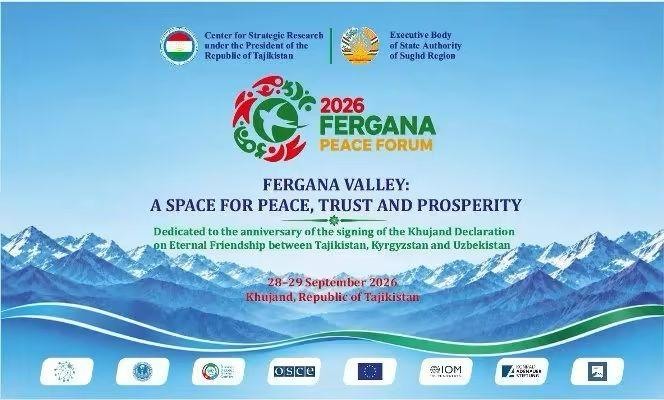
The next logical step is to hold the Forum’s forthcoming meeting in the Republic of Tajikistan. Khujand is scheduled to host it on 28-29 September 2026 at the initiative of the Center for Strategic Research under the President of the Republic of Tajikistan.
The choice of Khujand has both symbolic and political significance. On 31 March 2025, the heads of state of Tajikistan, Kyrgyzstan and Uzbekistan met in this city and signed important agreements concerning the borders and cooperation of the three countries. That event laid an important foundation for a new stage of good neighbourly relations in the Fergana Valley.
From this perspective, holding the Forum in Khujand can carry forward the region’s new processes of peacebuilding and trust-building.
Tajikistan’s contribution to the development of the Fergana Peace Forum can be assessed in several ways.
First, the proposal to create a permanent space for dialogue is consistent with Tajikistan’s peace-oriented policy. The experience of the Tajik peace process has shown that dialogue, compromise and trust can be effective ways of resolving complex political and social issues.
Second, Tajikistan does not view peace in the Fergana Valley solely through the lens of border security. Sustainable peace here has a broader meaning. It encompasses economic development, prudent use of water resources, environmental protection, cultural ties, the participation of women and young people, and closer connections among border communities.
Third, the Forum initiative helps strengthen public and expert diplomacy. Interstate relations provide an essential foundation, but long-term trust must also develop among communities. Connections among scholars, young people, women, entrepreneurs and residents of border areas can help make peace an enduring social value.
The significance of the Fergana Peace Forum extends beyond the meetings themselves. If it develops as a permanent platform, it could become a practical mechanism for building trust in Central Asia.
Such a format would allow regular discussion of shared water use, the environment and climate change, the development of border areas, cross-border trade, the participation of women and young people in peacebuilding, conflict prevention, and cultural and humanitarian ties.
Also Read: The US-Israel War on Iran: Tactical Success, Strategic Failure
In this respect, the Forum complements formal diplomacy. Political decisions are made at the state level, while continuing ties among communities and experts help sustain an atmosphere of trust.
The emergence of the Fergana Peace Forum suggests that a new culture of regional cooperation is gradually taking shape in Central Asia. Where the Fergana Valley was once discussed mainly in terms of border questions, resource sharing and disputes, there is now an opportunity to present it as a space for peace, cooperation and closer ties among communities.
Hosting the next Forum in Khujand has both symbolic and practical importance for Tajikistan. It offers an opportunity for an initiative first proposed in Tajikistan to continue as a shared regional platform and to help strengthen good neighbourly relations among Tajikistan, Uzbekistan and Kyrgyzstan.
Ultimately, the Forum’s central value lies in its understanding of peace: peace should be seen not simply as the temporary absence of conflict, but as a continuous process of dialogue, trust-building and cooperation among communities. Such an approach can help make the Fergana Valley a model of peaceful coexistence and lasting cooperation in Central Asia.

Doronshoeva Nekbakht Shoqosumovna
Doronshoeva is a Candidate of Political Sciences and Head of the US and Canada Department at the Institute for the Study of Problems of Asian and European Countries, National Academy of Sciences of Tajikistan.