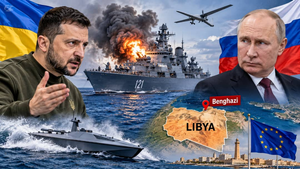

European security is affected by unconventional threats that have disrupted the region’s peace. Misinformation, campaigns, cyber attacks, sabotage and drone surveillance are used to target critical infrastructure of Europe.
The shift in the security environment from the traditional defence system to hybrid warfare exposed the limitations of existing security measures. The conventional system depends primarily on military aggression, but hybrid warfare requires more than physical attack.
Hybrid warfare is the mix of conventional and unconventional warfare methods such as political, economic, social or traditional vulnerabilities. The focus is less on the military force itself and more on deteriorating the transportation network or energy infrastructure of the state. One of the biggest threats during hybrid warfare is the destruction of communication systems and targeting democratic institutions. These activities are intentionally made ambiguous, making the responsible actor hard to identify.
The significance of hybrid warfare is creating chaos and destruction without declaring an official war. It creates confusion and targets the economy and psychology of people.
The State-Sponsored Threat to European Security
Russia is the most prominent state actor that has acquired itself as a threat to European security. The main Russian operations are conducted through cyber attacks, disinformation and espionage. On 4th November 2026, the UK parliament during its briefing, highlighted Russian-linked activities such as intelligence gathering, arson and explosives in European states. For example, railway sabotage in Poland and threat through fires In Estonia, meanwhile the European cargo aircraft Was targeted through explosives. The investigation of Associated Press reveals 145 incidents conducted by Russia, its proxies and Belarus. In fact, an interesting insight was Involvement of Belarus in hybrid activities against the EU, targeting Poland, Lithuania and Latvia, and weaponizing migration on its borders.
China has allegations over cyber espionage foreign interference and agency-intelligence gathering. The physical evidence against China is little, compared to the Russian campaigns. Iran and North Korea are also a concern for European security due to their similar intelligence related threats.
Since the Russian invasion of Ukraine in 2022 such incidents in Europe have increased. A search briefing of the European parliament in October 2026, stated that at least 16 NATO members have mentioned concern of drone airspace violation in the last 2 years. Such incidents have become a threat for European airspace security where military facilities, infrastructure and civilian aviation is at threat.
This challenge is new, as traditionally these events would have been viewed separately but in advanced-system they suggest a collective cause of political destabilisation and societal insecurity in the region.
Countering Hybrid Warfare
The European government has focused on strengthening the protection of their intelligence corporations and agencies, cyber security, and surveillance infrastructure. The European Union has developed a Hybrid Toolbox, a mechanism where responses of member states could be coordinated. Similarly NATO has also expanded its focus on hybrid threats, however these measurements could not be effective on their own. Their success depends on identifying the preparators, which is a hard task due to the ambiguous nature of such attacks. Cyber attacks and proxies in sabotage could be the responsibility of criminal networks or concealed state involvement. In such scenarios, not only the retaliation becomes hard but any potential diplomatic settlement could fail to be successful.
European parliament in September 2026, emphasized on hybrid warfare and the requirement for protecting territorial integrity and Europe’s security infrastructure. Regardless, Europe’s security architecture remains fragmented. Member states have different capabilities and reliance on nations’ privately operated infrastructure could make unified response difficult.
Also Read: The Geopolitics of Passport Privilege
Redefining European Security
From a critical global perspective, this case challenges the traditional realist assumptions that military capabilities and territorial defence are the main elements of security. Moreover the concept of deterrence also becomes complicated in such situations. Hybrid attacks are ambiguous, inexpensive and difficult to identify the responsible party. Without sufficient evidence states could not retaliate.
The concept of deterrence could be misinterpreted easily. If domestic security measures are taken for defence purposes, other states could see it as a threat, eventually leading to a direct conflict. Hostile actors use this uncertainty which also weakens the resilience of institutions.
The main challenge of Europe is to identify and deal with unconventional attacks, and shift from the traditional security mechanisms. Moreover a collective resilience approach needs to be developed where infrastructure and public trust on transparent institutions prevail. The European Union could not deal with the period of ultimate hybrid attacks if their focus is to strengthen the military army alone.
The views presented in this Blog are the author’s own and do not necessarily reflect the views of Global News Pakistan