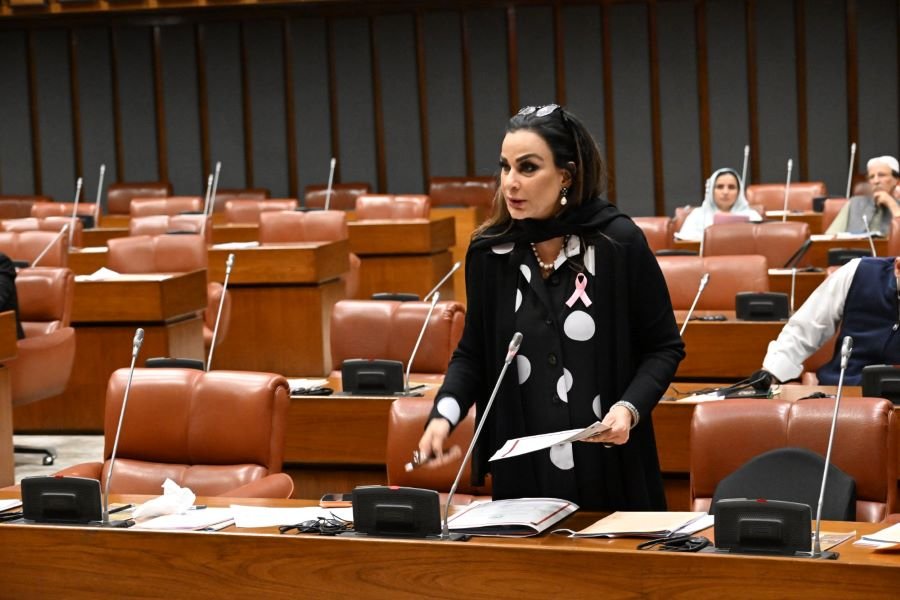
Islamabad (GNP): The Senate of Pakistan has passed a resolution moved by Vice President PPP Senator Sherry Rehman, calling for urgent and coordinated national action to address the challenges posed by Pakistan’s rapidly growing population.
Expressing gratitude to members of the House who signed the resolution, Senator Sherry Rehman underscored Pakistan’s population is projected to reach approximately 390 million by 2050 at the current rate of growth, placing unprecedented pressure on the country’s resources and public services.
She stressed that immediate and concerted action was necessary to address what remains one of Pakistan’s most overlooked and disregarded challenges.
According to the 2023 Population and Housing Census, Pakistan’s population stood at 241.49 million, with an annual growth rate of 2.55 percent, the highest in South Asia. Senator Rehman noted that rapid population growth was placing severe pressure on food security, water availability, education and healthcare, with consequences extending to households, schools and hospitals across the country.
“Pakistan’s population challenge is not simply a matter of numbers; it is a question of human development, public health and the country’s socioeconomic future,” she said. “At our current trajectory, the pressure on our resources will continue to intensify unless we take immediate and collective action.”
Senator Rehman emphasised that approximately 40 percent of children under the age of five in Pakistan suffer from stunted growth, reflecting inadequate access to proper nutrition at critical stages of development. She further pointed out that 26 million children remain out of school, warning that the combined impact of population growth, malnutrition and limited educational opportunities is undermining the quality and potential of the country’s human capital.
She also drew attention to the growing challenge of water insecurity, particularly as climate change intensifies existing vulnerabilities. Rapid population growth is placing additional pressure on household resources and essential services, making it increasingly difficult for families to secure basic necessities.
Highlighting the consequences for women’s health, Senator Rehman stressed that inadequate access to voluntary family planning and birth-spacing services exposes mothers to serious health risks. She said gaps in reproductive healthcare, child nutrition and education were deepening inequalities, increasing public health challenges and undermining Pakistan’s prospects for sustainable development.
“The population crisis has reached our kitchens, our schools and our hospitals. We cannot speak of sustainable development while millions of children remain out of school, many children suffer from malnutrition, and women lack access to the reproductive healthcare and family planning services they need,” she said.
The resolution emphasises that population planning is fundamental to Pakistan’s socioeconomic development and calls for a comprehensive national response to ensure that the country’s demographic dividend does not become a demographic burden. It underscores that addressing population growth is a shared responsibility that transcends provincial boundaries, political affiliations, communities, genders and faiths.
Senator Rehman called for a coordinated, whole-of-country approach involving federal and provincial governments, parliamentarians, public and private sector institutions, media practitioners, ulemas, religious scholars and community leaders. She stressed that reducing the population growth rate requires sustained political commitment, public awareness and improved access to essential services.
The resolution urges the Government of Pakistan to take all necessary measures to bring down the population growth rate through intensive nationwide information and awareness campaigns, the expansion of family planning services, and the strengthening and scaling up of the Lady Health Workers Programme. It also calls for budgetary incentives and a focused expansion of service delivery through existing reproductive healthcare facilities.
Also read: Parliamentary Forum Urges Joint Action on Population Challenge
Senator Rehman emphasised that population planning must be treated as a national development priority, supported by adequate resources, effective service delivery and collective responsibility. She said that coordinated action across all levels of government and society was essential to protect the health and well-being of families, improve opportunities for children and secure a more sustainable socioeconomic future for Pakistan.

Sohail Majeed is a Special Correspondent at The Diplomatic Insight. He has twelve plus years of experience in journalism & reporting. He covers International Affairs, Diplomacy, UN, Sports, Climate Change, Economy, Technology, and Health.