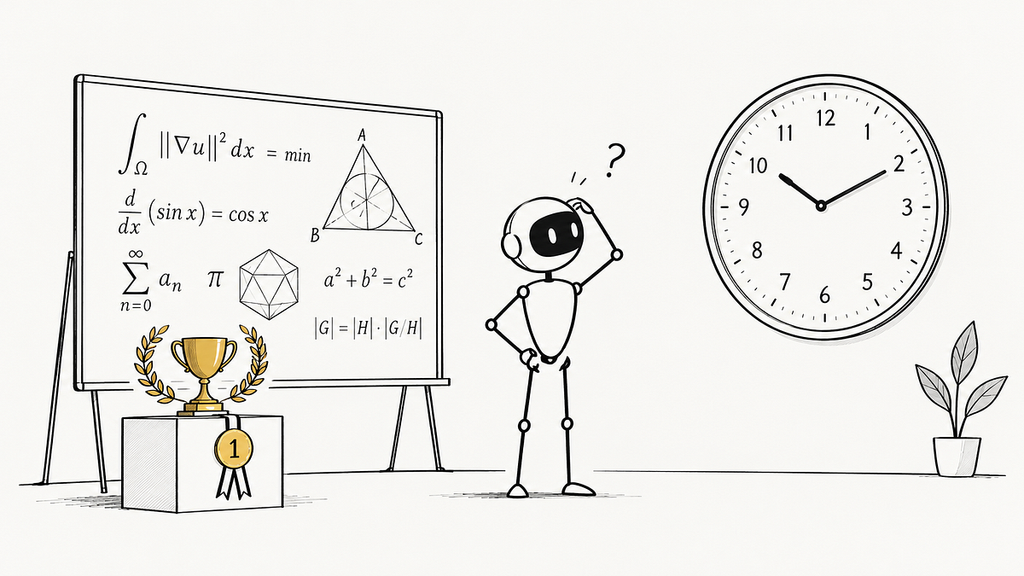
Islamabad (GNP): Artificial intelligence (AI) can now solve mathematics problems that challenge some of the world’s brightest minds, write sophisticated code and answer scientific questions that once took years of specialist study. Yet the same technology can misread an ordinary clock or invent information. Scientists remain divided on how close machines are to matching human intelligence.
That contradiction sits at the centre of the debate. By 2026, advanced models can analyse documents, generate realistic videos, assist scientific research and carry out increasingly complex computer-based tasks. Whether this amounts to intelligence comparable to the human mind is still an open question.
The pace of progress has surprised researchers and policymakers alike. Stanford University’s 2026 AI Index Report found that leading systems now meet or exceed human performance benchmarks in several demanding areas, including advanced scientific questions, mathematical reasoning and coding. In 2025, systems built by Google DeepMind and OpenAI reached gold-medal-level results on problems from the International Mathematical Olympiad.
The same strength shows up in everyday work. Software developers use AI to write and review code, researchers use it to examine complex information, and businesses increasingly rely on automated systems for analysis and customer service.
Even so, excelling in one field is not the same as having broad human-level intelligence. The 2026 International AI Safety Report describes the abilities of advanced AI as uneven. A system may do very well in a hard examination yet fail at a simpler task involving physical space, unfamiliar instructions or several consecutive decisions.
The Stanford index offers a clear example. Despite major gains in mathematical reasoning, one leading model read analogue clocks correctly only about half the time in one evaluation. Such gaps show why success on individual benchmarks cannot prove general human-level intelligence.
The difference comes down to how the systems work. Modern AI learns patterns from vast amounts of data and uses them to generate responses, predictions or actions. Humans, by contrast, learn from experience, adapt to unfamiliar situations and make decisions with incomplete information. Researchers still debate what these systems genuinely understand.
This debate leads to the next milestone, artificial general intelligence (AGI). It generally refers to AI that can handle a broad range of intellectual activities with human-like flexibility and competence. However, there is no universally accepted definition or test for when AGI has been reached. Some researchers stress performance across many cognitive tasks, while others say true general intelligence needs independent learning, reliable handling of unfamiliar situations and the ability to finish complex goals without constant supervision.
That uncertainty makes forecasts difficult, and it extends to artificial superintelligence, a hypothetical AI that would far exceed human ability across many fields. If it were ever built, it could speed up scientific discovery and medical research. But there is no established timetable. The International AI Safety Report notes that projections through 2030 vary widely, with some scenarios showing rapid advances and others slower progress or major limits.
One way researchers track progress is by how long a task AI can complete on its own. The research organisation METR reported that the length of software tasks frontier systems could finish at a set success rate had historically doubled roughly every seven months. METR cautions, however, that its measurements focus heavily on software and technical work, so they cannot show when AI will perform every human job or reach general intelligence.
Also Read: Shaza Outlines Pakistan’s Four Lessons in AI Governance at Seoul Summit
As capability grows, so do concerns about safety. Advanced systems can already produce convincing misinformation, assist cybercriminals and generate inaccurate material that appears authoritative. In July 2026, a United Nations scientific panel warned that AI development was moving faster than researchers’ understanding of its risks and governments’ ability to regulate it. The panel raised concerns about deceptive behaviour, autonomous systems and a possible loss of effective control.
These warnings do not show that AI will become uncontrollable. They do point to the need for independent testing, transparent safety evaluations and safeguards that match the power of the systems being deployed. Questions about employment, education, privacy and inequality follow close behind, because governments and businesses will have to decide how to share the benefits of AI and support workers whose roles change.
For many observers, this is where human intelligence keeps its importance. Machines may outperform people in analysis, calculation and information processing, but societies still depend on accountability, ethical judgement and decisions about which goals are worth pursuing. A system can find an efficient solution without being able to decide whether it serves the public interest.
The central challenge, then, is not only whether AI can become smarter than humans. It is whether societies can build the knowledge, regulation and institutions to use increasingly capable systems responsibly. Whether AGI arrives in a few years, takes decades or needs fundamentally different approaches remains uncertain, but AI is already changing how people work, learn, create and make decisions.

Managing Editor at Global News Pakistan (GNP), with a Bachelor's degree in International Relations from Riphah International University, graduated with a Gold Medal. Reach out at sabahtareengnp@gmail.com