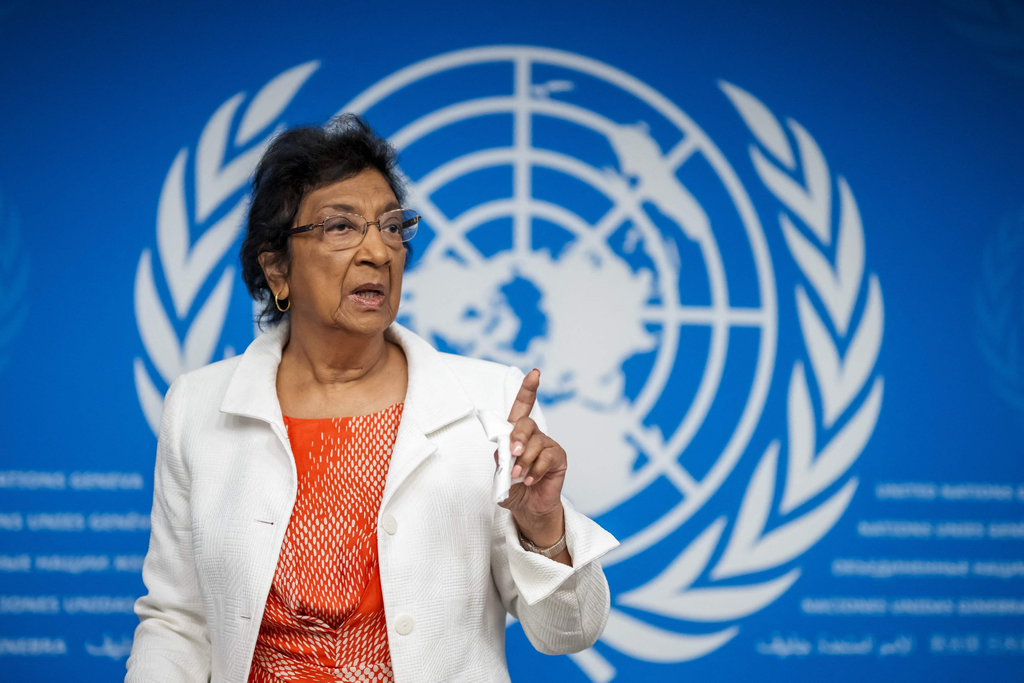
South African jurist Navanethem Navi Pillay, who has worked to advance peace and international law, has been named the 2026 Nobel Peace Prize winner.
The prize, which was announced in Oslo on Friday, October 9, honours Pillay’s decades-long efforts to create an international legal order in which states and individuals can be made accountable for breaching international law. The Norwegian Nobel Committee highlighted the importance of legal institutions and the rule of law in peaceful conflict resolution and said that political or military power should not substitute for justice.
Pillay’s career involves both South Africa’s struggle against apartheid and international criminal tribunals and the United Nations’ human rights system. Her recognition thus poses a wider international law challenge: could international law continue to be effective if the bodies it relies upon to enforce it are subject to political opposition by powerful states?
Apartheid Was Replaced by International Justice
Pillay was born in 1941 in Durban, South Africa, to a family of Indian Tamil descent and grew up in the apartheid era of South Africa, in which the rights of the country’s non-white population were denied. Her legal career emerged from this unequal political system, in which courts and security forces were often deployed to maintain racial segregation and to control the resistance.
Pillay was the first woman to set up a law practice in Natal, now KwaZulu-Natal, in 1967. She represented anti-apartheid activists and political prisoners who had protested against police torture and corruption. Her contribution to bringing prisoners to court for legal action is also recognised.
In 1973, she managed to get the political prisoners the right to involve lawyers. Her work revealed the ways in which the lack of legal representation can lead detainees to become isolated and weaken the protections against torture and mistreatment meant for them.
Pillay’s legal work challenged the notion that a government could take discriminatory action with the tacit approval of domestic law without its actions being questioned. It showed that the practice of law could be a way of challenging the injustice of institutions, even when a state is under repressive authority.
The struggle to achieve equality before the law has been led by Nelson Mandela.
Nelson Mandela: Equality Before War
The trajectory acknowledged by the Nobel Committee includes Pillay’s early defence of anti-apartheid activists, such as Nelson Mandela and others who opposed racial domination. Her role should not be taken as that of Mandela’s lawyer in his major trials, but rather as part of a broader legal battle during the apartheid era.
The relationship became institutionalised in 1995 when, after the end of apartheid, Pillay was appointed to South Africa’s High Court. Mandela, then South Africa’s first democratically elected president, played an important role in South Africa’s transition from a racially segregated state to a constitutional democracy.
This shift showed that political freedom alone could not ensure justice and that institutions were to play an important part. Pillay’s appointment was focused on changing the judicial field and increasing the just representation of institutions that had served under apartheid.
Also Read: Judge Who Defended Mandela Wins Nobel Peace Prize, Not Trump
The Rwanda Tribunal
Pillay’s international judicial career took a significant turn for the better when she was appointed as a judge to the International Criminal Tribunal for Rwanda and as president from 1999 to 2003.
The tribunal was set up following the Rwandan genocide in 1994, which resulted in the killing of Tutsi and moderate Hutu. Its proceedings helped shape international criminal law by focusing not just on direct involvement in violence, but also on the organisation and promotion of such mass atrocities.
Pillay had participated in an important case, Prosecutor v. Jean-Paul Akayesu. The judgment identifies rape and sexual violence as acts of genocide if they are committed with the intent to destroy a protected group. The decision was a major development in international jurisprudence. Sexual violence was often viewed as an occurrence of conflict rather than as an action that accounts for individual crime. The judgment called that distinction into question and further supported the legal recognition of crimes committed against women in mass violence.
The case also showed how judicial interpretation can have a profound impact on formulating international norms. International law is not formed solely by treaties or diplomatic negotiation, but also develops through such judgments.
At the United Nations
Pillay was the United Nations High Commissioner for Human Rights from 2008 to 2014. While working there, she assessed the causes of the needs of vulnerable communities and focused on the accountability of state and non-state actors for abuses. She is also a co-founder of Equality Now, an international organisation that seeks to promote the rights of women and girls.
Her ideas were part of a larger trend in international relations. Typical principles of state sovereignty tended to focus on governments’ control over their domestic affairs. However, international human rights law acknowledges that sovereignty does not exempt a state from its responsibility towards its people.
This puts a constant strain on global politics, where governments now have sovereignty, but when they violate fundamental rights, they can be under international scrutiny.
Gaza
Pillay headed the United Nations Independent International Commission of Inquiry on the Occupied Palestinian Territory (including East Jerusalem), and Israel from 2021 to 2025. The commission determined in September 2025 that Israel was guilty of genocide in Gaza. The finding was rejected by Israel.
The commission’s findings further fueled the debate within the international community about the use of the Genocide Convention and the role of international bodies in investigating alleged mass atrocities.
It should be noted that a commission of inquiry is not a court. A commission is an inquiry into events, an evaluation of evidence and a report giving its findings, but it is not a judicial finding. The identification of the legal responsibility of the State and of any individual criminal liability is in the hands of the competent courts and is subject to the applicable procedures and standards of those courts. However, investigative bodies have a role in accountability: to record evidence, clarify alleged violations, and note future legal proceedings.
Pillay’s involvement in the Gaza inquiry puts her at the core of this debate.
The World at War
Conflicts and disagreements regarding international judicial authority are still challenging the rules-based international order, making Pillay’s Nobel, with her groundbreaking contributions to international law, especially relevant. The prize celebrates a peacebuilding approach that is not so much about negotiations between political leaders as about institutions that investigate and call for accountability for war crimes.
Diplomatic solutions can limit violence, but these can only be sustained if the issues and concerns are resolved through legal institutions. Pillay’s career has been a good example of diplomacy and law.
Consistency is the main point. The use of international law more against weaker states than against stronger ones questions its legitimacy.
Another Disappointment for Trump
US President Donald Trump has long wanted the Nobel Peace Prize, describing his diplomatic efforts as proof of his peacemaking abilities. One of his key achievements in 2018, when he was president, was his negotiation with North Korea, but he was unable to reach a permanent deal regarding its nuclear program.
Trump has credited himself with making efforts to sustain a healthy global environment, with his supporters advocating for his right to win. While studying international relations, one could see that announced agreements and escalations provide loud popularity and applause, while sustainable solutions are quiet. This is a major flaw that could be seen in the Trump administration in solving world conflicts.