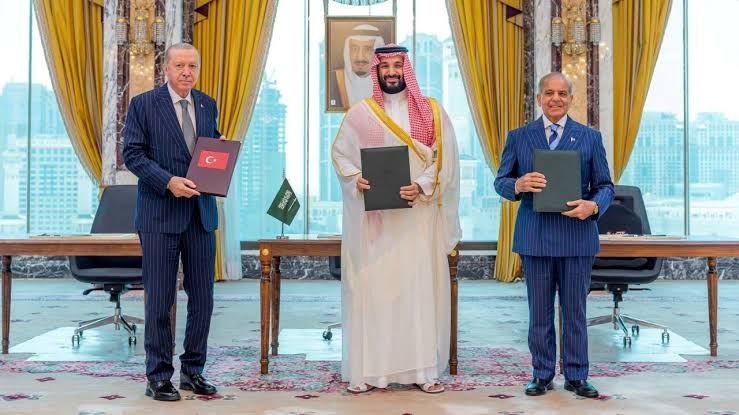
A short declaration issued in Makkah has created a much larger question in Dhaka. Should Bangladesh enter a defence arrangement linking three of the Muslim world’s most influential military and economic powers?
Saudi Arabia, Türkiye and Pakistan concluded the Makkah Joint Defence Agreement on August 7. Under its core provision, military aggression directed at any signatory would become a collective concern for the other two.
Bangladesh has not entered the arrangement. Government officials have indicated that the possibility will be judged according to national interest, leaving the door open without announcing a decision.
The proposal has nevertheless acquired a powerful nickname: an “Islamic NATO.” It is memorable, politically appealing and not entirely inaccurate. It is also capable of hiding more than it explains.
Bangladesh would undoubtedly gain from closer ties with the founding states. However, accepting a defence guarantee crosses a line that training programmes, arms purchases and diplomatic consultations do not. It connects the country’s future decisions to the security choices of other governments.
Dhaka must therefore examine not only what the proposed bloc could provide, but also what it might eventually demand.
A defence promise without a visible rulebook
The attraction of the NATO comparison comes from one shared idea. Both frameworks are based on the expectation that members will not face external aggression alone.
Beyond that principle, the two structures are far apart.
NATO’s security guarantee operates through an organisation developed over more than seven decades. Its members have consultation bodies, military headquarters, agreed planning systems and procedures for coordinating a response.
Even within that mature system, Article 5 allows each NATO government to determine what action it considers appropriate. Assistance can involve military force, but it does not have to take that form.
Only a brief description of the Makkah compact has been released publicly. That description establishes solidarity among the members but offers little guidance about implementation.
For Bangladesh, the missing details are critical.
The available text does not clarify whether a response would require political support, intelligence, equipment, access to facilities or the deployment of military personnel. It says nothing publicly about how members would reach a decision when the facts of a crisis are disputed.
The geographical reach is uncertain as well. A strike on national territory presents a relatively clear case. An incident involving a member’s troops, aircraft or vessels far from home would be harder to judge.
Modern conflict creates further complications. Governments now face cyber operations, attacks by armed groups, sabotage and disruption of critical shipping. Dhaka should know which of these situations, if any, would activate the agreement before accepting its obligations.
These gaps do not prove that the pact is dangerous. They show that a decision on membership would be premature until the complete rules are known.
Why Dhaka is interested
There are practical reasons for Bangladesh to examine the proposal seriously.
Saudi Arabia occupies an important place in Bangladesh’s economy. Figures published by Bangladesh Bank record $5.849 billion in remittances originating from the kingdom during the 2025–26 financial year. That was the highest amount attributed to any single source country and represented roughly one dollar out of every six received in total.
This money is not an abstract indicator. It pays household expenses, supports consumption and supplies the banking system with foreign currency. A strong relationship with Riyadh consequently affects the financial well-being of families across Bangladesh.
Türkiye brings a different set of opportunities. Its defence sector has developed aircraft, unmanned platforms, communication equipment and maritime products. Dhaka could use cooperation with Ankara to obtain technical knowledge, expand domestic production and reduce reliance on complete systems purchased abroad.
Engagement with Pakistan could bring staff training, professional exchanges and easier coordination on matters affecting South Asia and the broader Islamic world.
Together, the three states may provide Bangladesh with access to wider security discussions concerning sea lanes, energy shipments, terrorism and instability in the Gulf. All these issues can affect the Bangladeshi economy even when events take place thousands of kilometres away.
Dhaka is also looking for a wider choice of international partners. It does not want its economic or military future tied too closely to any one external power.
Bangladesh’s developing relationship with Beijing illustrates that strategy. A joint China–Bangladesh communiqué issued in June proposed further defence exchanges and considered a dialogue format bringing foreign-policy and military officials together.
Connections with Riyadh, Ankara and Islamabad could widen that diplomatic portfolio. Yet a diversified foreign policy requires several open doors. It loses its purpose if one of those doors leads to commitments that prevent Bangladesh from using the others.
How a useful partnership becomes an entanglement
An alliance attempts to prevent war by increasing the expected cost of attacking one of its members. The calculation is straightforward: an aggressor may hesitate if it expects a response from several countries.
The difficulty appears when the alliance members have different priorities.
Saudi security policy is shaped largely by events in the Gulf and the Arabian Peninsula. Türkiye operates at the intersection of Europe, the Mediterranean, the Middle East and the Black Sea. Pakistan devotes considerable attention to the strategic competition within South Asia.
Bangladesh faces another collection of concerns. Its immediate priorities include stability in the Bay of Bengal, the conflict in Myanmar, the unresolved Rohingya crisis, border management, cyber resilience and the safety of commercial routes.
These security agendas overlap in places, but they are not interchangeable.
Imagine a serious confrontation involving one founding member. Bangladesh might not face a direct threat, yet membership could produce requests for naval access, intelligence assistance, equipment, diplomatic endorsement or personnel.
Dhaka could refuse. But repeated refusals would raise questions about the meaning of its membership. Acceptance, meanwhile, could draw the country into a dispute over which it has little influence.
This is the central entanglement problem. The initial decision is presented as a way to gain protection. Later decisions may concern how much support Bangladesh owes to someone else.
Economic ties require caution, not automatic alignment
Supporters of membership may argue that Bangladesh should stand closely beside the countries that employ its citizens, provide energy and send investment.
That reasoning contains a weakness. The same economic exposure that encourages cooperation also increases the possible cost of taking sides.
Bangladeshi workers are present across several Middle Eastern countries, not only in Saudi Arabia. Dhaka must preserve communication with governments that may disagree with one another during a crisis.
A regional confrontation could affect employment, remittance channels, air travel, fuel costs and shipping insurance. Joining one security camp may make it harder for Bangladesh to protect its citizens or negotiate with all the parties involved.
The country should therefore separate economic diplomacy from unconditional military solidarity.
Better employment protections, skilled-worker programmes, stable energy contracts and investment commitments would be valuable. They should be negotiated directly and documented clearly. Bangladesh should not assume that military membership will automatically produce them.
A promise of future economic goodwill is too uncertain a return for a long-term defence obligation.
Geography will continue to shape policy
No discussion of the pact is complete without considering India, China and Pakistan.
Most of Bangladesh’s land frontier is shared with India. The countries are connected through rivers, transport links, commerce, border communities and electricity arrangements. Political tension can damage these relationships, but it cannot remove them.
A Bangladeshi decision to enter a military framework containing Pakistan would receive intense scrutiny in New Delhi. India’s reaction does not determine what Bangladesh is allowed to do. It does, however, form part of the likely cost.
If membership deepened Indian suspicion, existing disagreements over water, borders, trade and connectivity could become harder to manage. Bangladesh might then find itself facing greater regional pressure despite joining a bloc in search of security.
China’s response would require separate consideration. Beijing has extensive economic and military relations with Bangladesh and Pakistan, which may make it more comfortable with the arrangement. Still, China will assess any expanded pact according to its own interests, especially if the alliance develops positions concerning Iran, the Gulf or Western military policy.
Domestic history matters too.
Relations between Dhaka and Islamabad can improve, and cooperation should not be rejected merely because the past was painful. Nevertheless, Pakistan’s role in 1971 remains deeply connected to Bangladesh’s national consciousness.
A binding security relationship with Pakistan would therefore require open debate. Treating it as a routine executive decision could create questions about legitimacy, memory and accountability inside Bangladesh itself.
Bangladesh already possesses a valuable identity
For decades, Bangladesh has attempted to maintain broad international friendships while avoiding permanent hostility toward particular states. This approach is sometimes dismissed as excessive caution. It has also allowed Dhaka to work with governments that compete against one another.
The principle has constitutional foundations. Article 25 directs the country’s external relations toward sovereign equality, non-interference, negotiated solutions and compliance with international law.
Nothing in that tradition prevents Bangladesh from building its defences or cooperating with partners. International law itself permits countries to assist one another following aggression, as recognised in Article 51 of the UN Charter.
The challenge is to ensure that any alliance protects Bangladesh’s decision-making authority instead of transferring it elsewhere.
Bangladesh has also earned international standing through peacekeeping. As of April 2026, the United Nations ranked the country second among contributors of uniformed personnel to its missions.
This role presents Bangladesh as a provider of stability under multilateral authority. A defence pact would not necessarily contradict that image. Problems could arise, however, if Dhaka became associated with military competition between regional camps.
The country should place a high value on the reputation it has already built.
A middle course is available
Bangladesh does not need to answer the proposal with an immediate yes or no.
It could begin with observer participation or a specially negotiated partnership. This would allow Dhaka to study the organisation, attend appropriate consultations and identify areas where cooperation produces direct value.
Cybersecurity, disaster relief, maritime monitoring, military education and domestic defence production offer sensible starting points. Such activities could strengthen national capacity without predetermining Bangladesh’s response to a future war.
Before moving further, Dhaka should obtain the full agreement and establish firm conditions.
Bangladeshi forces must remain under Bangladeshi command. Assistance during a crisis should require a separate national decision rather than follow automatically from another member’s request.
Also Read: Bangladesh May Join Makkah Pact to Boost Regional Security
The framework must specify its territory of application and explain how a qualifying act of aggression will be identified. It should not cover another state’s offensive campaign, domestic power struggle or unrelated foreign intervention.
Any agreement should also contain scheduled reviews and a workable departure clause. Parliament and the public should have an opportunity to examine commitments that may one day involve national resources or military personnel.
Finally, the government should compare the expected benefits with the actual costs. Access to meetings and ceremonies would not be enough. Cooperation should produce concrete gains in skills, technology, maritime safety or the treatment of Bangladeshi workers abroad.
Partnership should not become dependency
The new defence initiative is neither automatically an Islamic NATO nor inevitably a trap.
It could become a serious platform for military consultation and technical cooperation. It might also help its members respond to an international order in which older security guarantees appear less dependable.
The danger lies in joining before the institution has answered its most difficult questions.
A policy that puts Bangladesh first should preserve the country’s ability to cooperate with Saudi Arabia, Türkiye and Pakistan while still making independent decisions about India, China, Iran and other states.
Bangladesh benefits when it has more capable partners. It loses when a partner’s confrontation becomes its responsibility without a clear connection to Bangladeshi security.
Dhaka should remain involved in the discussion, negotiate access to practical programmes and observe how the pact develops. Full membership should wait until every military obligation is defined, limited and publicly defensible.
The wisest foreign policy is not the one with the greatest number of alliances. It is the one that knows exactly where cooperation must end and national judgement must begin.