Islamabad (GNP): Aap Ki Izzat has quickly become one of the most discussed dramas on Pakistani television, not simply because of its star-studded cast, but because it touches a deeply familiar question.
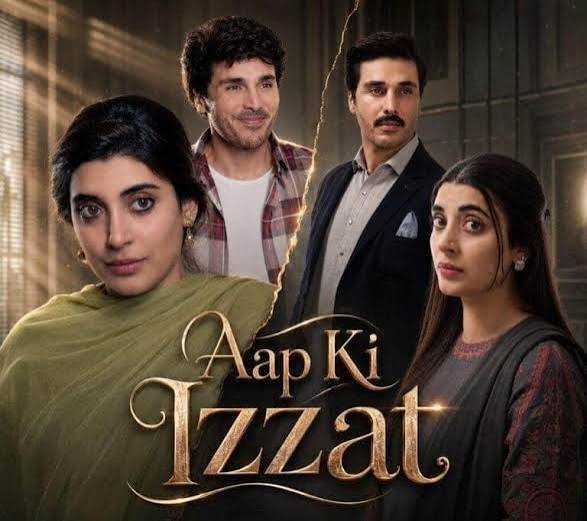
What happens when a marriage loses the respect that once held it together? Written by acclaimed writer Umera Ahmed and directed by Saife Hassan, the HUM TV drama brings together Ahsan Khan and Urwa Hocane as Tabish and Beena, a couple who have been married for 14 years and have built a family together.
The story begins by presenting a relationship that once appeared warm and deeply connected, but gradually reveals how wealth, ambition, family pressure and changing priorities can transform a marriage.
At the centre of the drama is Beena, a woman who has devoted much of her life to her husband, children and household.
Her identity has been closely tied to her family, while her husband’s success changes the world around them.
Tabish rises from a modest background to become a wealthy businessman and later sets his sights on politics. With his changing social position comes a change in the way he sees his marriage and his wife.
This transformation is perhaps the most uncomfortable aspect of the drama. Tabish does not suddenly become a completely different person. Instead, the change happens gradually. The man who once valued Beena begins to take her presence for granted.
Her sacrifices become ordinary to him, while his ambitions become increasingly important.The arrival of Naaz, an educated and ambitious woman involved in Tabish’s political campaign, adds another layer to the story.
What begins as a professional relationship develops into an emotional complication, forcing Beena to confront a reality she never expected from the man with whom she has spent 14 years of her life.
A Story About More Than Infidelity
Although the drama contains elements of marital betrayal, reducing Aap Ki Izzat to a story about an unfaithful husband would miss its larger message.
The drama explores emotional neglect, patriarchy, family interference, social status and the unequal expectations placed on women within marriage.
Beena is expected to remain patient, understanding and accommodating even when she is being emotionally hurt.
At the same time, Tabish’s decisions are repeatedly treated differently because he is the man of the household.
This contrast has generated considerable discussion among viewers. The early episodes have particularly attracted attention for showing how a woman’s sacrifices can become invisible inside a family while her husband continues to pursue personal ambitions.
Sania Saeed’s portrayal of Tabish’s mother adds another important dimension. Her character represents a familiar form of family thinking in which maintaining the son’s happiness and the family’s outward image becomes more important than confronting his wrongdoing.
Reviewers have particularly highlighted the character’s role in creating pressure on Beena.
Urwa Hocane’s Powerful Return
For Urwa Hocane, Aap Ki Izzat also marks an important return to television.
Her portrayal of Beena has attracted attention because the character is not simply written as a stereotypical helpless woman waiting for someone to rescue her.
Beena’s emotional journey is much more complicated. She has spent years adjusting to her family, but as the marriage begins to collapse, she is forced to ask a difficult question: How much of yourself can you sacrifice before sacrifice becomes the loss of your own identity?That question gives the character emotional depth and makes her struggles relatable to many viewers.
Ahsan Khan, meanwhile, takes on a morally complicated character. Tabish is not presented as a straightforward villain from the beginning. His gradual transformation makes his actions more uncomfortable because viewers can see the person he once was and the person he is becoming.
Khan’s performance has also received praise from viewers and critics, with early episodes generating millions of views and strong audience interest.
Why Aap Ki Izzat Is Creating Conversation
The success of a television drama is not always measured only by ratings or views. Sometimes its real impact can be seen in the conversations it creates.Aap Ki Izzat has encouraged viewers to debate questions surrounding marriage, women’s dignity, emotional abuse, second marriages, family expectations and the double standards that can exist between men and women.
The title itself becomes increasingly meaningful as the story develops. “Aap Ki Izzat” your honour, your dignity, your respect is not presented simply as something that society gives a person.
It becomes a question of how a person protects their own dignity when the people closest to them stop valuing it.That is what makes the drama particularly interesting.
It does not ask viewers to look only at who is right and who is wrong. Instead, it asks them to examine how relationships deteriorate, how silence can enable harmful behaviour, and how people sometimes realise the value of another person only after taking them for granted.
A Drama That Reflects Society
Pakistani dramas have frequently explored marriage and family relationships, but Aap Ki Izzat approaches the subject through the intersection of love, wealth, power and self-respect.
Tabish’s transformation from a struggling man into a wealthy and politically ambitious figure reflects a broader social reality, success can sometimes change people’s priorities and their understanding of relationships.
Also Read: World Heritage Convention Protects Global Treasures
The drama uses this transformation to question whether material success can compensate for the emotional damage caused within a family.
Beena’s journey, meanwhile, raises another important question: Is staying in a broken relationship always a sign of strength, or can walking away sometimes require greater courage?The answer may ultimately depend on how the story develops, but the question itself is what makes Aap Ki Izzat worth watching.
Aap Ki Izzat is more than another family drama built around marital conflict. It is becoming a conversation about respect, identity and the emotional cost of being taken for granted.
With Umera Ahmed’s layered writing, Saife Hassan’s direction and strong performances from Ahsan Khan, Urwa Hocane and Sania Saeed, the drama has established an emotionally charged foundation.
Its greatest strength is perhaps its ability to make viewers uncomfortable while encouraging them to think. Behind the glamour of wealth, marriage and social status lies a simple but powerful idea, a relationship cannot survive on love alone when respect disappears.
And perhaps that is the real meaning behind Aap Ki Izzat — before asking society to protect our honour, we must first recognise our own worth.