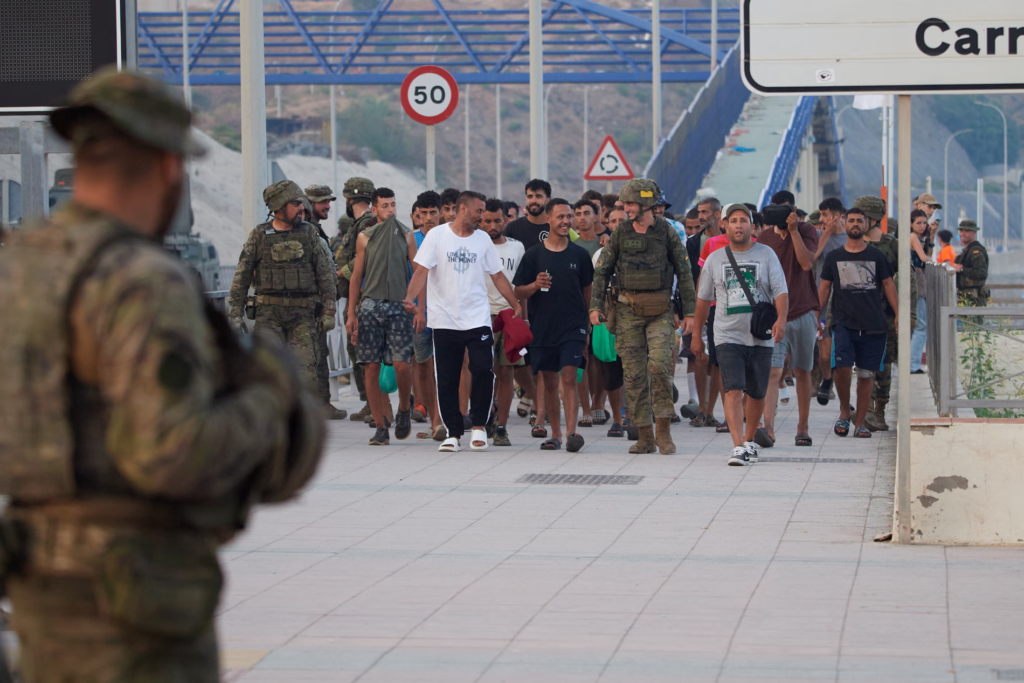
Ceuta (GNP): More than 50,000 people crossed from Morocco into the Spanish enclave of Ceuta this past week, leaving thousands stranded on its streets in a state of uncertainty even as most have since returned across the border.
Among them was Youssef El Abbas, a 44-year-old father of four who had been deported from Bilbao in 2019 after losing his job and his residency status. When word spread that hundreds had swum across the strait separating Morocco from Ceuta, he saw a chance to reunite with the life he had left behind, and travelled by taxi toward the frontier town of Fnideq.
What El Abbas found on the way was a region in disarray. The city of Tétouan was overrun with young men rushing toward the border, and by the time he reached Fnideq, the checkpoints that normally stopped undocumented travellers from approaching the frontier had vanished.
He described Moroccan police alternating between violence the night before and urging people forward the next morning, waving crowds toward Spain while pushing back sub-Saharan migrants by force. He crossed the border after a brief swim on Wednesday afternoon, but not everyone survived the attempt; he recalled seeing several bodies pulled from the water during his own crossing, part of a toll that has reached at least 72 dead from drowning or crush injuries.
Spain’s Prime Minister Pedro Sánchez called the mass crossing a breach of the country’s territorial integrity, while Madrid has pointed to human-trafficking networks exploiting a recent Spanish supreme court ruling that bars the summary return of migrants intercepted at sea near Ceuta or Melilla.
Moroccan officials have offered a different account, with government sources attributing the surge to criminal organisations and insisting cooperation with Spain remains intact, while Morocco’s ambassador to Spain said Rabat wants those who crossed to return.
Some observers have also linked the border’s sudden openness to tension between Rabat and Madrid following Sánchez’s recent visit to Algeria, a country that backs Western Sahara’s independence from Moroccan control, echoing a similar diplomatic stand-off in 2021 when Morocco eased border controls after Spain allowed a Western Sahara independence leader to receive medical treatment.
For El Abbas, arrival in Ceuta brought a mix of relief and violence. A Guardia Civil officer helped pull him from the sea, but three days later a military patrol surrounded and beat the group he was travelling with. He has spent years apart from his wife and four daughters in Bilbao, working odd repair jobs in Morocco, and said he never stopped hoping to return to the country where he had built a hospitality career over 14 years.
His experience mirrors that of many others still on Ceuta’s streets. Although most of those who crossed have already gone back to Morocco, hundreds remain in parks and public squares with little means of moving on. Among them is Said, a 17-year-old from Casablanca who was placed in a centre for unaccompanied minors only to find no space available, leaving him back outside with nothing but water and food given by residents; he and other teenagers said local shops and restaurants have turned them away over the language barrier.
Also Read: Spain Says Most Migrants Returning From Ceuta After 57 Deaths
A soldier who spoke on condition of anonymity said current protocol treats unaccompanied minors the same as adult migrants, returning them to Morocco rather than housing them separately.
Three days on, Ceuta is edging back toward normal life, with cafes reopening and residents distributing water, food, blankets and clothing to those still stranded. That local solidarity has come under strain from the arrival of far-right activists and a neo-Nazi group seeking to capitalise on the crisis, a development residents like Malika, who was born in Ceuta, have openly rejected.
City assembly member Fatima Hamed Hossain said the pressure of the past week has widened divisions between neighbours in ways that feed extremist politics, even as Malika noted that the scale of the crisis would have overwhelmed any city of Ceuta’s size, home to just over 80,000 people.
For Said, the turmoil has not changed his plans, only sharpened his sense of what is at stake. He hopes to secure a place in a protection center, learn Spanish over the coming year, and eventually work as a barber once he turns 18, with his greatest fear being that a lack of legal documentation could derail that path before it begins.

Managing Editor at Global News Pakistan (GNP), with a Bachelor's degree in International Relations from Riphah International University, graduated with a Gold Medal. Reach out at sabahtareengnp@gmail.com