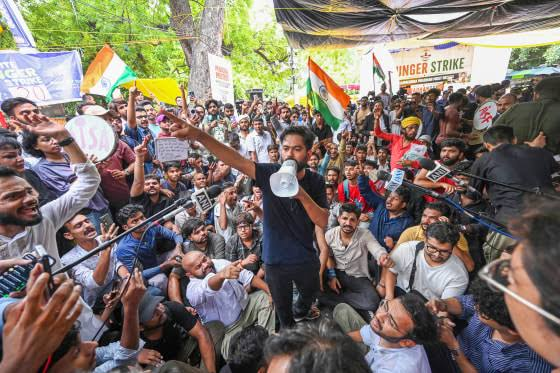
NEW DELHI (GNP): Thousands of students, parents, activists, and opposition politicians attempted to march toward India’s parliament on Monday, answering a call from the Cockroach Janta Party (CJP) for reforms to the country’s education system, as heavy police and paramilitary deployment sealed off routes around the protest site at Jantar Mantar.
The demonstration, one of the largest public displays of dissent to converge on the Indian capital’s power centre in recent years, followed weeks of anger over alleged irregularities and paper leaks in national entrance examinations. Delhi Police said organisers did not have permission for the march, but CJP representatives said they intended to proceed regardless.
Tensions had escalated over the weekend after police forcibly removed activist and educator Sonam Wangchuk from the protest stage on Saturday and took him to hospital, where he has continued a hunger strike now in its third week. His wife, Gitanjali Angmo, was expected to join Monday’s march. In a handwritten note shared on social media, Wangchuk asked hospital authorities for permission to leave, even temporarily, so he could take part.
CJP founder Abhijeet Dipke, who began a brief hunger strike of his own after Wangchuk’s removal, led protesters toward police barricades near the site on Monday morning, urging the crowd to remain seated and avoid confrontation if stopped. He later ended his fast after what the organisation described as an appeal from the parent of a student who had died by suicide. Dipke has demanded the resignation of Education Minister Dharmendra Pradhan and, following Saturday’s incident involving Wangchuk, extended that call to include Prime Minister Narendra Modi.
Protesters at the scene alleged that police used batons against segments of the crowd as some demonstrators pushed past barricades toward parliament, with volunteer medics saying they had treated a number of people for injuries at the site. Police disputed reports of “sporadic use of violence” in a statement posted online. Global News Pakistan has not independently verified these claims, which reflect competing accounts from protest organisers and law enforcement.
The CJP emerged in May as a student-led satirical collective, taking its name from a remark by India’s Chief Justice comparing sections of unemployed young people to cockroaches, a comment later withdrawn amid criticism. Organisers adopted the insect as a symbol of resilience, and the movement has since grown from an online campaign into mass demonstrations that have also taken place in Mumbai, Bengaluru and Hyderabad.
At the centre of the protesters’ grievances is the cancellation of a major medical entrance examination in early May after an alleged paper leak affected roughly 2.28 million candidates. A retest held on June 21 was followed by reports of more than 20 student suicides, according to families of the deceased, a toll organisers cite as central to their demand for accountability.
Also Read: Apollo 11 Anniversary Celebrates Humanity’s Historic Moon Landing Achievement
Two CJP representatives held a brief meeting with federal Health Minister JP Nadda on Monday to submit a list of demands, marking what organisers described as the first direct engagement by a senior minister with the movement. Separately, three students from the All India Students’ Association who had been fasting alongside Wangchuk for 23 days ended their hunger strike following appeals from activists and public figures, though the organisation said its broader protest in support of the CJP’s demands would continue.
Opposition leaders including Trinamool Congress MP Mahua Moitra and Aam Aadmi Party figures Sanjay Singh, Manish Sisodia and Atishi were present at the protest site, alongside actress Shabana Azmi.