Tehran (GNP): Iran announced on Saturday that it has suspended implementation of the Islamabad Memorandum of Understanding, deepening a week-long escalation between Tehran and Washington that has drawn in Gulf states, disrupted regional infrastructure and pushed global oil prices to a monthly high.
Iran Suspends MoU, Cites US Violations
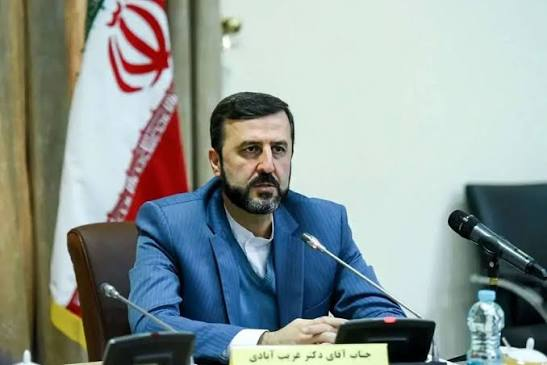
Iran’s Deputy Foreign Minister Kazem Gharibabadi said Tehran had halted its commitments under the Islamabad MoU after Washington violated its own obligations under the agreement. Gharibabadi said Iran was no longer implementing its side of the arrangement and was instead focused on defending the country. He also reiterated that Iran alone would guarantee security in the Strait of Hormuz, warning that no outside country would be permitted to interfere in matters concerning the waterway.
Casualty Toll Rises
Iran’s Health Ministry reported that 50 people have been killed and more than 500 injured in US strikes since June 27, according to Hossein Kermanpour, head of the ministry’s Public Relations and Information Centre. Kermanpour said the dead included five women and two minors, while the wounded included 32 women and 18 children and teenagers.
Separate strikes on Iran’s Hormozgan province were reported to have killed seven to eight civilians over two nights, according to a provincial representative cited by Tasnim news agency. One attack reportedly struck a bridge, killing six people in two family vehicles. A residential neighbourhood in Bandar Abbas was also hit, killing a woman and leaving a one-year-old child with an amputation, while a fuel delivery driver was killed in a related fire.
A US strike on a desalination plant in the coastal village of Bunji, also in Hormozgan, was reported to have cut off drinking water to roughly 10,000 residents across 20 villages, according to the CEO of the Hormozgan Water and Wastewater Company.
Iran Strikes US Bases Across the Gulf
Iran’s Islamic Revolutionary Guard Corps said its naval forces carried out drone and missile strikes on a US fuel support pier at Al Ahmadi port in Kuwait and on Sheikh Isa Air Base in Bahrain, and claimed to have destroyed a US intelligence data centre in Bahrain along with a communications centre in Kuwait. The IRGC separately claimed a missile and drone attack on Al-Azraq air base in Jordan, saying it destroyed at least two American fighter jets and damaged several others. An adviser to Iran’s Supreme Leader described the war as entering a more aggressive and destructive phase.
Kuwait, Jordan and Bahrain each reported responding to the attacks. Jordan’s Armed Forces said they intercepted ten Iranian missiles with no casualties or property damage, deploying engineering teams to clear missile debris. Bahrain’s Defense Force said it intercepted and destroyed several aerial attacks and condemned the targeting of civilian and private property as a violation of international humanitarian law. Kuwait reported a fire at a power generation and desalination plant, injuries among firefighters, and a temporary suspension of operations at Kuwait International Airport, with its national carrier rescheduling flights.
Kuwait Petroleum Corporation separately said one of its oil sector facilities sustained repeated attacks, resulting in injuries and significant material losses.
US Response and Naval Blockade
US Central Command said its own strikes targeted surveillance sites, military logistics infrastructure, underground weapons storage and maritime capabilities, using fighter aircraft, drones and warships, and noted that more than 50,000 American service members remain deployed across the Middle East. The US said it enforced a naval blockade by redirecting four commercial vessels, disabling one and boarding another. Iran’s Revolutionary Guards said it had separately intercepted four vessels it accused of violating its own shipping rules in the strait. Iranian media additionally reported two oil tankers catching fire after passing a mined route south of the strait, a claim the US military disputed.
Regional and Diplomatic Fallout
Oil prices rose more than four percent on Friday to their highest level in over a month. UN Secretary-General Antonio Guterres expressed concern over the escalation, particularly regarding attacks on civilian infrastructure in Iran and across the region, according to his spokesperson. The US State Department renewed its Middle East travel advisory, citing a complex security environment and urging American citizens to reconsider travel to the region.
Former IRGC commander-in-chief Mohsen Rezaei said both diplomacy and limited war had run their course, warning that continued US action within days would push Iran toward what he described as full-scale retaliation without regard to political borders.
The suspension of the Islamabad MoU marks a formal breakdown of the diplomatic framework that had briefly restrained the conflict, and it comes exactly one week after a ceasefire agreement between Washington and Tehran collapsed. Taken alongside the scale of this weekend’s exchanges, strikes reaching Kuwait, Bahrain and Jordan simultaneously, alongside disruption to civilian water, power and air transport infrastructure, the pattern suggests a conflict that has moved beyond direct US-Iran confrontation into a wider regional contest involving every Gulf state hosting American forces.
Also Read: Pakistan, Kuwait Explore Expanded Defense Pact Amid Regional Tensions
The economic dimension is difficult to separate from the military one. A fifth of the world’s oil supply moves through the Strait of Hormuz, and the current standoff pairs a US naval blockade with Iranian threats to halt fertiliser and oil exports entirely until strikes stop. Combined with the seizure of a vessel off Yemen, the situation now touches both of the Middle East’s key oil chokepoints at once, which helps explain the immediate jump in oil prices and the pressure that creates on Washington domestically ahead of November’s elections.
At the same time, the reporting reflects a familiar wartime pattern of contested claims: Iranian state media reporting military successes that US Central Command has in some cases disputed, and both sides describing their own strikes as defensive responses to the other’s aggression. Independent verification of casualty figures, damage claims, and the tanker fire incident remains limited, and the picture continues to shift by the hour.

Managing Editor at Global News Pakistan (GNP), with a Bachelor's degree in International Relations from Riphah International University, graduated with a Gold Medal. Reach out at sabahtareengnp@gmail.com