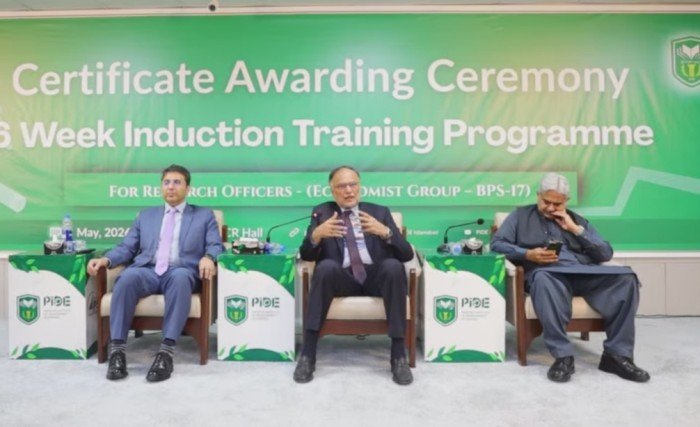
Islamabad (GNP): Pakistan Institute of Development Economics (PIDE) today inaugurated the “6th RASTA–PIDE Conference” in a virtual ceremony. The three-day virtual conference, organised under the RASTA–PIDE and Planning Commission Competitive Research Grants Programme, is running from May 15 to 17.
The conference is bringing together scholars, practitioners, government officials, and development experts from across Pakistan and abroad to deliberate on evidence-based solutions to the country’s most pressing economic and social challenges.
Professor Ahsan Iqbal (NI), Federal Minister for Planning, Development and Special Initiatives, Deputy Chairman of the Planning Commission, and Chancellor of PIDE, delivered the keynote address as the Chief Guest. He opened with a diagnosis of Pakistan’s development predicament, observing that for too long, research and policymaking in the country have travelled on parallel tracks where researchers were producing papers while policymakers managed crises, and that valuable evidence has remained confined to conferences and journals while implementation has suffered from weak feedback and limited engagement with ground realities.
He declared that this disconnect between knowledge and governance has been one of the silent structural weaknesses of Pakistan’s development journey, and that the time to change it is now.
Setting out the scale of national ambition, the Minister articulated Pakistan’s aspiration to transform into a trillion-dollar economy by 2035 and a three-trillion-dollar economy by 2047. He was clear, however, that such a transformation cannot emerge from slogans alone; it requires a new development mindset rooted in evidence, innovation, execution, and institutional coordination.
He identified URAAN Pakistan (the National Economic Transformation Plan 2024–29) as the expression of that mindset. Built around the 5Es framework of Exports, E-Pakistan, Environment, Energy, and Equity, URAAN Pakistan is, in the Minister’s words, not merely another planning document but an attempt to create a whole-of-government and whole-of-society approach to national transformation. Economic transformation, he argued, is never produced by isolated interventions; it happens when institutions, incentives, policies, and intellectual capital begin moving in the same direction.
While addressing the Pakistani research community, the Minister suggested that the country does not simply need more research, but more relevant, more courageous, and more implementable research.
The best policy insights, he said, are rarely born in isolation; they emerge when evidence meets lived experience. He called for the next generation of Pakistani policy research to become more field-informed, stakeholder-driven, and solution-oriented, and for scholars to answer the practical questions that actually matter to governance: how reforms can be implemented, what institutional bottlenecks stand in the way, how federal and provincial coordination can improve, and how policy can become simpler, smarter, and more citizen-focused.
He praised PIDE and RASTA for their efforts to connect academia with policymaking and address local issues through solutions. He also commended the Research Advisory Committee for encouraging diverse viewpoints and appreciated the virtual conference format, which was necessary due to government austerity measures. He stressed that intellectual engagement and policy dialogue should persist despite resource limitations.
“Pakistan needs more relevant research, more courageous research, more implementable research. The countries that rise in the twenty-first century will be those that can convert knowledge into productivity, innovation into competitiveness, and research into national capability. I hope this conference becomes not only a platform for presenting papers, but a platform for shaping solutions — solutions that are practical, implementable, and transformative.”
Prof. Ahsan Iqbal (NI), Federal Minister for Planning, Development, and Special Initiatives
Delivering the welcome address, Dr Nadeem Javaid (SI), Vice Chancellor of PIDE and Chairman of the Research Advisory Committee, RASTA, described PIDE as an institution that has evolved into a national knowledge and policy hub, one whose ambition extends well beyond the production of academic research.
He noted that PIDE’s engagement today extends to the Prime Minister’s Office, federal ministries, provincial governments, and local administrations, with initiatives such as RASTA and the Centre of Excellence for CPEC reflecting the institution’s commitment to evidence-informed policymaking. Dr Javaid drew particular attention to the RASTA Sludge Series as one of the most impactful recent examples of research converting into real governance change.
The findings, compiled into three comprehensive volumes, were subsequently adopted by the Board of Investment, the Capital Development Authority, and the Ministry of Interior in their institutional reform efforts.
He further outlined the structural reforms introduced in the latest cycle of the Competitive Grants Programme: a shift to a Research Idea call that saw applications rise from 471 to more than 1,700 in CGP 8.0; a structured capacity-building programme engaging more than 850 researchers; and a multi-stage review process, including rigorous double-blind assessment before an expanded Research Advisory Committee that now includes senior practitioners alongside academics.
“Pakistan has no shortage of talent. What we need are stronger platforms, better mentoring, and more credible pathways that connect ideas to policymaking. The Sludge Series should not remain an isolated success story — it should become the standard for policy research in Pakistan.”
Also Read: Pakistan, Egypt Agree to Enhance Bilateral Cooperation
Dr. Nadeem Javaid (SI), Vice Chancellor, PIDE & RAC Chairman, RASTA Awais Manzoor Sumra, Secretary of the Ministry of Planning, Development and Special Initiatives, spoke on behalf of the federal government, which established and continues to fund RASTA under the Public Sector Development Programme. He described the Ministry as sitting at the centre of Pakistan’s national development architecture, and underscored that effective planning today requires evidence, analysis, forecasting, and continuous policy learning rather than administrative process alone.
The Secretary highlighted the Demand-Driven Research mechanism as one of RASTA’s most significant institutional innovations, noting that eleven DDR studies had been commissioned at the Ministry’s recommendation — of which three have been completed and eight are currently ongoing — each addressing issues of direct policy relevance at federal and provincial levels.
He called for research findings to be presented within decision-making forums, including DDWP and CDWP meetings and sectoral policy consultations, rather than remaining confined to reports and conferences.
Secretary placed on record the Ministry’s appreciation for PIDE’s responsiveness, transparency, and institutional commitment, and reaffirmed the government’s continued support for strengthening Pakistan’s policy research ecosystem.
“Evidence-based policymaking is no longer optional — it is essential for effective governance and sustainable development. Policy-oriented research should not remain confined to reports and conferences. It should directly inform development decisions, project design, implementation frameworks, and public investment priorities.” — Awais Manzoor Sumra, Secretary, Ministry of Planning, Development & Special Initiatives.