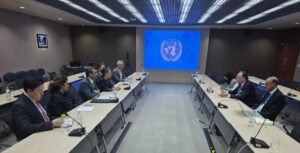
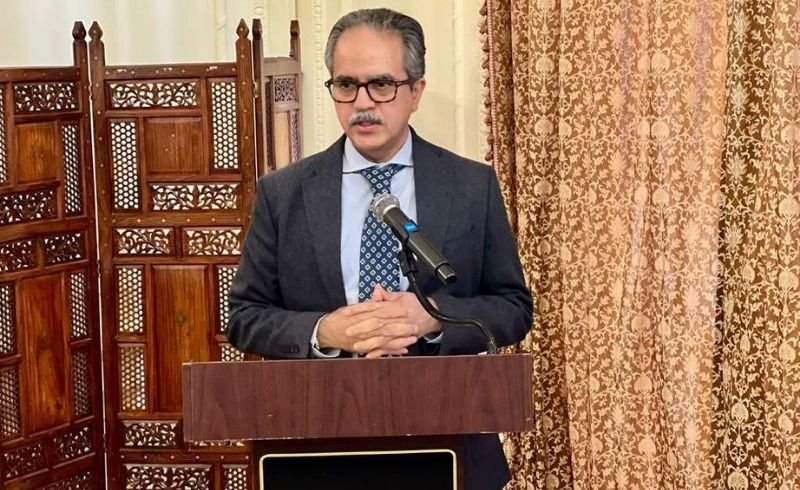
New York, GNP: Pakistan’s Permanent Representative to the United Nations, Asim Iftikhar Ahmad, reaffirmed Pakistan’s strong commitment to multilateralism, regional peace, and the principles of the UN Charter during a briefing for a delegation from the United States Army War College at the Pakistan Mission to the United Nations.
The 40-member delegation, led by Col. Stephan Walters and including five female officers, visited the Mission for a country briefing focused on Pakistan’s role at the United Nations, its foreign policy priorities, and regional and global developments.
During the session, Ambassador Asim Iftikhar Ahmad highlighted Pakistan’s active engagement at the United Nations and emphasized the importance of multilateral cooperation in addressing global challenges such as international peace and security, climate change, artificial intelligence, and economic instability.
He stated that no single country can tackle today’s interconnected challenges alone and stressed the need for stronger international cooperation through the UN framework. The ambassador also called for democratic and transparent reforms within the UN Security Council while reiterating Pakistan’s opposition to the creation of new permanent seats.
Speaking about Pakistan’s current role as a non-permanent member of the Security Council, Ambassador Ahmad noted the country’s contributions toward peacekeeping, counterterrorism, and the peaceful resolution of disputes. He referred to Pakistan’s recent initiative under its Security Council Presidency, which led to the unanimous adoption of a resolution reaffirming commitment to peaceful dispute settlement under Chapter VI of the UN Charter.
The ambassador also highlighted the broad and dynamic relationship between Pakistan and the United States in areas including defense, counterterrorism, trade, intelligence cooperation, and people-to-people ties. He emphasized Pakistan’s constructive diplomatic role in promoting dialogue and de-escalation, particularly regarding tensions involving the United States and Iran.
During an interactive question-and-answer session, participants discussed issues including Middle East security, artificial intelligence, demographic changes, and Islamophobia.
Addressing concerns over regional tensions involving Iran and the United States, Ambassador Ahmad warned that instability in the region could have serious global consequences, including disruptions to energy markets, maritime trade, food security, and economic growth. Referring to developments in the Strait of Hormuz, he stressed the importance of diplomatic engagement to avoid further escalation.
He noted that Pakistan has remained actively engaged with regional and international partners, including the United States, Iran, Gulf countries, Egypt, China, and Türkiye, to support dialogue and peaceful conflict resolution.
On the issue of artificial intelligence, the ambassador said AI is increasingly influencing policymaking and governance and may raise significant human rights concerns in the future. He noted that the United Nations is actively discussing the implications of AI in areas related to development, human rights, and global governance.
Also Read: Addis Ababa and Turkish Chambers Sign Strategic Investment Deal
Responding to questions about Islamophobia, Ambassador Ahmad described it as discrimination and marginalization of Muslims based on their faith. He emphasized the importance of religious freedom, tolerance, and interfaith harmony, and highlighted Pakistan’s leadership role at the United Nations in promoting efforts to combat Islamophobia, including support for appointing a UN Special Envoy on the issue.
The ambassador also stressed Pakistan’s balanced and principled foreign policy approach, saying the country’s relations with major regional and global stakeholders position it to play a constructive role in diplomacy and peacebuilding efforts.
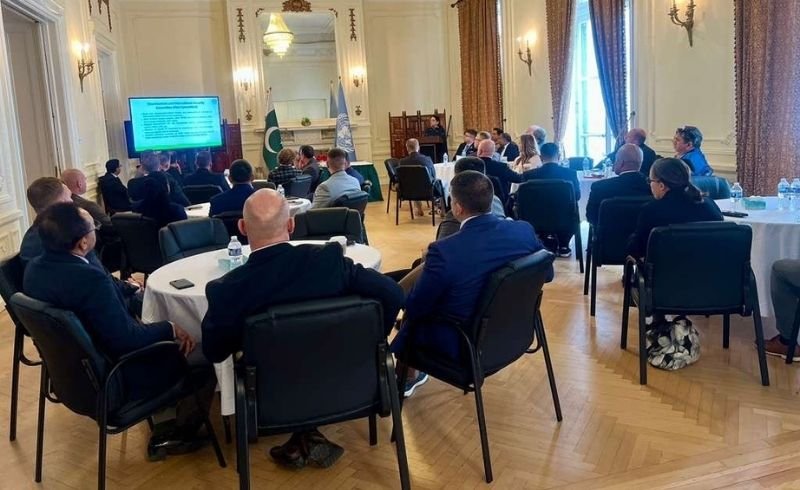
The interaction concluded with participants appreciating the Pakistan Mission’s hospitality and acknowledging Pakistan’s active contributions toward diplomacy, mediation, and peace initiatives at the United Nations.
Earlier, Counsellor Saima Saleem and Col. Umar Shafique briefed the delegation on the work of the Pakistan Mission and Pakistan’s contributions to UN peacekeeping operations.
The delegation included 33 American participants along with representatives from Pakistan, Türkiye, Sri Lanka, Moldova, Guatemala, and Ecuador.