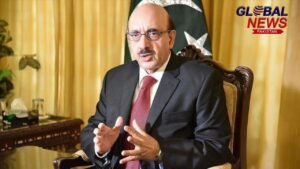
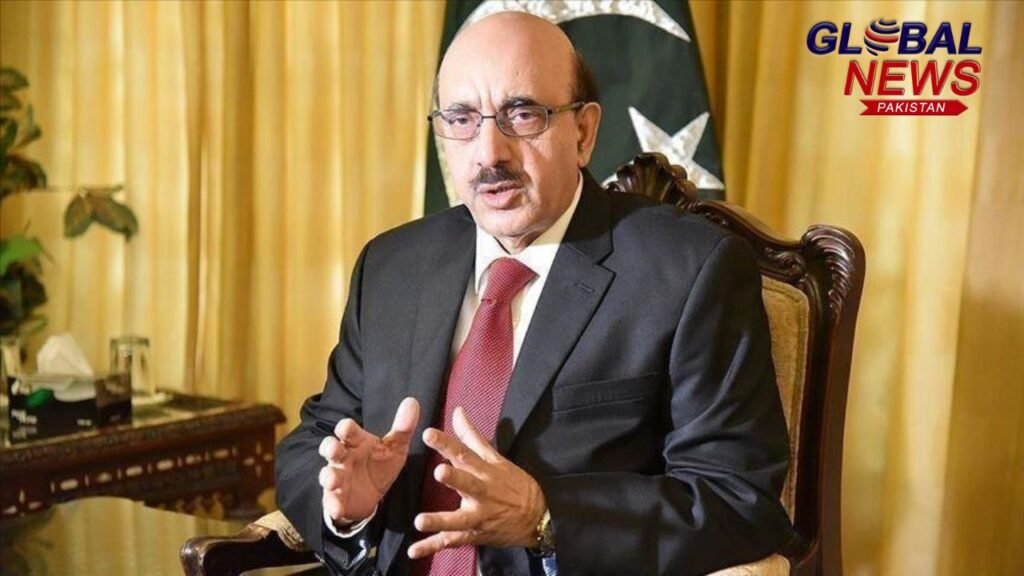
Islamabad (GNP) :- Sardar Masood Khan, former Ambassador of Pakistan to the United States, China, and the United Nations, has stated that the world has taken a collective sigh of relief as tensions between the United States and Iran eased following a crucial extension in the ceasefire, achieved through Pakistan’s timely and proactive diplomacy.
He noted that both sides were on the brink of renewed conflict, with military escalation and economic coercion pushing the region towards another devastating phase of war. However, Pakistan’s last-minute diplomatic intervention—particularly its advice to extend the ceasefire—played a decisive role in stabilizing the situation. He observed that despite initial hesitation, U.S. President Donald Trump agreed to expand the ceasefire, creating space for negotiations to proceed.
Sardar Masood Khan emphasized that Pakistan’s role in mediating between major global and regional powers marks a historic development in diplomacy. “It is rare in classical diplomacy for a country like Pakistan to act as a bridge between powers of such magnitude in an active conflict,” he said, adding that this effort has effectively written a “new chapter” in international relations.
He highlighted that Pakistan earned this role through sustained engagement and by building trust across multiple capitals, including Washington, Tehran, Beijing, Moscow, and key European and Gulf partners. He noted that traditional mediators or institutions such as the United Nations were largely absent, making Pakistan’s leadership even more significant.
Addressing the evolving dynamics, Sardar Masood Khan pointed out that both sides had engaged in intense brinkmanship, employing military threats and economic pressure to gain leverage. Iran, he said, demonstrated strategic restraint despite facing severe threats to its infrastructure, while also maintaining its negotiating position amid a U.S. naval blockade and seizure of vessels.
He further observed that the current phase of diplomacy is unconventional, with decision-making in Washington becoming highly centralized and often communicated through direct public statements, creating volatility in global markets and strategic calculations.
Outlining the path forward, he stressed that confidence-building measures—such as lifting blockades and ensuring freedom of navigation through the Strait of Hormuz—are essential for restoring trust. He also identified key challenges for upcoming talks, including lack of trust, competing strategic interests, and domestic political pressures on both sides.
Reaffirming Pakistan’s commitment, he stated that Islamabad remains fully engaged in facilitating dialogue and maintaining momentum. “If these efforts falter, it will not be Pakistan’s failure, but a collective failure of the international community,” he cautioned.
Concluding, Sardar Masood Khan expressed optimism that sustained diplomatic engagement could transform the current ceasefire into a durable peace, reinforcing Pakistan’s role as a credible mediator and a stabilizing force in global affairs.