
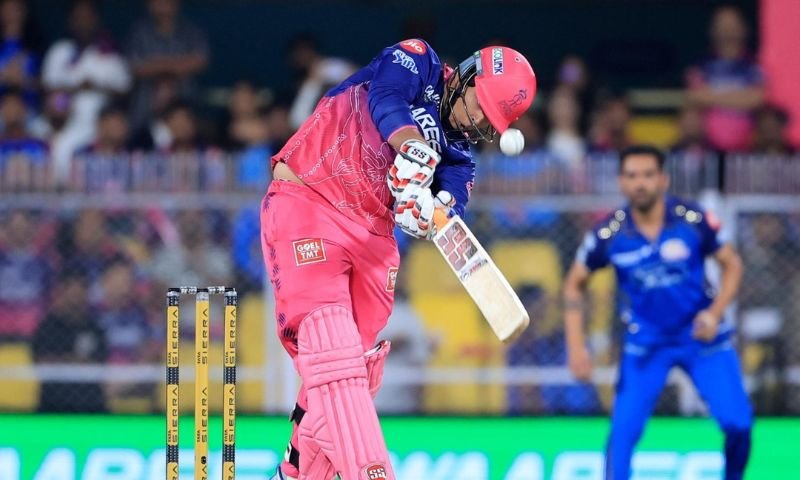
Islamabad GNP:- Vaibhav Sooryavanshi faced just 14 balls against Mumbai Indians, and yet he didn’t even produce the most substantial innings of the day. Still, what he did in that brief window was explosive enough to dominate the conversation including taking on Jasprit Bumrah. It raises a compelling question: at what point does his age become irrelevant?
Consider Yashasvi Jaiswal, himself regarded as one of India’s brightest young batting prospects. Before this game, across four IPL innings and 16 deliveries, he had managed to clear the boundary just once against Bumrah arguably India’s finest fast bowler.
Sooryavanshi, on the other hand, needed just a single delivery to match that. Two balls later, he had already gone beyond it.
Players like Andre Russell, Heinrich Klaasen, MS Dhoni, David Miller, and now Jaiswal have each hit two sixes off Bumrah in the IPL. Among them, the fewest balls faced to achieve that is 22. Sooryavanshi did it in a fraction of that time.
Of course, context matters. This version of Bumrah wasn’t at his absolute peak. He hasn’t crossed the 140 kmph mark this season and has been carefully managing his workload after time at the Centre of Excellence. The match itself was shortened to 11 overs, naturally encouraging aggressive batting where wickets carry less value and risks are taken more freely.
Still, what unfolded in Guwahati during those 25 minutes was remarkable.
When Sooryavanshi whipped a delivery 88 metres over long-on, Bumrah could only shut his eyes in acknowledgment it was a poor ball, in the slot and not particularly quick. Even elite bowlers have such moments, and often they escape punishment because batters play the reputation rather than the delivery. Add to that the fact that Sooryavanshi had never faced Bumrah before; caution would have been understandable.
But caution wasn’t part of the script.
After nudging the next ball for a single, he punished a slightly shorter delivery, launching it over square leg with a swing that seemed almost exaggerated in its power. A high full toss followed, which he survived, but then came a moment that reminded everyone of his youth he awkwardly stumbled back onto his stumps while trying to make his ground, narrowly avoiding a run-out.
When Shardul Thakur entered the attack, the assault continued. Sooryavanshi struck him for six over cover almost a mirror image of the six he had hit off Thakur on his IPL debut the previous year. The next ball was dispatched for four in the same region. The reactions from the fielding side said it all.
There was an immediate huddle involving Thakur, Bumrah, and captain Hardik Pandya. Between them stood a wealth of experience 564 international caps and 410 IPL matches, yet they appeared unsettled by a 15-year-old who had faced only 11 deliveries up to that point, coincidentally matching the number of IPL titles shared among them.
Despite the earlier fireworks against Bumrah, the defining moment came against Thakur. The field placement appeared on screen: three boundary riders on the off side sweeper, deep backward point, and deep cover. while long-on and cow corner guarded the leg side.
The plan seemed clear: bowl into the field and force an error.
Thakur delivered on a length outside off stump, angling across the left-hander a line that could have induced a mistimed slash or an outside edge. Sooryavanshi, known for his tendency to swing hard in such situations, could easily have fallen into the trap.
Instead, he outthought the field entirely.
With a bat swing that came from low to high, he adjusted at the very last moment, using a sharp twist of the wrists to send the ball soaring straight over the vacant long-off region. It cleared the boundary comfortably, but even a mishit might have found safety.
He was dismissed on the very next delivery, though not before striking the ball with such force that it nearly knocked over the boundary fielder. A slightly higher trajectory would have meant yet another six.
In total, Sooryavanshi contributed 14 balls to Rajasthan’s 66 runs. Jaiswal, by contrast, played the more complete innings an unbeaten 77 at a strike rate of 14.4 runs per over. Yet in those 14 balls, Sooryavanshi hit five sixes. His teammates managed six sixes in 52 balls combined. Against Bumrah specifically, he hit two sixes in five balls, while the rest of the team managed just one in 13.
His fearless attack on one of the world’s most respected bowlers echoed memories of another teenage prodigy Sachin Tendulkar’s iconic 28-run over against Abdul Qadir in 1989, which included four sixes. Both moments carry a similar sense of audacity that immediately captures attention.
But labeling Sooryavanshi as merely audacious or cheeky doesn’t fully capture what’s happening. Those terms often suggest innocence or naivety the idea of a youngster unaware of the magnitude of the stage. That’s not the case here. He seems fully aware of where he stands and exactly what he intends to do.
At some point, the conversation has to move beyond his age.
He is not just an extraordinary cricketer for a 15-year-old.
He is simply an extraordinary cricketer.