
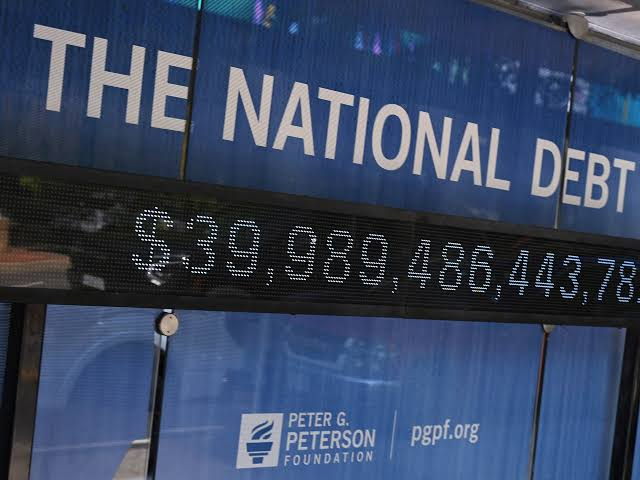
Washington (GNP): The United States national debt has crossed $40 trillion for the first time, Treasury Department figures showed this week, marking a milestone that budget watchdogs say confirms fears of an accelerating fiscal crisis in Washington.
The Treasury’s daily cash and debt balances statement placed total public debt outstanding at $40.047 trillion, comprising $32.266 trillion in securities held by the public and $7.782 trillion in intra-governmental holdings.
The figure represents more than a doubling of federal debt in under a decade, rising from just under $20 trillion when President Donald Trump was first sworn into office in January 2017.
Roughly a third of that growth stems from emergency borrowing during the COVID-19 pandemic, while the remainder reflects fiscal choices made across the Trump and Biden administrations, combined with long-standing gaps between government spending and revenue.
Public debt increased by $11.6 trillion across Trump’s two terms, including $3.8 trillion since he returned to office in January 2025, while debt grew by $8.4 trillion during President Joe Biden’s four years in the White House.
The Congressional Budget Office had projected total borrowing would not reach $39.6 trillion until the end of fiscal year 2026, meaning the actual pace of accumulation outstripped official estimates. The CBO expects debt to climb toward $64 trillion by 2036 as the country approaches its $41.1 trillion statutory ceiling.
Maya MacGuineas, president of the Committee for a Responsible Federal Budget, warned that the burden extends well beyond government accounting. Says MacGuineas, “The more we borrow, the more we exacerbate inflation, squeeze out other priorities in the budget, and leave ourselves vulnerable to emergencies at home and turmoil abroad.” She noted that the $40 trillion threshold was reached less than five months after debt passed $39 trillion, a pace she described as reflecting a predictable pattern of fiscal decline.
The debt milestone has coincided with sharp movement in bond markets. Yields on 30-year Treasury bonds touched 5.34 percent on Tuesday, their highest level in nearly two decades, before easing to 5.18 percent after the Treasury Department announced it would double its buyback operations for 10 to 30-year securities, raising them from $2 billion to at least $4 billion per operation between September 9 and November 4. Treasury Secretary Scott Bessent’s intervention was framed as an effort to support liquidity in longer-dated bonds.
John Canavan, lead analyst at Oxford Economics, said the buyback increase appeared aimed at easing pressure built up from rising oil prices, inflation risk and heavy global borrowing demand. Says Canavan, the move was “unlikely to provide meaningful long-term relief” given the scale of outstanding Treasury debt.
Rene Albrecht, senior analyst at DZ Bank, linked the timing to the political calendar, noting that officials are working to contain yields ahead of midterm elections just three months away. Economist Mohamed A. El-Erian said the strategy pointed toward a broader attempt at influencing the yield curve, cautioning that while it may temporarily lower borrowing costs, it carries the risk of unintended consequences.
Asked whether Americans should be concerned about volatility in the bond market, Trump dismissed the worry. Says Trump, “I think we have a very powerful country, and we’re powering through these ridiculous interest rates. When our country is strong, interest rates should go down.”
Also Read: PM Shehbaz Meets Google Team, Opens Pakistan Office
Interest payments on federal debt have become one of the largest single items in the federal budget, with roughly $1.1 trillion spent annually on debt service. In the first ten months of fiscal year 2026, interest costs surpassed Medicare spending to become the second-largest budget line after Social Security.
The Treasury also reported a $432 billion deficit for July, the fourth-highest monthly shortfall on record, driven partly by tariff refunds that pushed customs receipts negative for a third consecutive month.
According to the International Monetary Fund, US debt now stands at 125.8 percent of gross domestic product, among the highest ratios of any major economy.
By comparison, the United Kingdom’s debt-to-GDP ratio stands at 103.6 percent and China’s at 106.9 percent, while Japan carries the highest burden among major economies at more than 200 percent of GDP.

Managing Editor at Global News Pakistan (GNP), with a Bachelor's degree in International Relations from Riphah International University, graduated with a Gold Medal. Reach out at sabahtareengnp@gmail.com