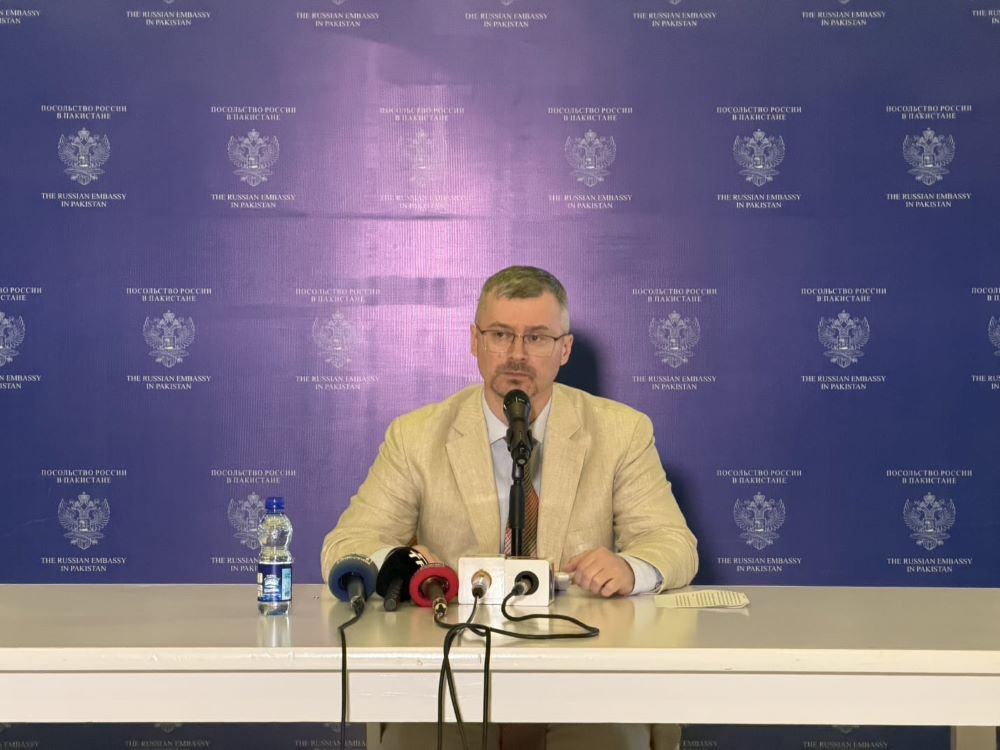
Islamabad (GNP): Russian Ambassador to Pakistan Albert P. Khorev said Ukrainian drone attacks on Russian cities were intended to disrupt the electoral process during Russia’s parliamentary elections held on September 20, claiming that voter turnout reached record levels despite what he described as external pressure and attacks.
The Ambassador held a briefing on developments related to the Ukraine conflict, which opened with a moment of silence honoring victims of the Siege of Leningrad, marking the 85th anniversary of that event on September 8.
The briefing covered the military, political, economic, legal, and informational dimensions of the conflict. Khorev characterized the Ukraine crisis as a broad confrontation between Russia and what he called the collective West, arguing that Ukraine is being used as a proxy to weaken Russia.
On the economic front, he claimed that Western sanctions have failed to trigger the economic collapse sought by their proponents, while instead causing significant harm to the countries imposing them and to the global economy more broadly. He cited figures suggesting the EU’s cumulative losses from sanctions-related effects between 2022 and 2025 totaled €1-1.6 trillion, with European companies that exited the Russian market losing an additional €400-450 billion. He argued that sanctions pressure is accelerating a shift toward trade in national currencies and the development of alternative financial infrastructure among BRICS, the SCO, and ASEAN.
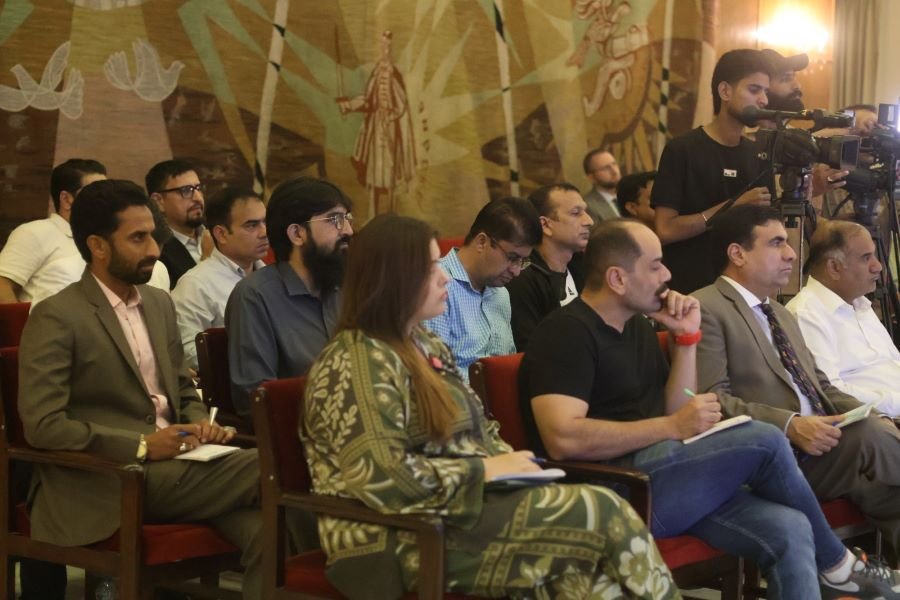
The briefing also touched on maritime law and freedom of navigation, with Khorev criticizing Western actions targeting what he called the “shadow fleet” — a term he described as a fabricated pretext used by Western countries to justify seizing Russian vessels. He also raised concerns over a sharp rise in Ukrainian attacks on civilian ships in the Black and Azov Seas, warning that further escalation could threaten international shipping.
In this context, he pointed to global wheat export figures — noting Ukraine’s roughly 7% share of global wheat exports compared to Russia’s 23% — arguing that Western restrictions on Russian agricultural exports carry negative consequences for global food security.
On the legal front, Khorev said Russia does not recognize Western-established mechanisms dealing with compensation claims against it and has no intention of complying with their rulings. He did, however, highlight a June 15, 2026 ruling by the Permanent Court of Arbitration in The Hague, which he said unanimously rejected several Ukrainian claims, including demands for compensation and reparations, as well as claims related to Crimea’s maritime areas and the Sea of Azov region.
The Ambassador also addressed what he referred to as the “children’s issue” and the situation involving the Ukrainian Orthodox Church, alleging systematic pressure by Ukrainian authorities against the Church and its members.
Concluding his remarks, Khorev said Russia remains committed to pursuing a political and diplomatic resolution to the conflict, noting that Russia had initiated the resumption of negotiations last year after talks were halted by Kyiv, and said Russia remains open to continuing dialogue while accounting for its national interests. He further stated that Russia has no plans for military action against Europe or NATO and sees no genuine reason to escalate tensions with European countries.
Guests at the briefing also viewed an exhibition titled “Crimean Gold: ‘Civilized’ Europe Plunders Russian Treasures,” with the Ambassador arguing that a collection of ancient archaeological artifacts from Crimea — held in Crimean museums until 2014 — should be returned to the peninsula.
Also read: TİKA Supports Disaster-Hit Farmers in Pakistan
This summarizes the Russian Ambassador’s statements at an official briefing. Many of the claims presented here — including characterizations of the conflict’s origins, the legal status of the 2026 Hague ruling, and the “shadow fleet” characterization — are disputed by Ukraine, Western governments, and independent legal and economic analysts.

Sohail Majeed is a Special Correspondent at The Diplomatic Insight. He has twelve plus years of experience in journalism & reporting. He covers International Affairs, Diplomacy, UN, Sports, Climate Change, Economy, Technology, and Health.