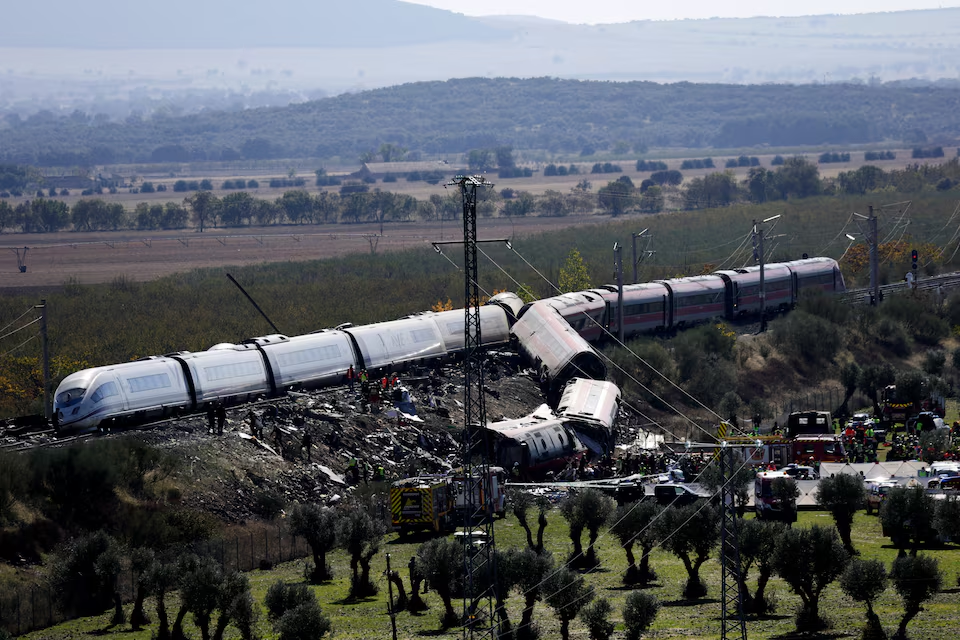
Madrid (GNP): At least 68 people have died after a high-speed train collision near Urda in Spain’s Toledo province, making it the country’s second deadly rail disaster this year. Rescue teams were still searching the damaged carriages for more victims as darkness fell on Wednesday.
The crash happened at about 9 am local time on the Madrid-Andalusia line, between the towns of Mora and Orgaz. A Renfe train hit an Iryo train that had been standing on the track, and two Iryo carriages derailed. Regional authorities said 147 passengers were aboard the Iryo service and 397 on the Renfe train.
Castilla-La Mancha regional head Emiliano García-Page confirmed the toll of 68. Officials had earlier reported 64 deaths and warned that the figure could rise. Health Minister Monica Garcia said 80 people were injured, 15 of them seriously.
Transport Minister Oscar Puente said a computer communications failure triggered a red signal that automatically halted traffic. He said an erroneous decision was then made to let the Renfe train move forward. Renfe said its driver continued as instructed and that investigators must establish the exact sequence of events. It added that it does not know why the Iryo train was stationary.
Iryo said it had activated its emergency protocols. The infrastructure operator Adif had not commented at the time of reporting.
Footage from the scene showed a train on an elevated stretch of track, with twisted metal scattered down an embankment where at least three carriages had fallen. Passengers, some bandaged and bloodied, were taken away along a nearby road. Relatives were directed to a school in Urda, and Renfe opened a special line for families. It also suspended ticket sales on the Madrid-Andalusia corridor until December 13.
Prime Minister Pedro Sanchez said all of Spain was in mourning and promised a full investigation. He added that the causes of this crash and the earlier one appeared to be unrelated. He also pledged to strengthen safety if needed to restore confidence in high-speed rail.
The earlier crash happened in January near Adamuz in Córdoba province, when a train derailed and struck an oncoming one on the same line, killing 46 people. A preliminary Civil Guard report in February pointed to defects in the track, rail or a weld as the leading theory. Investigators kept seven other possibilities open.
Also Read: IAEA Chief Tells UN Council Iran Must Let Inspectors Return
Together, the two disasters have renewed debate over rail maintenance. Spain’s railway safety authority has recorded a rise in accidents from 45 in 2016 to 57 in 2024 and 69 last year. European Commission data shows that only about 16 per cent of Spain’s high-speed spending between 2018 and 2022 went to maintenance, renewals and upgrades.
The disaster is the deadliest in Europe since the 2013 Santiago de Compostela derailment, which killed 80 people. It also comes weeks before a snap election on November 29, and the opposition People’s Party cancelled all of its campaign events for the day.
Passenger Salvador Arriza, 62, described the chaos in his carriage. He said, “Some people practically couldn’t move because they were trapped amongst the seats.”

Managing Editor at Global News Pakistan (GNP), with a Bachelor's degree in International Relations from Riphah International University, graduated with a Gold Medal. Reach out at sabahtareengnp@gmail.com