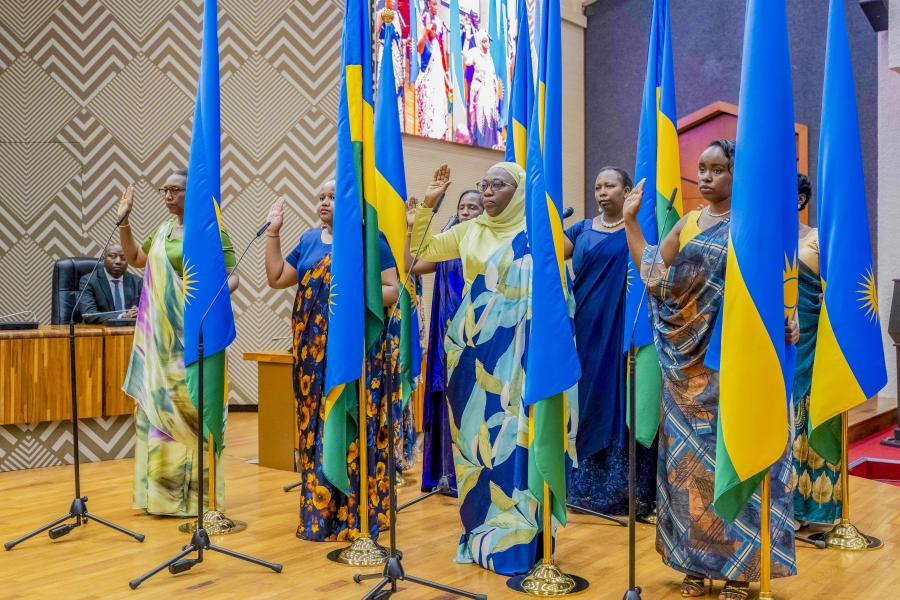
Kigali (GNP): Rwanda remains a global leader in female legislative representation, according to figures presented during a briefing at the Ministry of Gender and Family Promotion (MIGEPROF) on Wednesday, which set out how the country has achieved and sustained this position.
Women occupy 63.75 per cent of seats in the Chamber of Deputies and 46.2 per cent of the Senate, with parity extending into the judiciary and executive branches, where a woman serves as Chief Justice, another as Prosecutor General, and a woman leads the central bank as governor.
Representation remains strong at the local level as well, with women making up 46.9 per cent of district councils and 38.8 per cent of cabinet ministers.
However, parity thins out in more technical and administrative posts. Only 20 per cent of province governors and 26 per cent of permanent secretaries are women, while judges overall stand at 36 per cent and heads of public institutions at 31 per cent.
This pattern suggests parity is strongest in elected and high-visibility roles, but comparatively weaker across appointed administrative tiers.
On the economic front, 55.6 per cent of women participate in the labour force, against a national gap that leaves female participation at 56 per cent compared with 71 per cent for men. Financial inclusion remains comparatively strong, with 96 per cent of women reported as financially included.
Land ownership data from the National Land Authority, cited in the presentation, shows women alone hold just 18.89 per cent of land, against 12 per cent owned by men only, while nearly half of all land, 48.96 per cent, is co-owned between men and women. A further fifth falls into other ownership categories.
The gap between co-ownership as the dominant category and outright female-only ownership as the smallest is expected to remain a policy focus going forward.
Also Read: Decoding China-US ‘Constructive Strategic Stability’ Ahead of Xi’s Visit
Rwanda’s gender ecosystem is anchored by four key bodies. MIGEPROF sets policy on gender equality, efforts against gender-based violence, and family welfare, while the Gender Monitoring Office tracks gender mainstreaming across sectors and pushes accountability.
The National Women’s Council mobilises women into development programmes, working alongside the National Child Development Agency on child protection, while the Rwanda Women Parliamentary Forum lobbies for gender-responsive legislation.
This institutional architecture is backed by a dense policy stack, including the Revised National Gender Policy of 2021, Vision 2050, and the 2024-2029 National Strategy for Transformation, alongside laws on land, labour and family.
Programmatic tools such as Gender Responsive Budgeting, together with the Indashyikirwa and Bandebereho initiatives, further support efforts to shift household gender dynamics across the country.

Managing Editor at Global News Pakistan (GNP), with a Bachelor's degree in International Relations from Riphah International University, graduated with a Gold Medal. Reach out at sabahtareengnp@gmail.com