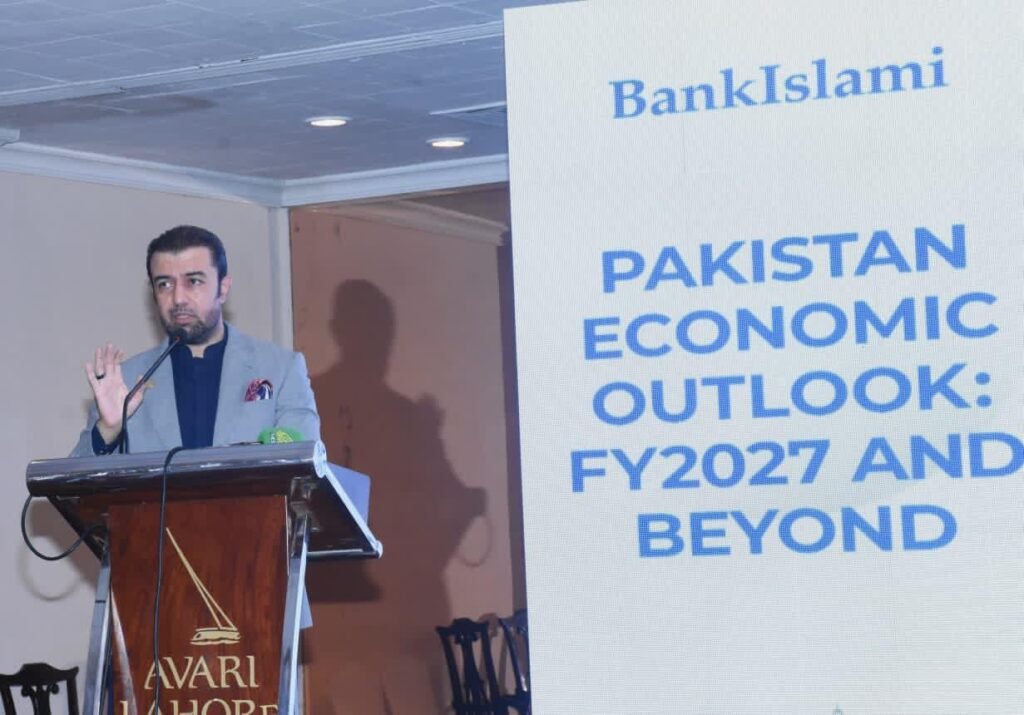
Lahore (GNP): Government of Pakistan is building its long-term economic strategy around sustained macroeconomic stability, wide-ranging structural reforms, and growth driven by the private sector, according to Adviser to the Finance Minister Khurram Schehzad, speaking at a seminar titled “Pakistan Economic Outlook: FY2027 and Beyond” held at a hotel in Lahore.
Speaking to an audience that included well-known economists, business leaders, and financial experts such as Dr. Ali Hasanain, Ali Khizer, and Khurram Husain, Schehzad traced Pakistan’s economic turnaround over the last two to three years, pointing to marked gains across major indicators while laying out upcoming policy plans meant to embed long-term growth into the system.
Fiscal and Growth Indicators
Reviewing the broader fiscal and economic picture, Schehzad described a shift away from sharp economic contraction and external fragility toward structural stability. Real GDP growth, he said, climbed out of negative territory to hit 3.7 percent, driven by gains across real economic sectors: agriculture grew 2.89 percent (above its 25-year historical average), Large-Scale Manufacturing posted a four-year-high growth rate of 6.1 percent, and services expanded 4.4 percent.
On fiscal management, the deficit was held under 1 percent of GDP over a nine-month stretch, with projections putting it near 3 percent going forward — a sharp drop from 8 percent in 2022. The primary balance, meanwhile, hit a record surplus, and total debt-to-GDP fell from 75 percent to 68 percent, which Schehzad attributed to disciplined fiscal management in line with statutory debt rules.
External Sector Performance
On the external front, Schehzad noted the current account deficit had shrunk to under $150 million, down sharply from $17.5 billion in 2022, while headline inflation eased to 7.5 percent. Foreign exchange reserves held by the State Bank of Pakistan grew from a low of $3 billion in early 2023 to $18 billion, enough to cover more than three months of imports.
He stressed that this reserve buildup came largely from organic capital inflows rather than fresh borrowing, with total public external debt holding steady near $100 billion. Contributing factors included record inflows through Roshan Digital Accounts, which topped $13 billion with monthly inflows now averaging $300 million, along with IT exports reaching $4.6 billion and freelance earnings of $1.76 billion. This improved economic standing was reflected in an upgrade from S&P, which raised Pakistan’s credit rating to ‘B’ with a stable outlook.
Structural Reforms
Turning to reform implementation, Schehzad outlined progress across eleven core areas aimed at shrinking the state’s role in commercial activity and encouraging market-driven competition.
On state-owned enterprises, he pointed to 28 privatization deals now underway, including the completed bidding process for Pakistan International Airlines and ongoing privatization efforts for First Women Bank, House Building Finance Corporation, and power distribution companies. Alongside energy sector divestment, the government is rolling out a Competitive Trading Bilateral Contract Market framework to break up monopoly-based power purchasing. In tax administration, the Federal Board of Revenue is moving toward a fully faceless, multi-layered digital system designed to remove discretionary decision-making in assessments. Other reforms underway include downsizing federal ministries, winding down underperforming state bodies such as PASCO and PWD, moving civil service pensions to a defined-contribution structure, and cutting tariffs to reduce protectionism and lower input costs for exporters.
Private Sector Growth
Schehzad said fiscal policy is being shaped to encourage private investment and industrial growth. Private sector credit rose by 1.46 trillion rupees, up 15 percent year-on-year, while agricultural credit flows reached 2.7 trillion rupees.
He pointed to renewed business confidence reflected in 11 Initial Public Offerings in a single year — a 20-year high — along with more than 43,000 new corporate registrations annually.
Also Read: India-France Rafale Deal Stalls Over Software Access
To boost export competitiveness, the recent national budget introduced tax relief measures, including scrapping the super tax for companies earning under 500 million rupees in profit, cutting the turnover tax to 1.25 percent, and lowering energy tariffs for off-peak industrial use. The Economic Coordination Committee also approved an export refinancing facility offering discounted credit at 4.5 percent to support small and medium exporters.
Schehzad said the government is putting the finishing touches on two major long-term frameworks: a Comprehensive Industrial Policy to boost manufacturing competitiveness, and a Medium-Term Tax Policy intended to give both domestic and foreign investors greater policy predictability over multiple years.
Responding to questions on social protection, poverty, and jobs during the Q&A session, Schehzad said short-term fiscal steps are being paired with an expanded social safety net, pointing to increased funding for the Benazir Income Support Programme to protect vulnerable groups during the economic transition. He closed by reiterating that lasting job creation and poverty reduction depend on continuing to support private enterprise, improving industrial efficiency, and maintaining steady macroeconomic policy.

Sohail Majeed is a Special Correspondent at The Diplomatic Insight. He has twelve plus years of experience in journalism & reporting. He covers International Affairs, Diplomacy, UN, Sports, Climate Change, Economy, Technology, and Health.