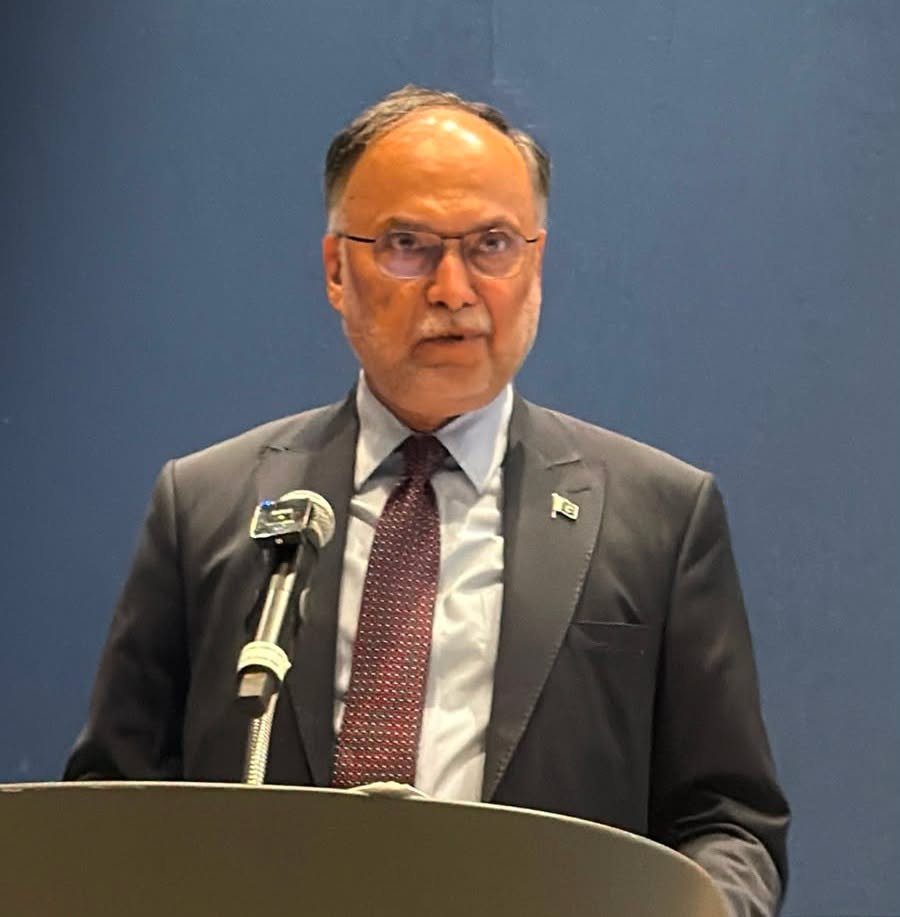
Houston, USA (GNP): Marking World Population Day, Federal Minister for Planning, Development and Special Initiatives Professor Ahsan Iqbal reaffirmed the government’s commitment to tackling Pakistan’s population challenges through coordinated, evidence-based policy, stating that the country’s future depends not on population size, but on the quality, productivity, and preparedness of its people.
Referencing this year’s theme, “Realizing the hopes and aspirations of young people, today and for the future,” Iqbal said it holds particular significance for Pakistan, where a large youth population represents both a national opportunity and a policy responsibility. He argued that Pakistan’s population should be viewed as human capital to invest in rather than a burden to manage, noting that spending on health, nutrition, education, skills, and women’s empowerment today translates into future productivity and prosperity.
Fertility Trends and Population Growth
Iqbal noted that Pakistan’s total fertility rate declined from 4.1 births per woman in 2006-07 to 3.6 in 2017-18, a figure that has since remained steady according to the Household Integrated Economic Survey 2024-25. While calling this progress encouraging, he said the pace remains insufficient given Pakistan’s development needs. He pointed to the 2023 Digital Census, which recorded Pakistan’s population at 241.49 million with an annual growth rate of 2.55%, warning that current trends could push the population past 386 million by 2050 — placing significant strain on education, healthcare, housing, employment, water and food security, infrastructure, and public finances.
Governance and the National Population Council
Iqbal described population outcomes as fundamentally governance outcomes, noting that after the 18th Constitutional Amendment, responsibilities related to fertility, health, education, and social protection became spread across different levels of government. He said Pakistan’s challenge has never been a shortage of policies, but the absence of a mechanism empowered enough to align various stakeholders around a unified approach — a gap he said the newly established National Population Council aims to fill.
He explained that the Council, chaired by Prime Minister Shehbaz Sharif and including provincial leadership, representatives from AJK and Gilgit-Baltistan, key federal ministers, and military leadership including the CDF and COAS, represents the highest-level forum ever convened on this issue in Pakistan. He said the military’s involvement reflects the seriousness with which the state now views the issue, rather than any institutional shortfall, and that the Council’s purpose is to convert demographic data into coordinated policy rather than fragmented programs.
Demographic Dividend and Policy Sequencing
Iqbal said population stabilization is not an end in itself but a starting point for capturing what he called a demographic dividend — a window in which Pakistan’s youthful population could drive economic growth if policy priorities are properly sequenced. This includes addressing unmet family planning needs, improving maternal health, keeping girls in school, boosting women’s workforce participation, and expanding skills training and job creation. He warned that delayed action would turn today’s demographic potential into a growing fiscal and social burden, stressing that the window for capturing this dividend is narrowing each year policy attention lags.
Gender Equality as a Core Strategy
The minister emphasized that gender equality sits at the center of effective population policy, noting that women’s education, economic participation, and decision-making agency around family size are among the strongest drivers of long-term development and population stabilization. He argued that no country can realize a demographic dividend while excluding half its population, framing investment in women’s health, education, and economic opportunity as both a matter of social justice and sound economic policy.
Alignment with URAAN Pakistan
Iqbal linked population policy to the government’s broader URAAN Pakistan framework, particularly its Equity and Empowerment pillar focused on women, children, youth, education, health, and human capital development. He said the government’s goal extends beyond simply slowing population growth to ensuring every Pakistani child grows up healthier, better educated, and better equipped to contribute to national development.
He said Pakistan’s greatest strength lies in its people, and that investing in their future represents the country’s most important responsibility — describing population management not as an effort to limit people, but to expand opportunity for every child to access quality education, healthcare, and nutrition.
Call to Action
On World Population Day, Iqbal urged federal and provincial governments, parliamentarians, development partners, civil society, academia, the private sector, media, religious scholars, and local communities to join a collective national effort centered on responsible parenthood, informed decision-making, women’s empowerment, and sustainable development.
He expressed confidence that under the prime minister’s leadership and with whole-of-government commitment, Pakistan can transform its demographic challenges into a foundation for stronger human capital, greater prosperity, and long-term national stability.

Sohail Majeed is a Special Correspondent at The Diplomatic Insight. He has twelve plus years of experience in journalism & reporting. He covers International Affairs, Diplomacy, UN, Sports, Climate Change, Economy, Technology, and Health.