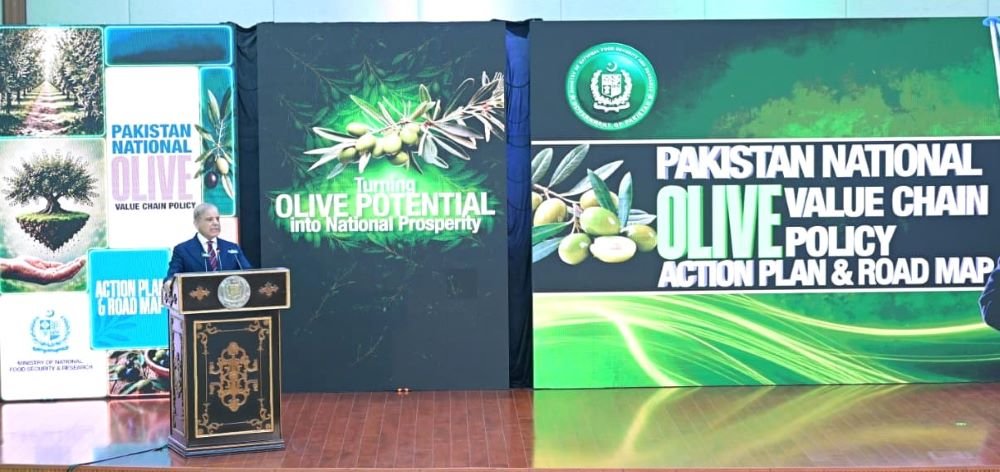
Islamabad (GNP): Prime Minister Muhammad Shehbaz Sharif officially rolled out Pakistan’s National Olive Value Chain Policy, calling the country’s expanding olive industry a standout success story with the potential to reshape national agriculture and cut down the country’s massive edible oil import bill.
Speaking at a ceremony organized jointly with the Italian government and attended by farmers, growers, diplomats and young entrepreneurs, the prime minister noted that Pakistan currently spends close to four billion dollars a year importing crude edible oil — a cost that could be substantially reduced by scaling up domestic olive farming.
“Olive oil ranks among the healthiest products out there, and producing it at home would mean real savings for the country, even if we only capture part of that import bill,” he said, adding that Pakistan could achieve self-sufficiency in edible oil within a matter of years given sustained commitment.
The prime minister praised the early olive growers who pushed ahead despite doubts from their own families and communities, highlighting farmers from Balochistan and Khyber Pakhtunkhwa whose produce has gone on to earn recognition at international events in New York, London and Dubai.
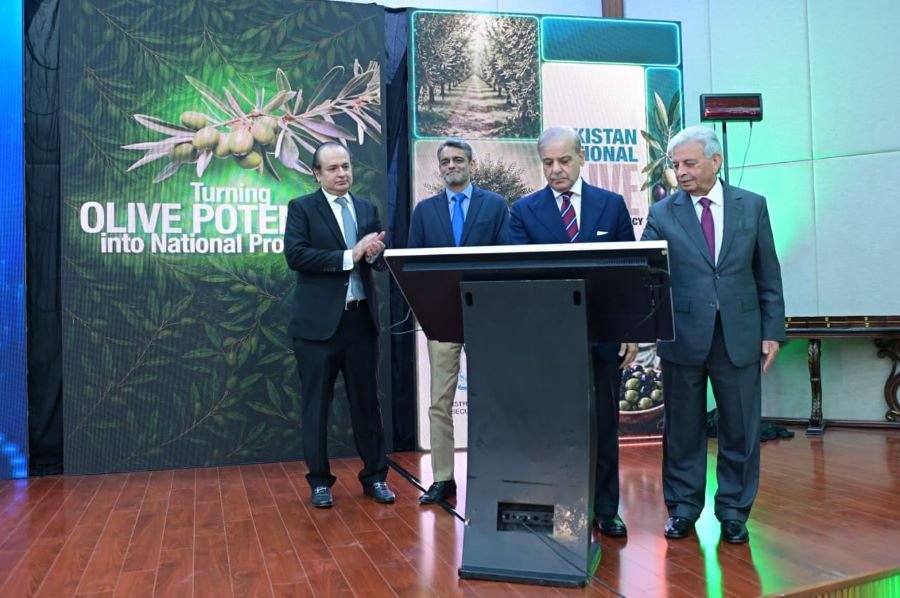
Their success, he said, showed that “such revolutions can be brought about” through determination and passion, and he commended provincial governments for backing farmers throughout the process.
He also expressed appreciation for Italy’s decades-long partnership with Pakistan, referencing seven decades of collaboration spanning archaeology, agriculture, trade and industry. As part of this cooperation, he announced that Pakistan would sponsor the training of 100 young agriculture graduates in Italy in olive farming, processing and marketing, equipping them to strengthen the local industry upon their return.
The prime minister added that his administration would continue promoting other edible oil crops, such as palm and sunflower, alongside the olive program, urging farmers and officials to focus on fieldwork rather than paperwork alone.
Closing his remarks, he offered personal thanks to Italian Prime Minister Giorgia Meloni, describing her as an excellent leader and voicing gratitude for Italy’s continued support. He reflected on his own history with Pakistan-Italy trade dating to his time as a young businessman in the 1960s and 70s, when Pakistan imported substantial Italian textile machinery — equipment he described as exceptional — and noted that tractor manufacturing had also been a strong area of bilateral cooperation.
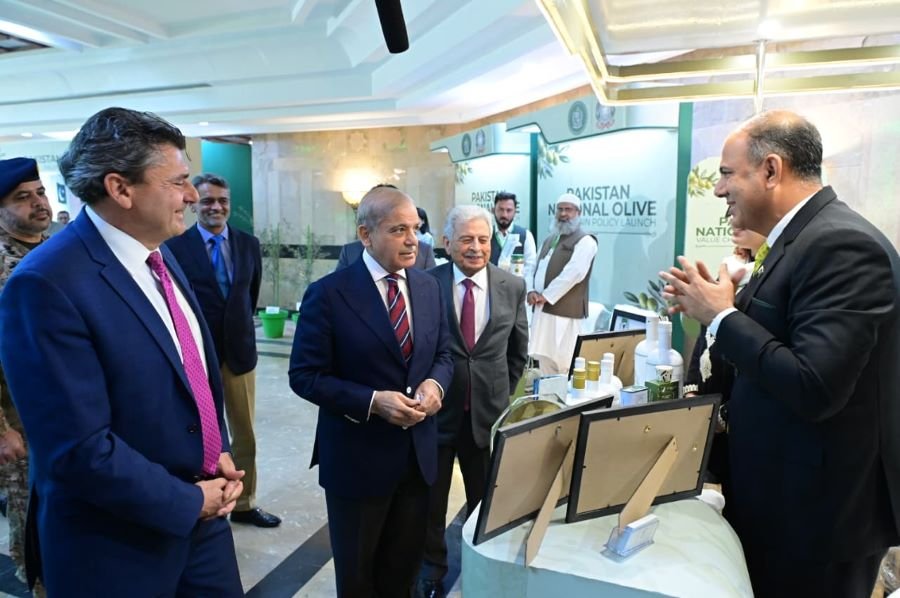
The newly launched policy lays out a plan to grow olive production, improve processing and quality control, and build branding and marketing capacity, with the aim of establishing Pakistan as a regional olive oil hub across South, Central and Eastern Asia.
Officials at the event noted that the number of olive trees nationwide has jumped from about 500,000 in 2016 to over seven million today, spanning Punjab, Khyber Pakhtunkhwa, Balochistan and Sindh, with orchards now covering roughly 60,000 acres.
The ceremony also highlighted that Pakistan secured a permanent seat on the International Olive Council this year during its 123rd session held in Portugal, and that the country’s first Olive Sensory Evaluation Lab has since been set up in Islamabad.
Minister for National Food Security and Research Rana Tanveer Hussain said the policy aims to push Pakistan’s olive sector beyond raw production and into processing, packaging, branding and export markets.
He described the initiative as an effort to “set a new limit for agriculture,” noting that today’s agricultural competition hinges on quality, value addition, branding and market access rather than production volume alone. He credited the prime minister’s leadership for Pakistan’s permanent Council seat, achieved after the country first applied for membership back in 2014.
Secretary of the Ministry of National Food Security and Research, Amir Ali Ahmed, outlined the policy’s goals, saying it would position Pakistan as a key olive oil production centre for South, Central and Eastern Asia.
He said the prime minister’s vision extended beyond planting alone toward building a comprehensive system of processing, value addition, branding and marketing. He reiterated that Pakistan had become a regular member of the International Olive Council this year and confirmed the establishment of the country’s first Olive Sensory Evaluation Lab in Islamabad.
Italian Ambassador Ugo Ciarlatani expressed thanks to the prime minister and the ministry, describing the policy as the product of a partnership between Italy and Pakistan spanning more than seven decades.
He noted that Italian assistance had contributed to setting up sensor and phytosanitary labs, training plant pathologists and chemists, establishing seven notified nurseries, and forming 36 business development groups led by women and young people — citing the €20 million Professional Capacity Building and Extension Agriculture Programme as the most recent example. The ambassador also reflected on olive oil’s cultural importance in Italy, describing it as central to Italian “identity,” “traditions” and “way of life.”
The event featured accounts from farmers and entrepreneurs who have built olive enterprises from Loralai in Balochistan to Mardan in Khyber Pakhtunkhwa, several of whom were recognized on stage by the prime minister for their role in the sector’s growth.
Coordinator to the Prime Minister Ahmed Umair led a discussion session with farmers from across the country, saying the goal was to spotlight “the people who are actually behind this success in remote areas of Pakistan.”
Abdul Jabbar, an olive farmer from Loralai, Balochistan, recounted starting his olive venture in 2011 despite scepticism from his family. With support from the Olive Culture project and local authorities, his orchard began yielding produce in 2017 and has since expanded to tens of thousands of plants — some of which produced the award-winning olive oil recognized in New York and London.
Dr. Qurat-ul-Ain Irfan, noted as one of Pakistan’s foremost female olive farmers, said she planted over 14,000 olive trees across more than 600 canals of land in Mardan, after an Italian government survey flagged the region’s potential back in 2008-09.
Yaqub Izhar, who runs Pakistan’s largest private-sector olive nursery, said he became interested in olives after visiting an exhibition in Istanbul around 2007-08, despite having no background in agriculture or horticulture.
Dr. Marco Marchetti, described as an internationally recognised agronomist and one of the foremost architects of Pakistan’s olive sector, was invited on stage during the awards segment alongside farmers Dr. Qurat-ul-Ain Irfan and Hassan Tareem, a grower from Loralai, both of whom were honoured by the Prime Minister for their contributions.
Also read:
Earlier, Gianmarco, an Italian expert affiliated with the Mediterranean Agronomic Institute described as having worked in Pakistan for 45 years, said his organisation was providing technical assistance to federal and provincial authorities to help establish the olive value chain.

Sohail Majeed is a Special Correspondent at The Diplomatic Insight. He has twelve plus years of experience in journalism & reporting. He covers International Affairs, Diplomacy, UN, Sports, Climate Change, Economy, Technology, and Health.