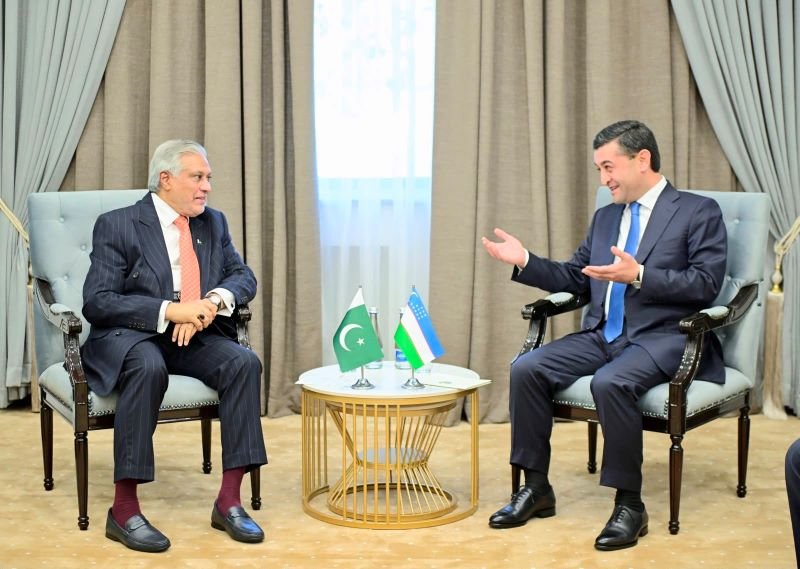
Cholpon-Ata, Kyrgyzstan (GNP): Deputy Prime Minister/Foreign Minister Senator Mohammad Ishaq Dar met with the Foreign Minister of Uzbekistan, Bakhtiyor Saidov on the sidelines of the SCO CFM Meeting in Cholpon-Ata, Kyrgyzstan.
The two Ministers reaffirmed the strength of the Pakistan-Uzbekistan strategic partnership and reviewed progress in bilateral cooperation across trade, investment, connectivity, energy, culture, and people-to-people exchanges.
They emphasized the importance of sustained high-level exchanges and closer engagement between the business communities of both countries to further expand economic ties. They also discussed cooperation at regional and multilateral forums.
Both Ministers recalled the successful visit of President Shavkat Mirziyoyev to Pakistan earlier this year and underscored the importance of translating the understandings reached during the visit into tangible outcomes through timely implementation.
The two sides also exchanged views on regional and global developments. Foreign Minister Saidov appreciated Pakistan’s diplomatic efforts to promote regional peace and stability, including its role in facilitating the Islamabad MoU.
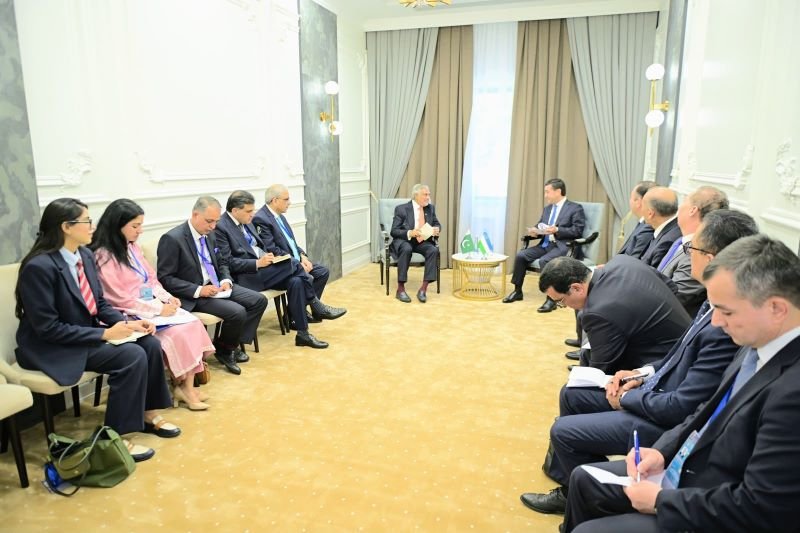
Both sides expressed hope that dialogue and diplomacy would continue to pave the way for lasting peace and regional stability. The two Ministers agreed to remain in close contact.
Deputy Prime Minister/Foreign Minister Senator Mohammad Ishaq Dar, departed Cholpon-Ata, Kyrgyz Republic for Islamabad after successfully concluding his visits to Manila, Philippines, for the ASEAN Regional Forum (ARF) Ministerial meeting and to Kyrgyz Republic to participate in the SCO Council of Foreign Ministers meeting.
At the airport, the DPM/FM was seen off by Deputy Foreign Minister of the Kyrgyz Republic Kairat Erkinovich Tursunkulov, Ambassador of Pakistan to the Kyrgyz Republic Altamash Wazir and officials of the Embassy of Pakistan in Bishkek, the Foreign Office Spokesperson said in a press release.
The relations between Uzbekistan and Pakistan can be traced back centuries. It is shaped by cultural, religious, and trade ties. The cities of Samarkand and Bukhara in Uzbekistan were once major centers of Islamic learning, influencing scholars in the Indian subcontinent.
The Silk Road played a dynamic role in trade and cultural interactions between the two regions, with merchants, scholars, and Sufi saints traveling between them. Another significant historical link between both states is that the first Mughal emperor, Babar, was from Uzbekistan. After being forced out of Central Asia, he conquered northern India and established the Mughal dynasty in 1526, maintaining strong ties with his homeland.
Many Mughal emperors continued to bring scholars, artists, and architects from Central Asia, deepening the cultural connection. However, during the Soviet era, Uzbekistan’s integration into the USSR limited direct relations with Pakistan. Despite Pakistan’s alliance with the West and the USSR’s socialist stance, diplomatic interactions existed, mainly through backchannels related to Afghanistan.
Following Uzbekistan’s independence in 1991, Pakistan was among the first nations to recognize it, leading to the formal establishment of diplomatic ties in 1992. Since then, both countries have signed multiple agreements in trade, education, defense, and regional connectivity.
Also read: Uzbekistan and Belarus: A New Stage of Strategic Cooperation in Vocational Education
Over the years, their cooperation has grown, particularly in security and economic development. Recent years have witnessed a strengthening of bilateral relations, with a focus on trade routes, defense collaboration, and regional stability.

Sohail Majeed is a Special Correspondent at The Diplomatic Insight. He has twelve plus years of experience in journalism & reporting. He covers International Affairs, Diplomacy, UN, Sports, Climate Change, Economy, Technology, and Health.