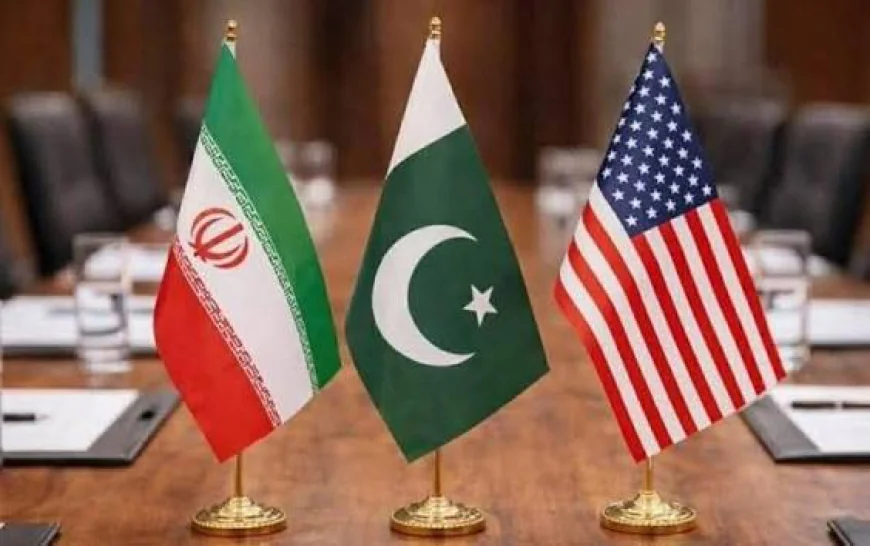
Islamabad (GNP): Pakistan’s Foreign Office said on Thursday that Islamabad is making every effort to bring the United States and Iran back to the negotiating table under the Islamabad memorandum of understanding signed last month, as concerns grow over the fragile security situation in the Middle East.
Addressing the weekly press briefing, FO spokesperson Tahir Andrabi said Pakistan continues to view the region’s security environment as precarious, noting that although recent days had brought a relative calm that raised hopes of a durable and fully respected ceasefire, that momentum has yet to translate into a lasting resolution.
Andrabi reaffirmed Pakistan’s position that dialogue and diplomacy remain the only viable path forward, welcoming all efforts aimed at sustaining the cessation of hostilities and reviving talks between Iran and the United States.
He said Pakistan remains actively engaged in these efforts and intends to continue playing that role, adding that negotiations between the two parties are currently underway to normalise the situation, particularly around the Strait of Hormuz, and to de-escalate broader tensions in the region.
Central to Pakistan’s diplomatic push, according to Andrabi, is an effort to bring both sides back to the Islamabad MoU itself, so that outstanding issues can be resolved in line with the spirit of the agreement and the Pakistan-Qatar joint statement issued on June 22. He urged both Washington and Tehran to exercise maximum restraint and to fully honour their commitment to resume technical-level talks, in keeping with both the Islamabad MoU and the joint statement with Qatar.
That agreement was originally signed on June 18 following weeks of intensive diplomatic engagement, with the aim of reopening the Strait of Hormuz and bringing an end to a Middle East conflict that had begun in February with US-Israeli strikes on Iran, with a further sixty days of negotiations envisioned under the deal.
However, the fragile understanding collapsed on July 7, when Iran struck commercial shipping vessels in the Strait of Hormuz, including a Qatari liquefied natural gas tanker, accusing Washington of violating the terms of the agreement, a move that triggered multiple rounds of US strikes against Iranian military targets in response.
Since then, the conflict has continued to widen, with Houthi rebels in Yemen imposing a naval blockade on Saudi Arabia and extending the confrontation to a second critical shipping corridor. The situation escalated further on Wednesday, when explosions struck a natural gas loading port in Egypt and a US-owned floating storage tanker was reportedly hit by a drone, while the United States and Saudi Arabia carried out joint strikes against Iran-backed paramilitary groups in Iraq in response to earlier attacks on American troops and Saudi oil infrastructure. By Thursday, after nearly a week’s pause in direct exchanges, the United States struck Iran again, this time in retaliation for an attack on American bases in Jordan.
Beyond the regional security discussion, Andrabi also addressed a recent documentary on Pakistan’s nuclear programme aired by Germany’s Deutsche Welle, dismissing it as misleading and describing it as a repetition of tired, speculative commentary drawn from biased sourcing.
He said the documentary reflected either a serious misunderstanding or a deliberate disregard of the history and rationale behind Pakistan’s nuclear programme, and cautioned that by giving a platform to poorly sourced and one-sided material, DW risked damaging its own credibility as a professional news organisation.
Also Read: PM Reaffirms Solidarity with Kuwait on ME Situation
Andrabi called on the broadcaster to exercise greater editorial responsibility on matters with significant implications for international peace and security, while affirming that Pakistan maintains full confidence in the strength of its command and control systems and the technical, legal and institutional frameworks governing its nuclear programme, standards he said have been consistently recognised by independent international experts.
Andrabi was also asked to comment on India’s decision to restrict access to the social media accounts of state-run Pakistan Television for users within India, responding pointedly that the move was unsurprising. He placed the decision within a broader pattern that has developed since tensions between Islamabad and New Delhi escalated following the Pahalgam attack in April, which also triggered a brief military confrontation between the two countries and has since been accompanied by India blocking access to a number of Pakistani social media accounts and YouTube channels.
He described the latest restriction as consistent with what he characterised as India’s established approach of limiting information flow while promoting an officially curated narrative through media he said operates under significant state influence, adding that the trend reflected a broader intolerance for independent voices. He went on to call on the international community to take fuller notice of restrictions on media freedom and the shrinking space for free expression in India.

Managing Editor at Global News Pakistan (GNP), with a Bachelor's degree in International Relations from Riphah International University, graduated with a Gold Medal. Reach out at sabahtareengnp@gmail.com