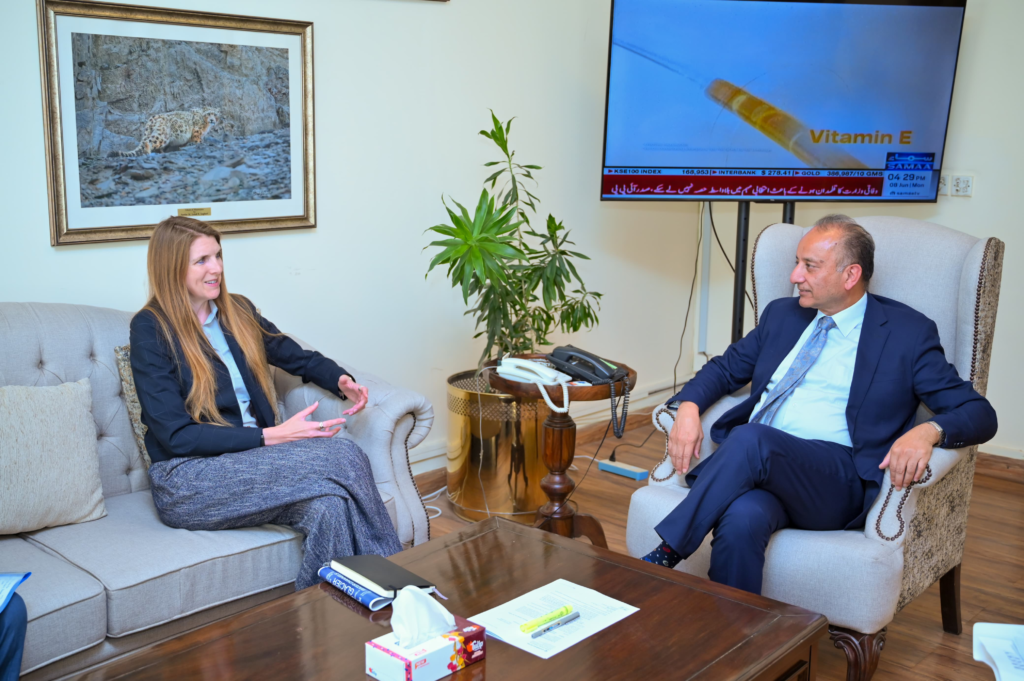
Islamabad (GNP): British High Commissioner to Pakistan, Jane Marriott, called on the Federal Minister for Climate Change and Environmental Coordination, Dr. Musadik Malik.
The meeting focused on the implementation and future course of the Green Compact, a £35 million bilateral climate cooperation framework aimed at strengthening Pakistan’s resilience against the growing impacts of climate change.
During the meeting, the British High Commissioner presented the Action Plan for the Green Compact and briefed the Federal Minister on its key priorities and proposed areas of collaboration. Dr. Musadik Malik emphasized that the objective of the Green Compact should be to develop initiatives and interventions that deliver tangible and high-impact outcomes for the people of Pakistan.
The Federal Minister also briefed the High Commissioner on progress being made towards the establishment of a Green University in Islamabad. He informed her about ongoing discussions with international partners, including Italy and stakeholders associated with the Arctic Circle initiative.
Dr. Musadik Malik further highlighted the establishment of a Green Tech Hub at the National University of Sciences and Technology (NUST) in collaboration with the Ministry of Climate Change and Environmental Coordination. The initiative aims to support young entrepreneurs working on green technologies and sustainable business solutions.
The Minister stated that it is essential to facilitate young people not only in green entrepreneurship but also in research and innovation that can generate practical and scalable solutions to environmental and climate challenges.
Also Read: Developing skills only part of the solution, James
British High Commissioner, Jane Marriott briefed the Minister on the United Kingdom’s youth entrepreneurship programmes and ongoing projects being implemented in Pakistan in collaboration with the British High Commission, particularly those focused on climate resilience and green solutions.
The meeting also included discussions on strengthening early warning systems and enhancing preparedness for climate-related disasters.