Islamabad (GNP): Prime Minister Muhammad Shehbaz Sharif declared that Pakistan and Iran would stand together as an unbreakable barrier against any forces attempting to sabotage regional peace, warning that there were many actors worldwide unhappy with the breakthrough embodied in the Islamabad Memorandum of Understanding.
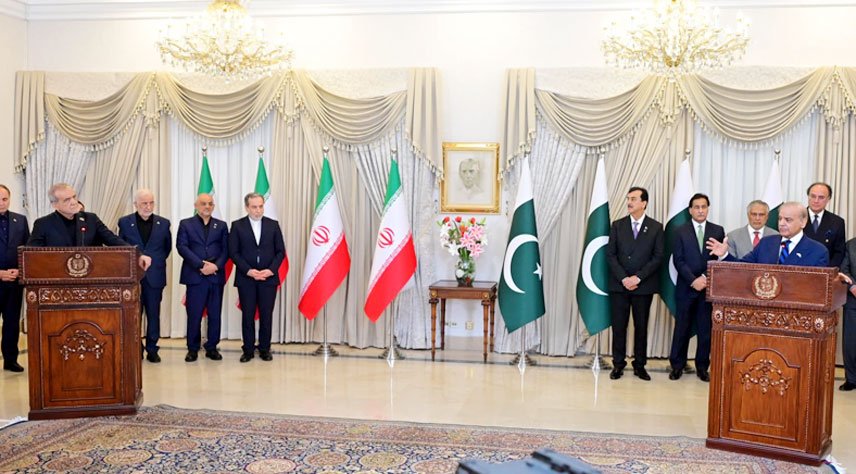
The Prime Minister made these remarks at a joint press stakeout with Iranian President Dr. Masoud Pezeshkian, held after delegation-level talks between the two sides. President Pezeshkian is in Pakistan on a state visit at the invitation of Prime Minister Shehbaz, accompanied by a high-level delegation of ministers and senior officials.
Shehbaz said both leaders were fully committed to standing firm against efforts to cast doubt on the peace process or undermine the ceasefire that could pave the way for lasting peace and prosperity in the region. He described his talks with the Iranian President as highly productive and warm in spirit, comparing the meeting to a family reunion between brothers speaking with complete honesty and a shared commitment to take their relationship to new heights.
He reflected on the history of Pakistan and Iran standing by each other in hard times, saying recent events had once again proved the durability of that friendship. Describing the moment as historic for Pakistan-Iran relations, the Prime Minister welcomed the successful conclusion of the Islamabad MoU between the United States and Iran the previous week, calling it a matter of relief that a conflict capable of engulfing the entire region and beyond had been brought to an end.
Prime Minister Shehbaz praised President Pezeshkian’s leadership throughout the process and underlined Pakistan’s role as an honest and impartial facilitator of the peace effort. He also announced that he would travel to Tehran the following week to pay his respects to the late Iranian Supreme Leader Ayatollah Ali Khamenei and reaffirm Pakistan’s solidarity with the Iranian people.
He paid tribute to Iran’s resilience in the face of recent hardships, extending condolences over thousands of lives lost and pledging Pakistan’s unwavering support. He expressed the bond between the two nations in deeply personal terms, saying that the joy and the pain of one country belonged equally to the other.
The Prime Minister thanked the Iranian leadership for trusting Pakistan to facilitate the peace process and credited both the Iranian and American delegations for engaging constructively in the technical talks held in Switzerland. He also acknowledged the encouragement provided by regional leaders — Qatar’s Emir Sheikh Tamim bin Hamad Al Thani, Saudi Crown Prince Mohammed bin Salman, Turkish President Recep Tayyip Erdogan, and Egyptian President Abdel Fattah el-Sisi — in pushing the peace effort forward.
President Pezeshkian, in his remarks, said Pakistan was not simply a neighbor but a brotherly nation tied to Iran through centuries of shared history, culture, and faith. He invoked the poetry of Allama Iqbal — whom he referred to as Iqbal Lahori — saying the poet’s call for Muslim unity remained as meaningful today as ever. He described the two peoples as sharing not just geography but a common destiny in their hopes, fears, and ambitions.
The Iranian President thanked Prime Minister Shehbaz Sharif, Field Marshal Asim Munir, Pakistan’s parliamentarians, and the Pakistani public for their solidarity with Iran throughout the recent conflict, saying that without their efforts the two leaders would not be standing together at that moment.
He said he had held productive meetings with the Prime Minister, President Asif Ali Zardari, and Field Marshal Munir, with both sides agreeing to use the current positive momentum to open a new chapter of cooperation and development.
Pezeshkian called for a stronger regional security architecture grounded in friendship, respect, and mutual understanding, arguing that peace, stability, and shared prosperity in the region can only be built through dialogue.
Both leaders also highlighted the importance of growing trade, deepening economic ties, and strengthening people-to-people connections, expressing confidence that the political will on both sides would carry the bilateral relationship to unprecedented levels.
Also Read: NA Speaker Defends Parliamentary Boundaries During Budget Session
During a question-and-answer session, both leaders flatly denied reports that Iran’s ballistic missile programme had featured in the Islamabad MoU negotiations. President Pezeshkian said Iran’s missile capability exists solely for national defense and was never part of any discussion.
Prime Minister Shehbaz backed this up, stating without qualification that ballistic missiles were not discussed, not mentioned in the MoU, and were not on the table at any point. He cautioned against deliberate misinformation aimed at derailing the peace process and reaffirmed that both countries would keep working together to ensure the initiative succeeded.
The press stakeout ended with both leaders embracing warmly, a moment that spoke to the close and enduring bonds between the two neighboring nations.

Sohail Majeed is a Special Correspondent at The Diplomatic Insight. He has twelve plus years of experience in journalism & reporting. He covers International Affairs, Diplomacy, UN, Sports, Climate Change, Economy, Technology, and Health.