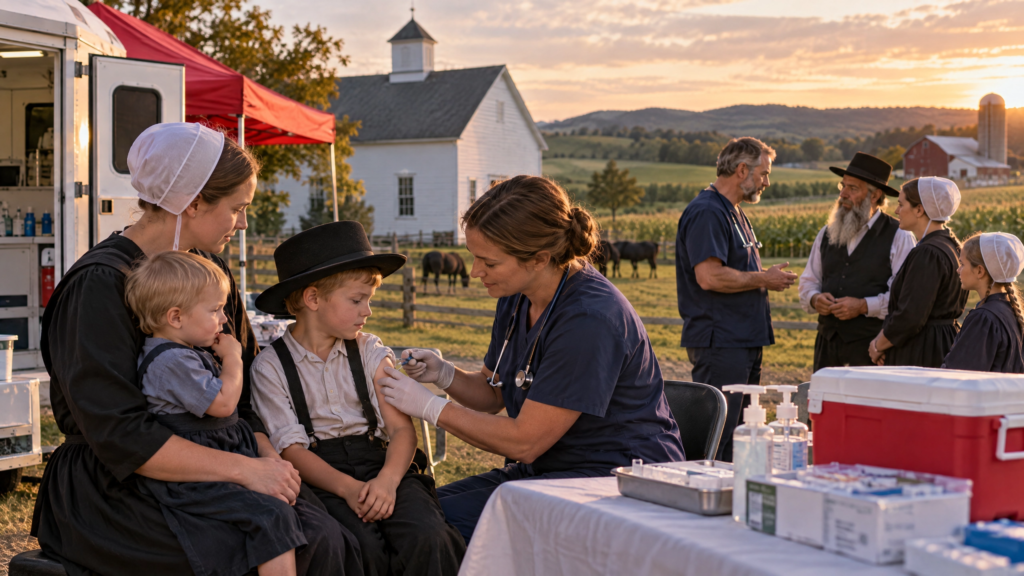
Ohio (GNP): Amish Measles Outbreak has prompted health workers and nurses to take an unusual approach to controlling the spread of the highly contagious disease, with medical teams visiting homes directly to provide information, identify possible cases and encourage vaccination.
The Amish Measles Outbreak has increased the need for direct communication between healthcare workers and families in affected communities.
This following reaction signifies mosaic being a major problem in Amish communities where vaccination levels have always been lower as opposed to other regions in the US. Nurses have been moving from house to house because it allows health care professionals to explain the dangers presented by measles directly to families.
The Amish Measles Outbreak has also highlighted the importance of reaching families who may have limited contact with conventional public health campaigns.
Measles is an extreme contagious disease which means that the virus spreads whenever a sick person coughs, sneezes or simply breathes. The disease is able to stay in air for some time or infect other surfaces. If a given person has not developed immunity, he will be infected after meeting people suffering from measles.
Because of the contagious nature of measles, the Amish Measles Outbreak requires health workers to focus on prevention and early identification of possible infections.
In the process of watching for outbreak prevention, communications has played a vital role. Instead of just making audio advertisements, nurses are visiting families and talking to them in person about the disease.
Communication has become an important part of the response to the Amish Measles Outbreak because nurses can address questions directly during their visits.
Door to door approach appears to give health care workers a better insight into the community. Families have a chance to ask questions and express their concerns about vaccinations.
The symptoms of measles usually consist of fever, cough, runny nose, and red/watery eyes, and it will be followed by a classic rash. Some individuals can heal without complications, but the ailment still can cause serious medical issues, especially in case of the little children and people with weak immunity.
During the Amish Measles Outbreak, recognizing these symptoms can help families seek appropriate medical guidance and reduce the risk of further transmission.
This is why health officials pay their attention to controlling the spread of the virus properly. Detecting those people who might be infected helps the workers in the health care sector recommend the necessary action.
Early detection remains an important part of managing the Amish Measles Outbreak and protecting people who may be more vulnerable to serious illness.
The vaccination is believed to be one of the most efficient methods of the prevention of the disease. The vaccination that protects from measles, mumps, and rubella makes the disease have fewer infections in the United States.
On the other hand, there are various things that can influence the decision to be vaccinated. Hence, clear communication is of paramount importance in the process of infection control.
The Amish Measles Outbreak demonstrates why clear and respectful communication can be important when health officials discuss vaccination and disease prevention.
There is a lot of diversity among the Amish and various approaches to health are common among different settlements. Therefore, it is important for health workers to know the specifics of the local situation in order to supply people with proper information about the risks of infection and the protection available.
The situation also shows that measles monitoring is crucially important in the USA. Although the disease was declared eliminated in the country in the year 2000, imported cases of measles may appear if the disease gets to people who have not developed immunity to it.
The Amish Measles Outbreak shows that continued monitoring remains important even after measles was declared eliminated in the United States.
Also Read: Ethiopian Embassy, AIOU Launch Green Legacy
Cases are monitored very carefully, and quite a number of infections can happen when unprotected members of a society can become infected. It follows that effective intervention, vaccination, and informing the public can help minimize the impact of the epidemic.
Effective intervention during the Amish Measles Outbreak can help health workers identify potential cases and reduce opportunities for further transmission.
Going from one apartment to another is a more personal approach to public health activities. Nurses are not simply handing out brochures or leaflets but talking to people and increasing their awareness of health issues.
This personal approach has become a notable feature of the response to the Amish Measles Outbreak.
Moreover, recognizing the signs of infection is crucial for families affected by the outbreak. Individuals displaying symptoms similar to measles should immediately contact their doctors before going to healthcare facilities so that necessary measures can be taken to minimize risks of spreading the disease.
During the Amish Measles Outbreak, families can play an important role by recognizing symptoms and following appropriate healthcare guidance.
This case illustrates the possibility of integrating traditional public health measures with the community’s involvement. Even though vaccination is the first and foremost method of preventing measles, using verbal communication can significantly contribute to the success of elders’ attempt to reach people who are usually difficult to find.
The case illustrates how complicated it can be to stop outbreaks of very contagious diseases, especially in close-knit communities. The healthcare professionals have to act promptly while being in touch with the elders.
The Amish Measles Outbreak demonstrates how vaccination efforts and direct community engagement can work together as part of an outbreak response.
While response activities continue, medical professionals will be focused on the identification of the potential cases of disease and will also provide people with necessary information aimed at stopping further spreads of disease.
The Amish Measles outbreak serves an example of how health care workers can go directly to communities, where traditional methods of communication fail to reach people.