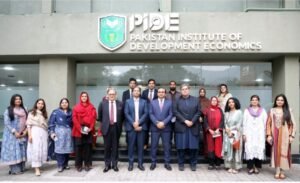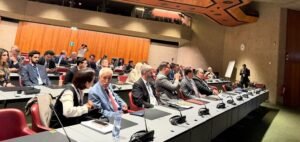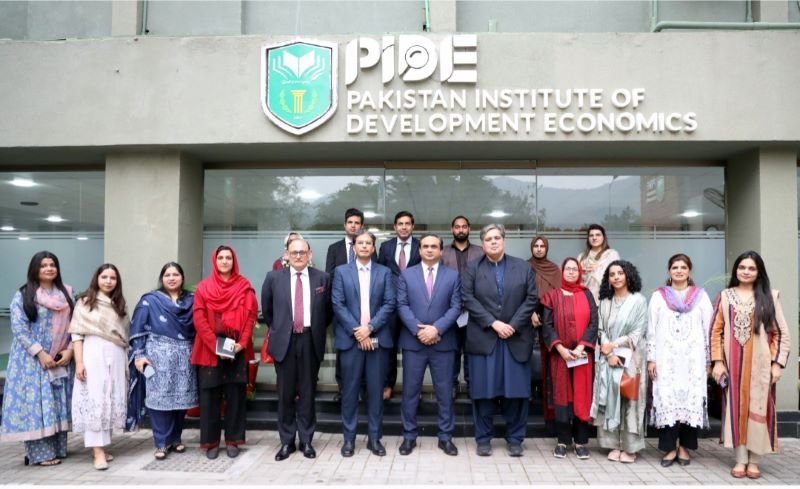
Islamabad (GNP): The Pakistan Institute of Development Economics (PIDE) held a roundtable titled “From Signing to Exporting: Exploring the Export-Promoting Role of Trade Agreements,” which gathered policymakers, trade experts, academics and private-sector representatives. The discussion was based on PIDE’s forthcoming report, “Trade Agreements of Pakistan: A Critical Review of RTAs’ Export Performance,” written by Dr Amjad Masood and Aneela Zubair of PIDE’s Center for Trade, Logistics and Infrastructure (CTLI).
Attendees included representatives of the WTO, the Economic Advisory Group, the Pakistan Business Council, APTMA, EXIM Bank of Pakistan, Pakistan Single Window, IBA and SPRC, among others. Dr Uzma Zia, Senior Research Economist at PIDE, moderated.
Dr Masood, PIDE’s Chief of Research and CTLI Director, presented the findings. Since 2000, imports from regional trade agreement (RTA) partners have grown much faster than exports, to the point where every dollar of imports is matched by only about 20 cents of exports. The report proposes an Export-Oriented RTA Framework with these elements:
- export-focused negotiation
- alignment with industrial policy
- demand-based selection of partners
- sanitary and phytosanitary (SPS) access alongside tariff cuts
- deeper agreements
- a KPI-based performance review at the Ministry of Commerce
It also compares the framework with Pakistan’s existing agreements, identifying the provisions already in place, the main gaps, and the clauses and actions needed to close them.
Dr Manzoor Ahmad, former Pakistani Ambassador to the WTO and Chair of the WTO Trade Dispute Arbitration Panel, welcomed the study as timely. He noted that Pakistan’s latest agreement, with Türkiye, covers only about 2% of its trade, and that apart from the one with China, none of Pakistan’s RTAs has succeeded. He blamed this partly on high domestic protection, which led business interests to push for weaker deals, and said negotiation and implementation matter as much as the concessions exchanged.
Dr Vaqar Ahmed, Member of the Economic Advisory Group and Team Lead at the Oxford Policy Unit, argued that zero tariffs alone will not sustain long-term growth, while a higher frequency of trade would. He proposed treating FTA offers as a step toward unilateral liberalisation even while talks continue, opening trade with all neighbours with a strong focus on connectivity, and bringing all provinces on board.
Dr Hassan Butt, Senior Advisor at CEEC, stressed economic diplomacy and coordination among ministries, observing that many MoUs signed through embassies are never implemented. Sarrah Javad of APTMA said the market access Pakistan secures often misses the tariff lines that matter to its exporters: Phase II of the China-Pakistan FTA added access on 313 tariff lines, but many cover products Pakistan does not export. Javed Kureishi, CEO of the Pakistan Business Council, called for clearly designated leads for review processes, backed by a proper follow-up protocol.
Sarmad Pretu of EXIM Bank of Pakistan named collateral requirements as a key obstacle to SMEs’ access to export finance and described how the Bank’s support for exporters has developed. Dr Zafar Mahmood, Professor at NUST, argued that Pakistan’s problem is not too few agreements but a failure to turn preferential access into export competitiveness, and called for more active economic diplomacy. Dr Adil Nakhoda, Chairperson of the EAG, urged Pakistan to pursue deeper agreements and lower its MFN tariffs to integrate into global value chains.
Also read: Pakistan Urged to Counter Regional Security Threats
Participants praised PIDE for bringing government, industry and academia together for a timely discussion. The insights will feed into the final version of the report.

Sohail Majeed is a Special Correspondent at The Diplomatic Insight. He has twelve plus years of experience in journalism & reporting. He covers International Affairs, Diplomacy, UN, Sports, Climate Change, Economy, Technology, and Health.