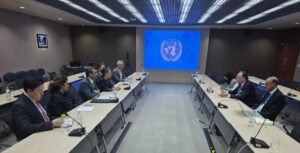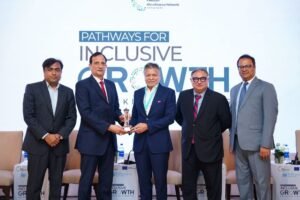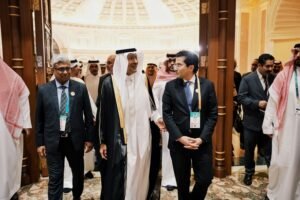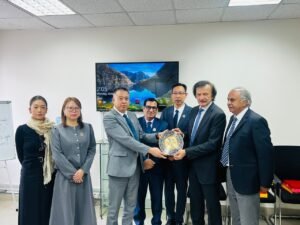
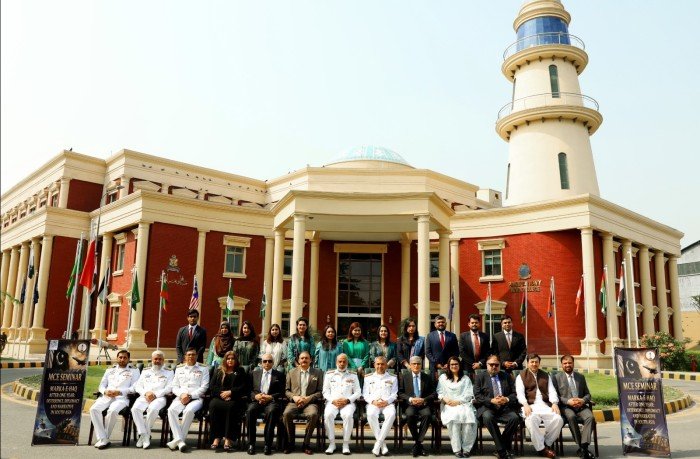
Lahore (GNP): A seminar titled “Marka-e-Haq After One Year: Deterrence, Diplomacy and Narrative in South Asia” was organised by the Maritime Centre of Excellence (MCE) at Pakistan Navy War College (PNWC), Lahore.
Vice Admiral Raja Rab Nawaz, Chief of Staff, Pakistan Navy, graced the occasion as Chief Guest. In his address, he remarked that during Marka-e-Haq, Pakistan Navy’s strategic acumen, professionalism, and unwavering resolve proved decisive in keeping the enemy at bay. He underscored that credible deterrence and a coherent national strategic narrative demand sustained engagement among military institutions, academia, media, and the diplomatic community.
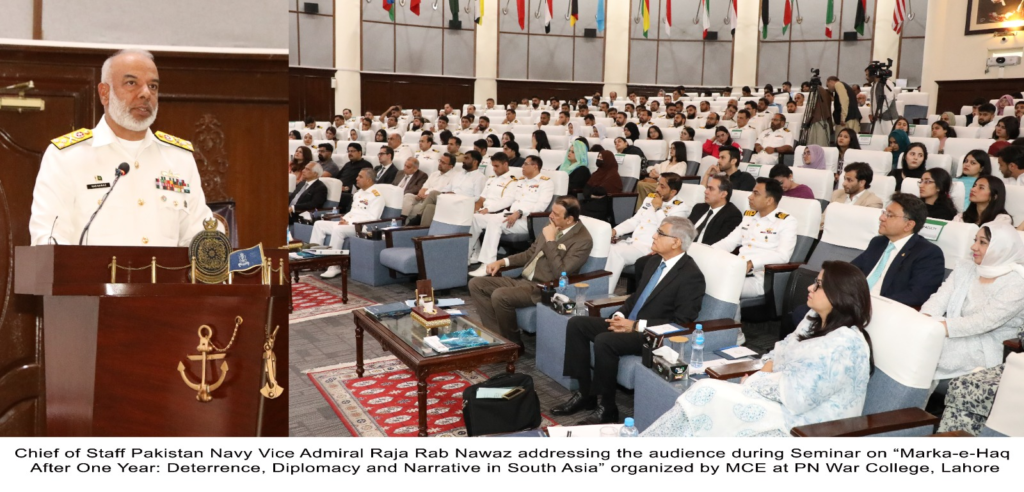
While addressing the gathering, President MCE Rear Admiral Sohail Ahmad Azmie highlighted the importance of objective and evidence-based assessment of Pakistan’s deterrence posture and diplomatic standing in the post-Marka-e-Haq regional environment.
Also Read: Nation, Armed Forces, Ever Ready to Defend the Motherland, Zardari
President MCE emphasized maintaining perpetual combat readiness against traditional & non-traditional challenges in the maritime domain. In the backdrop of the ongoing situation in the Middle East, he noted emerging threats in the maritime domain, including freedom of navigation, potential disruption to vital Sea Lines of Communication (SLOCs), and a volatile maritime security situation across strategic choke-points. Admiral stressed on acquiring niche and cutting-edge technologies as an absolute strategic necessity for the Pakistan Navy.
The seminar featured presentations by distinguished experts and was attended by military officials, senior diplomats, academics, media representatives, and university students. Organized to mark the first anniversary of Operation Marka-e-Haq, the event provided a multidimensional platform for open dialogue, bringing together diverse stakeholders to critically examine the strategic, diplomatic, and narrative dimensions of the operation. Speakers deliberated on lessons learned, regional stability mechanisms, and the evolving security architecture of South Asia. The seminar underscored the importance of institutional engagement between civil and military thought leaders in shaping a coherent national narrative in the aftermath of a defining moment in Pakistan’s defence history
Pakistan’s Resolute Response: Marka-e-Haq One Year On
One year after Pakistan’s landmark military response, the nation continues to reflect on the events of May 10, 2025, when the Pakistan Armed Forces launched Operation Bunyan-um-Marsoos, a swift and decisive retaliatory strike in response to India’s Operation Sindoor. The operation marked a defining moment in South Asian security history, demonstrating Pakistan’s unwavering resolve to defend its sovereignty and territorial integrity at all costs.
Pakistan has long maintained a doctrine of credible minimum deterrence, underpinned by a robust conventional and strategic defence posture. Rooted in decades of military professionalism and strategic restraint, Pakistan’s armed forces have consistently demonstrated their capability to respond to any act of aggression with measured yet effective force. The events of May 2025 reinforced this doctrine before the international community, establishing a new benchmark in regional deterrence.
When India launched Operation Sindoor under the pretext of counter-terrorism, Pakistan’s military leadership responded with calculated precision. Operation Bunyan-um-Marsoos delivered a powerful message that any misadventure against Pakistan would be met with a proportionate and resolute response. The operation was widely regarded as a successful demonstration of Pakistan’s multi-domain military capability, spanning air, land, and sea, and was executed with professionalism that drew acknowledgement from strategic observers worldwide.
Also Read: COAS Asim Munir Issues a Warning Against Aggression
The anniversary of Marka-e-Haq has since become a symbol of national pride, military preparedness, and diplomatic resilience. It also reignited broader conversations around deterrence stability, conflict escalation, and the urgent need for structured diplomatic engagement between nuclear-armed neighbours. As South Asia continues to navigate complex security dynamics, the events of May 2025 serve as a stark reminder that peace in the region must be built on mutual respect, strategic balance, and responsible statecraft.

Sohail Majeed is a Special Correspondent at The Diplomatic Insight. He has twelve plus years of experience in journalism & reporting. He covers International Affairs, Diplomacy, UN, Sports, Climate Change, Economy, Technology, and Health.