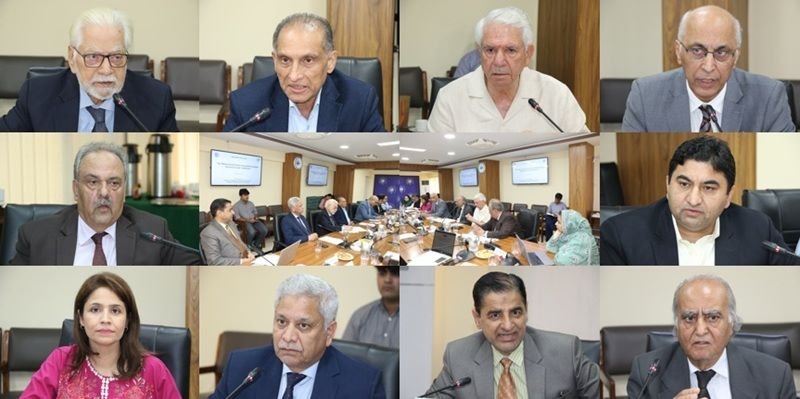
Islamabad (GNP): Institute of Strategic Studies Islamabad’s Centre for Afghanistan, Middle East and Africa (CAMEA) hosted a roundtable on the newly signed Makkah Joint Defence Agreement and its implications for the region’s security landscape. The session drew former diplomats, academics, and security analysts, who examined the pact’s likely effects and Pakistan’s evolving role within it.
Attendees characterized the agreement as an early move toward a wider security framework — one that could eventually expand to include additional states and help stabilize the region. They stressed that the pact is defensive in character and is not aimed at any particular country.
Pakistan, Saudi Arabia, and Türkiye signed the Makkah agreement on August 7, 2026, cementing a strategic realignment that has been building since Hamas’s October 2023 attacks. Aggressive actions by both Israel and Iran pushed the three nations closer together. The pact extends a mutual-defense agreement Pakistan and Saudi Arabia had already reached in September 2025, and it builds on an existing four-way consultative arrangement — the R-4 Group — that also includes Egypt.
At its heart, the agreement treats an attack on any signatory as an attack on all three. Turkish Foreign Minister Hakan Fidan has compared this clause to NATO’s Article 5, though he noted the specific response in any given case would be worked out collectively among the members.
The agreement responds to a region roiled by both Israeli and Iranian aggression. Israel struck Hamas figures in Doha and fought two separate conflicts with Iran within roughly a year — the 2025 Twelve-Day War and a 2026 campaign that also involved the United States. Iran, for its part, has hit back mainly at Gulf states, launching thousands of missiles and drones at civilian and military sites while disrupting shipping through the Strait of Hormuz.
Whether the pact will actually deter aggression remains uncertain. Earlier regional alliances — the Arab League’s 1950 joint defense treaty and the GCC’s 2000 defense agreement among them — largely failed to produce real cooperation. Even Pakistan’s bilateral defense pact with Saudi Arabia wasn’t enough to bring Islamabad into the 2026 war on Riyadh’s side early on; instead.
Pakistan helped Iran skirt a U.S. naval blockade by opening land routes across their border, while also acting as a mediator. Pakistani troops, jets, and air-defense systems didn’t arrive in Saudi Arabia until early April — more than a month into the war, right around when a ceasefire was reached.
How the alliance is institutionalized will likely determine its real-world impact. Fidan has floated a ministerial committee and a joint secretariat, but the depth of military integration — joint exercises, interoperable forces, shared command structures — will be the real test. Sudan offers one possible testing ground, since all three members already back the Sudanese Armed Forces there.
Perhaps the most sensitive unresolved issue is whether Pakistan would extend nuclear protection to its partners. Pakistani officials have wavered on this before: Defence Minister Khawaja Asif suggested last September that Pakistan’s nuclear arsenal “will absolutely be available” under the earlier bilateral pact, then walked that back days later, saying nuclear weapons were “not on the radar.”
That ambiguity may actually work in the allies’ favor by keeping adversaries guessing. The full text of the new trilateral agreement hasn’t been made public, and none of the three governments has directly addressed the nuclear question.
A more concrete avenue for collaboration may be joint defense manufacturing — talks on this front between the three countries date back to 2023. A Saudi official has pushed back on framing the pact as a military bloc or anything nuclear-related, describing it instead as an effort to build self-sufficient defense capabilities.
Riyadh has watched Türkiye and Pakistan develop domestic arms industries and wants to reduce its own dependence on Washington, which has long limited advanced weapons sales to Saudi Arabia in order to preserve Israel’s military edge. Turkish and Pakistani officials have already discussed defense-technology partnerships that could draw on Saudi financing.
Egypt’s decision to stay out of the pact is notable given its role in the R-4 Group. Cairo may simply be wary of binding commitments during a volatile period.
Also read: South Korea Shortens Joint War Games With US, Cites Washington Request
Egypt receives roughly $1.3 billion a year in U.S. military aid and has generally avoided friction with Israel, even as Israel has repeatedly breached the 1979 peace treaty — asserting control over Gaza’s Rafah crossing and stationing troops in the buffer zone along the Egyptian border. Cairo has instead positioned itself as a mediator with Iran and pressed Washington to de-escalate, despite having been hit by drone strikes — likely from Iran or its proxies — targeting LNG tankers at its Damietta port.

Sohail Majeed is a Special Correspondent at The Diplomatic Insight. He has twelve plus years of experience in journalism & reporting. He covers International Affairs, Diplomacy, UN, Sports, Climate Change, Economy, Technology, and Health.