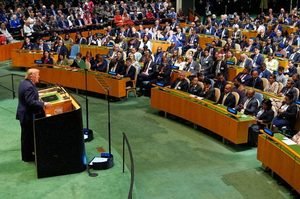
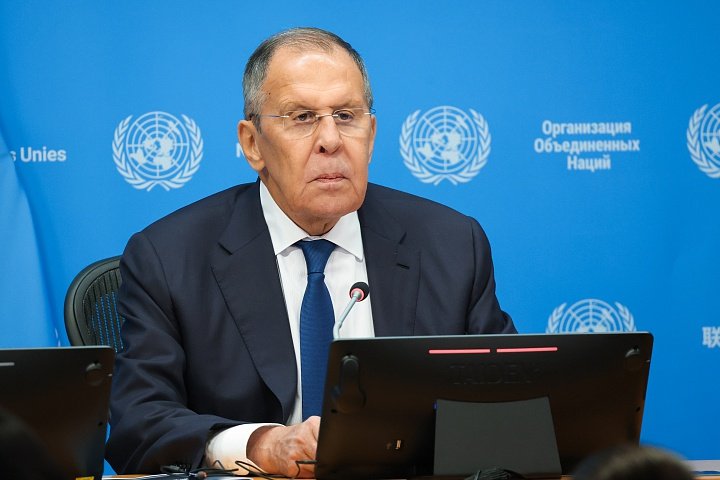
New York (GNP): Russian Foreign Minister Sergey Lavrov outlined Moscow’s positions on United Nations (UN) reform, the war in Ukraine, US and European relations, the Middle East, and Eurasian security in remarks and a question-and-answer session on the sidelines of the 81st UN General Assembly.
UN Security Council reform: Lavrov said the UN must adapt to current realities, including by expanding the Security Council with representatives from Asia, Africa, and Latin America. He rejected any additional seats for Western countries, arguing they are already overrepresented. He said Russia expects the next Secretary-General to serve all of humanity rather than a narrow “golden billion” and to meet the Charter’s standards of impartiality, objectivity, and competent administration.
Ukraine: Lavrov rejected claims that Russia lacks trust or avoids contact, saying bilateral talks continued in Istanbul and trilateral talks took place in Abu Dhabi with US involvement. He said Russia did not end any of these rounds and that the parties who did are now accusing Moscow of avoiding dialogue. He called the Islamabad Memorandum a fair deal, and suggested that since it was signed at the highest level, the parties should return to it.
Eurasian Charter: Russia is setting no artificial deadlines for the Eurasian Charter of Diversity and Multipolarity in the 21st Century, though Lavrov said he does not want the process to drag on, since the continent needs an open framework free of outside interference. An open-ended expert group of interested countries is being formed, with the first talks in Minsk before the end of the year and a second round in Moscow in the first half of 2027. Other countries have offered to host later consultations. Lavrov noted that Africa and Latin America have pan-continental structures, while Eurasia lacks an umbrella platform for regular exchange.
Russia-US relations: Lavrov said regular dialogue with the Trump administration is itself a sign of normality, but argued that daily condemnations of Russia and calls for its “strategic defeat” are not diplomacy. He said no country, even one as powerful as the US, can solve global problems alone or at others’ expense, and expressed confidence that reality would push Washington toward multilateralism.
Russia-Europe relations: Lavrov said he was tired of the topic, reiterating that Russia has no intention of waging war on Europe, which he called absurd, and claimed that it is Europe that is preparing for war with Russia.
UN Secretary-General race: Asked whether Russia would veto candidates, Lavrov said the word “fully” in an earlier official statement should not be over-parsed, joking that full agreement is found only in the grave. He said several candidates are worthy and have the necessary qualities.
Middle East and the Gulf: Asked about President Trump’s rejection of Iran’s seven-day plan, tensions in the Strait of Hormuz, Houthi control of Bab-el-Mandeb, and attacks on Saudi Arabia, Lavrov said such rejections are not new, pointing to the Islamabad Memorandum, which contained specific agreements signed at the highest level. He again argued the parties should revisit it.
Palestine: On the unimplemented Resolution 2803, endorsing the “Trump plan,” Lavrov said failure to implement Security Council resolutions is longstanding and stems from Western hidden agendas. He cited Resolution 1244 on Kosovo and Resolution 1515 on the Middle East roadmap and Palestinian state as earlier examples. He explained that Russia abstained on 2803 because of doubts, particularly the absence of any reference to the UN’s role, but did not veto it because most Arab states and the Palestinians asked it not to. China also abstained.
Responding to a question on the two-state solution, Lavrov agreed that the West Bank situation is deteriorating rapidly and that settlement decisions in East Jerusalem could sever Gaza from the West Bank, leaving no space for a Palestinian state. He noted that under Resolution 2803, most of Gaza would come under Palestinian entities overseen by the Board of Peace, though Palestinians currently control perhaps 20 percent of the territory. He stressed Russia’s long-standing advocacy of Palestinian unity, noting that Moscow hosted all 14 factions, who agreed to unite, and that China later did the same, but those agreements remained on paper because of internal divisions. He said Russia stands ready to help if there is interest, contrasting this with Western initiatives he described as staged events that produce no results.
Also read: Pakistan Chose Peace Over War; PM Calls for Kashmir, Palestine Resolution
S-400 and Türkiye: Lavrov said the S-400 systems were supplied under a contract requiring compliance with an end-user certificate, meaning they cannot be resold beyond Türkiye’s borders without Russia’s official consent. He said no such request has been made.

Sohail Majeed is a Special Correspondent at The Diplomatic Insight. He has twelve plus years of experience in journalism & reporting. He covers International Affairs, Diplomacy, UN, Sports, Climate Change, Economy, Technology, and Health.