Kashima, Japan GNP): Rescue workers in southern Japan continued to comb through collapsed buildings on Wednesday, a day after a powerful earthquake tore through Kumamoto prefecture, leaving at least 13 people dead and dozens more injured.
The quake, which struck on Tuesday with magnitude readings reported between 6.8 and 7.1 depending on the measuring agency, registered the highest level on Japan’s seismic intensity scale in some areas and was followed by more than 100 aftershocks.
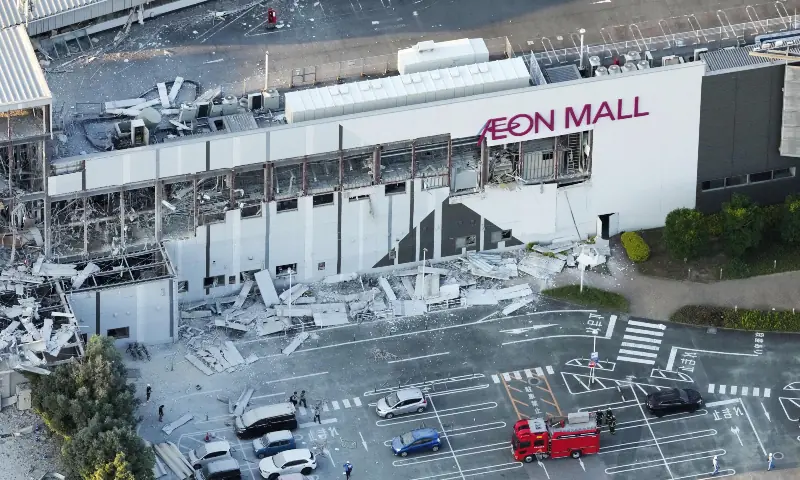
The disaster’s most visible scar was left at an Aeon shopping mall in Kashima town, where an explosion tore through the structure roughly an hour after the initial tremor. Eight people were pulled from the rubble there, three of whom later died, while mall operator Aeon confirmed that four employees remained unaccounted for after the company checked in with its roughly 2,700 staff members on site.
Authorities said they were still investigating whether a gas leak triggered the blast, with rescuers reporting the smell of gas inside the building even as the cause remained officially unconfirmed.
Not far away, seven workers went missing after a chimney collapsed at a Nippon Paper Industries factory, with four others seriously hurt in the same incident, according to a local government official.
Speaking to reporters in Tokyo, Prime Minister Sanae Takaichi described the recovery effort as a race against time, adding that people were still waiting to be pulled from the wreckage and that the government would commit every available resource to save those who could still be reached. More than 4,500 soldiers, alongside police and fire crews, have since been deployed across the quake zone to support the search.
The scale of displacement has been significant, with roughly 260,000 residents instructed to move to evacuation centres and more than 36,000 homes still without electricity as of Wednesday. That power loss has compounded the danger, since temperatures in the region have climbed to around 34 degrees Celsius, prompting warnings from officials about the added risk of heat stroke among displaced residents.
Hospitals across the prefecture have also come under strain, with one facility in Uki city reporting it could no longer function normally after the quake knocked out its power, forcing staff to operate more like a field hospital, while another nearby hospital said it had stopped accepting new patients after treating 86 injured people, three of them seriously.
The tremor’s epicentre was located about 20 kilometres south of Kumamoto City, a hub of roughly 700,000 people in central Kyushu that also suffered a devastating earthquake a decade ago. That 2016 disaster killed 275 people and damaged thousands of structures, including the walls of Kumamoto Castle, one of the region’s most visited landmarks. This week’s quake reopened some of those old wounds, damaging the castle further and cracking the walls of a centuries-old tea house along with several shrines known for their heavy tiled roofs.
Also Read: Japan, UNICEF strengthen partnership for Pakistan’s children
Industrial disruption followed swiftly as well, with major manufacturers including Sony, Renesas Electronics, Tokyo Electron and Honda halting operations at plants in the affected area as a safety precaution. Toyota extended similar caution to three of its factories outside Kumamoto, citing concerns about its supply chain in the region, while TSMC, the world’s largest contract chipmaker, briefly evacuated staff from its local facility before resuming operations later on Tuesday. Bridges and roads across the prefecture also buckled under the strain, including a section of a bridge that collapsed into the Kumagawa River, drawing residents to the site even as authorities urged caution.
Japan’s seismic officials have cautioned that the risk of further strong aftershocks and landslides is likely to persist for about a week in the hardest-hit areas, including Yatsushiro city, where cracked roads and damaged homes have left many local businesses shuttered. Given Japan’s position along the Pacific “Ring of Fire,” where roughly one-fifth of the world’s earthquakes of magnitude 6.0 or higher occur, officials say the country remains on alert as recovery work continues.

Managing Editor at Global News Pakistan (GNP), with a Bachelor's degree in International Relations from Riphah International University, graduated with a Gold Medal. Reach out at sabahtareengnp@gmail.com