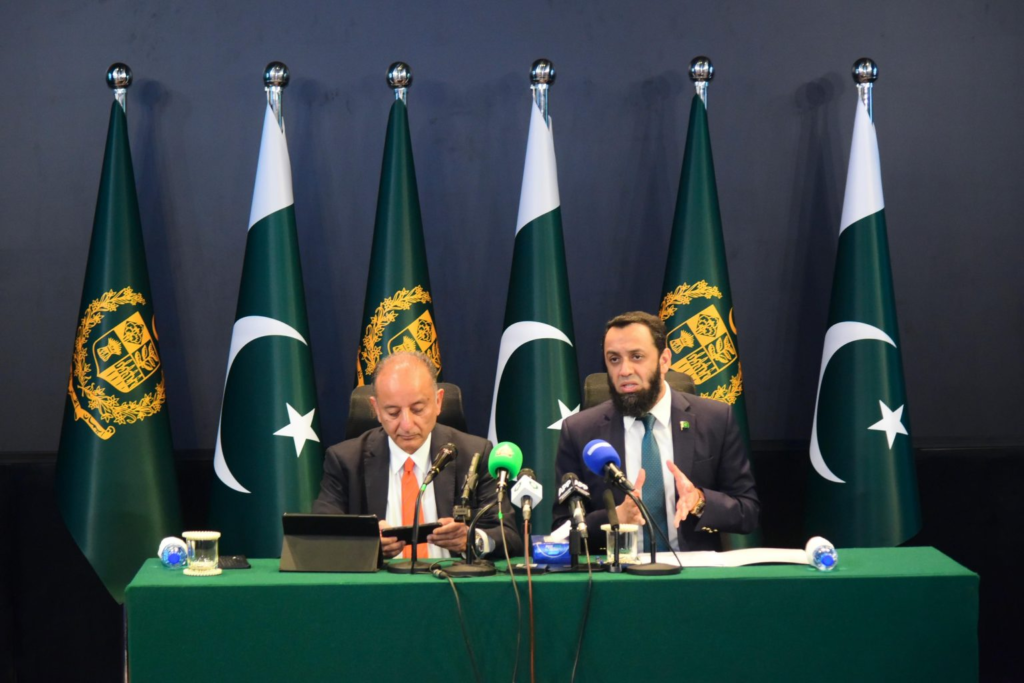
The international seminar held in Islamabad on June 30, 2026, titled “Indus Waters Treaty: An Instrument of Peace and Regional Stability,” stands out as one of Pakistan’s most effective recent exercises in public diplomacy. Organized by the Ministry of Information and Broadcasting together with the Institute of Regional Studies at the Jinnah Convention Centre, the seminar brought together Pakistani leadership and international scholars to present a unified, fact-based case on the Indus Waters Treaty.
The result was a carefully constructed platform that projected Pakistan not as an aggrieved party making noise, but as a responsible state defending an internationally binding agreement through law, diplomacy, and restraint. This is precisely the kind of soft image Pakistan needs on the world stage, and the seminar delivered it with discipline.
A Treaty, Not a Quarrel
What made this seminar so effective as an image-building exercise was its choice of subject. The Indus Waters Treaty is not a contested political claim; it is a World Bank-brokered international agreement that has held for more than six decades. By centering the entire event on this treaty, Pakistan placed itself on the strongest possible legal ground while simultaneously addressing an issue that touches the daily lives of 240 million people, as Federal Minister for Information Attaullah Tarar emphasized in his opening address.
Tarar described the Indus as Pakistan’s lifeline and stated that the treaty cannot be amended, revoked, suspended, or held in abeyance unilaterally, since it came into being through mutual consensus and can only be amended the same way. He further noted that India’s attempt to unilaterally hold the treaty in abeyance has led to international embarrassment for India at various forums, including legal ones. This framing immediately set the tone for the day: Pakistan as the custodian of an agreement under threat, not as a party seeking conflict.
Legal Credibility as the Centerpiece
The strongest pillar of the seminar’s soft image strategy was its legal argumentation, delivered most forcefully by former Federal Law Minister Ahmer Bilal Soofi. Soofi explained that under international law, no state holds absolute or exclusive title over shared water resources, and that rivers crossing international borders are part of the global commons that must be used equitably by all riparian states, a principle reflected directly in the Indus Waters Treaty.
He stated clearly that India’s declaration of placing the treaty “in abeyance” has no legal standing under international law or the Vienna Convention on the Law of Treaties, describing the move as an effective admission of breaching treaty obligations. This is a powerful argument for international audiences, because it does not rely on emotion or political rhetoric. It relies on established legal doctrine, and it positions Pakistan as the party upholding international norms.
This legal framing was reinforced by Pakistan’s Commissioner for Indus Waters, Syed Mehar Ali Shah, who detailed Pakistan’s continued compliance with treaty mechanisms even as India has gone silent. He noted that Pakistan transmitted its draft annual report and sought consultations under Article 9 during the 2025-26 treaty year, yet received no response from the Indian side.
He pointed out that no meetings of the Permanent Indus Commission have been held since May 2022, no inspection tours conducted, and that monthly data exchange has been suspended. Shah stressed that Pakistan’s restraint has been deliberate, but that water, food, livelihood, and social stability are not negotiable abstractions.
He also confirmed that Deputy Prime Minister and Foreign Minister Ishaq Dar briefed the diplomatic corps, the President of the UN Security Council, and the President of the UN General Assembly, while Pakistan’s Permanent Representative to the UN formally transmitted the record to the Security Council. Few narratives build international credibility as effectively as a documented, procedural record of compliance paired with active engagement at the United Nations.
International Voices Lending Global Weight
A seminar of domestic officials speaking to a domestic audience would have limited reach. What elevated this event was the presence of independent international experts willing to validate Pakistan’s position. Dr. Roxelana Zegon, Head of the Scientific Centre of International and Strategic Studies at the University of World Civilization in Moscow, stated that India is weaponizing water through infrastructure projects and that all Indian unilateral actions, including constructing dams and shrinking water supplies, threaten Pakistan’s food security and economic stability.
She further cautioned that reduced data sharing and lack of coordination are increasing uncertainty and crisis volatility in South Asia, and urged both sides to pursue diplomatic resolution given the dangers of escalation between two nuclear-armed states.
Dr. Victor Gao, a prominent Chinese scholar and diplomat, offered a memorable and quotable line of moral reasoning, advising India to follow the principle of not doing to others what it would not want done to itself, and stressing that water-sharing agreements like the Indus Waters Treaty only function when both sides respect the spirit of the agreement and avoid unilateral actions.
The participation of voices from both Russia and China at this seminar matters strategically, because it shows that concern over India’s conduct on the Indus Waters Treaty is not confined to Pakistan alone, but is shared by independent observers from major global powers.
Humanizing the Policy Debate
Beyond law and diplomacy, the seminar’s most emotionally resonant contribution came from Federal Minister for Climate Change Musadik Malik, who grounded the abstract treaty debate in the lived experience of ordinary Pakistanis. Malik highlighted the story of farmer Iqbal Solangi, who has been repeatedly displaced and suffered heavy losses due to devastating floods, and connected this experience to similar struggles faced by river-dependent communities in Bangladesh, Africa, and elsewhere.
Malik argued that water insecurity stems not only from climate change but significantly from upstream control of river flows, citing sharp and unnatural fluctuations in river levels as evidence of unmanaged or externally influenced water regulation. He framed the issue as one of justice, where millions of Pakistanis suffer despite having no control over critical water decisions made upstream.
Malik also emphasized that Pakistan’s economy, agriculture, and food security are heavily dependent on predictable Indus flows, regretting what he described as the manipulation of water flows by the neighbouring country, and calling for a covenant that imposes economic, political, and diplomatic consequences on states found to be manipulating water flows to the detriment of downstream countries. This human dimension does more for Pakistan’s image internationally than any statistic alone could, because it invites empathy from audiences far beyond South Asia who can recognize the universal stakes of water security.
Firmness Without Forfeiting the Moral High Ground
What is notable throughout the seminar’s proceedings is that even the firmest statements were framed around defending an existing legal agreement rather than initiating confrontation. Attaullah Tarar stated plainly that any attempt to block or stop Pakistan’s water will always fail, and that if any attempt is made to stop the water of Pakistan, the country’s leadership stands resolved to respond effectively to restore it for the people of Pakistan. He also stressed that the weaponization of water or attempts to unilaterally alter established arrangements undermine not only regional peace and stability but also the broader framework of international law, and reaffirmed that Pakistan has consistently demonstrated commitment to peaceful engagement, constructive dialogue, and faithful implementation of the treaty.
This combination, resolve paired with a consistent emphasis on dialogue, law, and restraint, is precisely the posture that earns credibility with international audiences. It allows Pakistan to demonstrate seriousness about protecting its rights without appearing to seek escalation, which is a difficult balance that this seminar managed to strike consistently across every session.
A Coordinated and Effective Diplomatic Exercise
Structurally, the seminar’s design reinforced its message. Sessions chaired by senior figures such as Khurram Dastagir Khan and Hina Rabbani Khar, both former federal ministers with established foreign policy credentials, gave the event the gravity of a serious policy forum rather than a press conference.
The agenda moved deliberately from the treaty’s legal and institutional foundations in the first session to the practical perils of non-cooperation in the second, ending with a closing session and a clear consensus message that preserving the Indus Waters Treaty is essential for peace and stability in South Asia. This structure, combined with extensive local and international media coverage, allowed Pakistan to globalize an issue that might otherwise have remained a narrow bilateral dispute, and to do so on terms that consistently favored its own legal and moral position.
Also Read: Pakistan Post Honors Sadequain with Commemorative Stamp
Taken as a whole, the Indus Waters Treaty seminar represents a model of how Pakistan can build a positive international image without compromise or apology. By grounding its case in established international law, by securing validation from credible international scholars in Russia and China, by humanizing the stakes through real stories like that of farmer Iqbal Solangi, and by consistently pairing firm resolve with an emphasis on dialogue and restraint, Pakistan presented itself to the world as the principled defender of a treaty under threat.
For a country that has often struggled to control international narratives in its rivalry with India, this seminar offers a clear template: lead with law, bring in independent global voices, and never lose sight of the human cost behind the policy debate. If sustained, this approach has the potential to shift how the world perceives Pakistan’s position on the Indus Waters Treaty, from a regional grievance to a defense of international law itself.