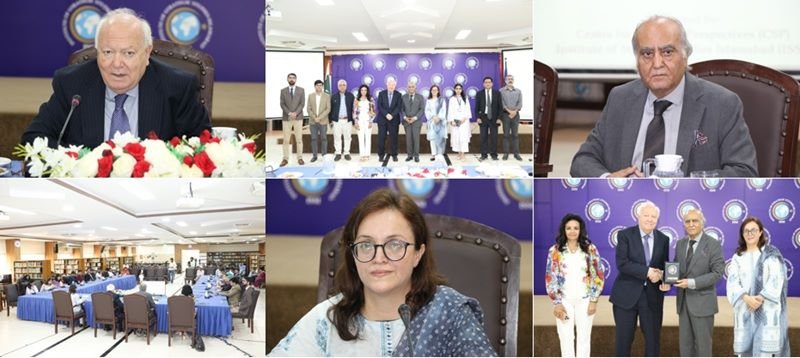
Islamabad (GNP): The Centre for Strategic Perspectives (CSP) at the Institute of Strategic Studies Islamabad (ISSI) recently held a public lecture featuring Miguel Ángel Moratinos, the United Nations High Representative for the Alliance of Civilizations (UNAOC), who also serves as the UN’s Special Envoy on combating Islamophobia.
Opening the event, Dr. Neelum Nigar pointed out that UNAOC’s mission still carries significant weight today, since its focus on cross-cultural and interfaith dialogue lines up closely with Pakistan’s long-standing dedication to coexistence, religious tolerance, and constructive global engagement.
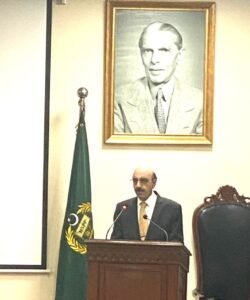
In his welcoming remarks, Ambassador Khalid Mahmood warned that the world is seeing a troubling surge in division along identity lines, alongside rising religious intolerance, hate speech, and extremism, with less and less room left for genuine dialogue.
He noted that Islamophobia in particular has grown from scattered incidents of bias into a global problem that undermines core values like equality, dignity, and freedom of belief. Pointing to the increase in anti-Muslim sentiment, attacks on mosques and other religious sites, and biased media narratives, he cited both the situation in India and the ongoing crisis in Gaza as examples that have sparked international alarm over religious discrimination.
He reaffirmed Pakistan’s consistent stance that no religion should be linked to terrorism, and no community should face hostility because of the actions of a small minority. He also recalled that Pakistan played a key role in getting the UN General Assembly to establish the International Day to Combat Islamophobia, and welcomed the creation of the UN Special Envoy position on this issue. He closed by stressing that genuine peace can only come through mutual respect and cultural dialogue, praising UNAOC’s contribution to building understanding and resilience against extremism.
In his keynote, Moratinos said the global order is at a critical turning point, shaped by deepening political fragmentation, weakening trust in multilateral bodies, and a growing list of cross-border problems. He argued that rebuilding dialogue and trust in international institutions isn’t just a nice-to-have anymore, it’s now essential for maintaining peace and security worldwide.
He called on world leaders to choose cooperation over confrontation as the world undergoes major shifts, and warned that global conversations have become too focused on narrow security concerns, pushing the broader goal of lasting peace to the margins. According to Moratinos, ongoing conflicts, deepening inequality, climate change, and the fast pace of AI development are all reshaping the world order, and while AI holds real promise, he stressed it also raises serious ethical and governance questions that demand careful, coordinated oversight.
Moratinos went on to say that today’s biggest challenges, climate change, terrorism, pandemics, AI, and sustainable development, don’t respect national borders and can’t be solved by any one country acting alone. He framed the central question of this century not as a competition between nations, but as a test of whether they’re willing to work together. He maintained that multilateral cooperation remains the only realistic path forward for tackling shared problems, calling dialogue essential to building a more stable and prosperous future.
Turning to concerns about rising polarization and the spread of false information, Moratinos cautioned against framing diversity as a source of conflict rather than one of humanity’s biggest assets. He argued that societies built on pluralism and mutual respect are far better equipped to head off conflict, resist extremism, and maintain peace — and credited UNAOC with playing a central role in fostering that kind of cross-cultural understanding.
Also Read: Artificial Intelligence Drives Intel Innovation for America
On Pakistan specifically, Moratinos noted that the country’s geographic position, diplomatic engagement, and role connecting different regions and civilizations give it a unique opportunity to help address global problems. He praised Pakistan’s long history of supporting the UN, including its substantial contributions to peacekeeping missions, and pointed to the country’s rich cultural history as a source of valuable lessons on dialogue and mutual understanding.
He wrapped up his address by calling for a renewed commitment to multilateralism in light of today’s shifting, increasingly multipolar world, suggesting that countries like Pakistan have a growing role to play in promoting inclusive diplomacy and intercultural understanding. He closed by reaffirming that dialogue remains the most powerful tool available for rebuilding trust and working toward a more unified, peaceful world.

Sohail Majeed is a Special Correspondent at The Diplomatic Insight. He has twelve plus years of experience in journalism & reporting. He covers International Affairs, Diplomacy, UN, Sports, Climate Change, Economy, Technology, and Health.