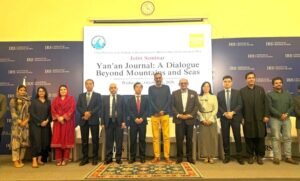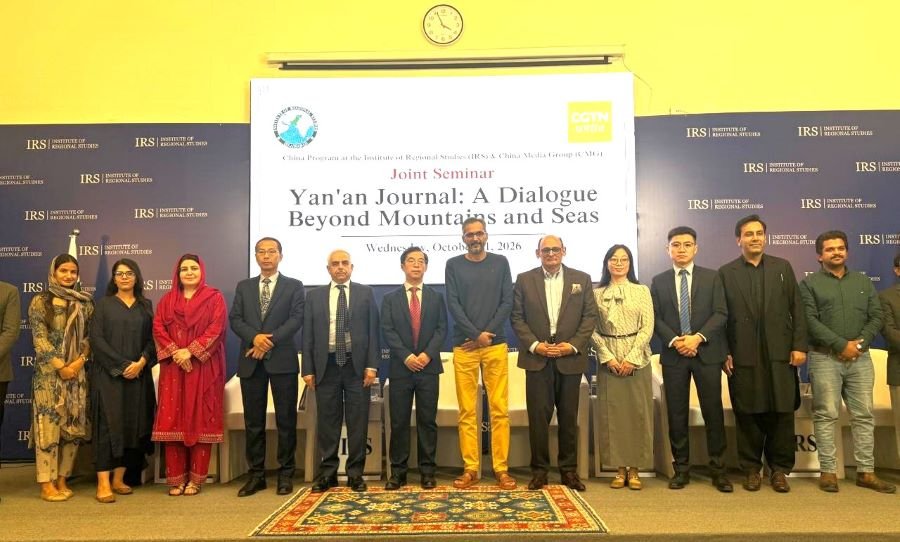
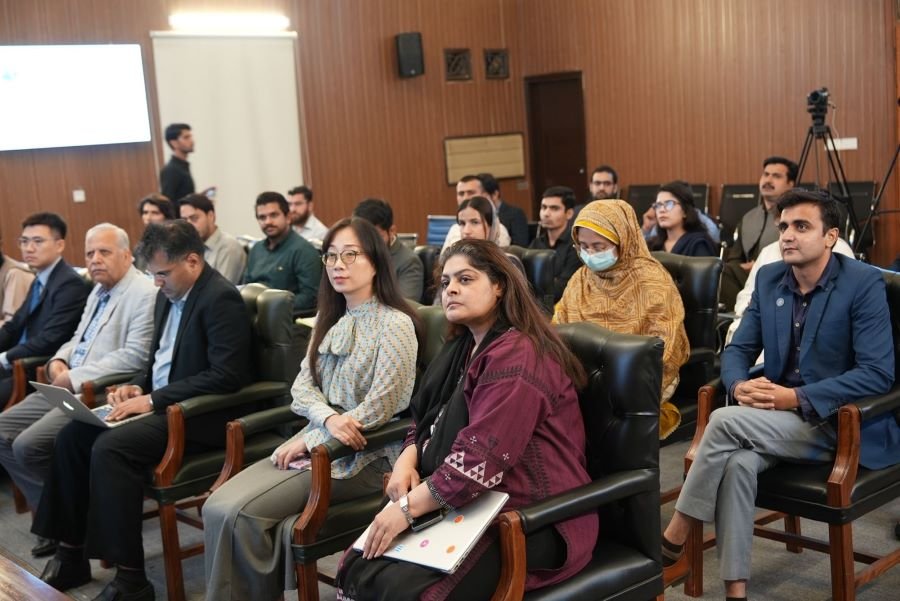
ISLAMABAD (GNP): The China Program at the Institute of Regional Studies (IRS), working with China Media Group (CGTN Urdu), hosted a seminar titled “Yan’an Journal: A Dialogue Beyond Mountains and Seas.” Chen Peng, Cultural Counsellor at the Chinese Embassy in Pakistan, was guest of honour. The panellists were Shakeel Ahmad Ramay, CEO of the Asian Institute of Eco-civilization Research and Development (AIERD), and Dr Hassan Daud Butt, Associate Professor at Bahria University, Islamabad.
Nabila Jafer, Senior Research Analyst and Head of the China Program at IRS, moderated. She noted that 2026 marks 90 years since the Long March of 1934-35 and 75 years of Pakistan-China diplomatic relations. The idea that each generation faces its own Long March, she said, runs through the film shown at the event, and she asked the panellists to consider how perseverance, unity, integrity and service to the people shape Party building in the New Era and China’s goals of national rejuvenation, harmony between humanity and nature, and a community with a shared future for humankind.
Calling the Pakistan-China friendship exemplary, she said the seminar offered another chance to deepen mutual understanding.
The seminar began with a 20-minute CGTN Urdu documentary following international visitors, Ramay among them, as they retraced the Long March and visited Yan’an. It recalls the Red Army’s hardships before turning to modern China, including the story of a young graduate who went home to grow his family’s apple business through e-commerce.
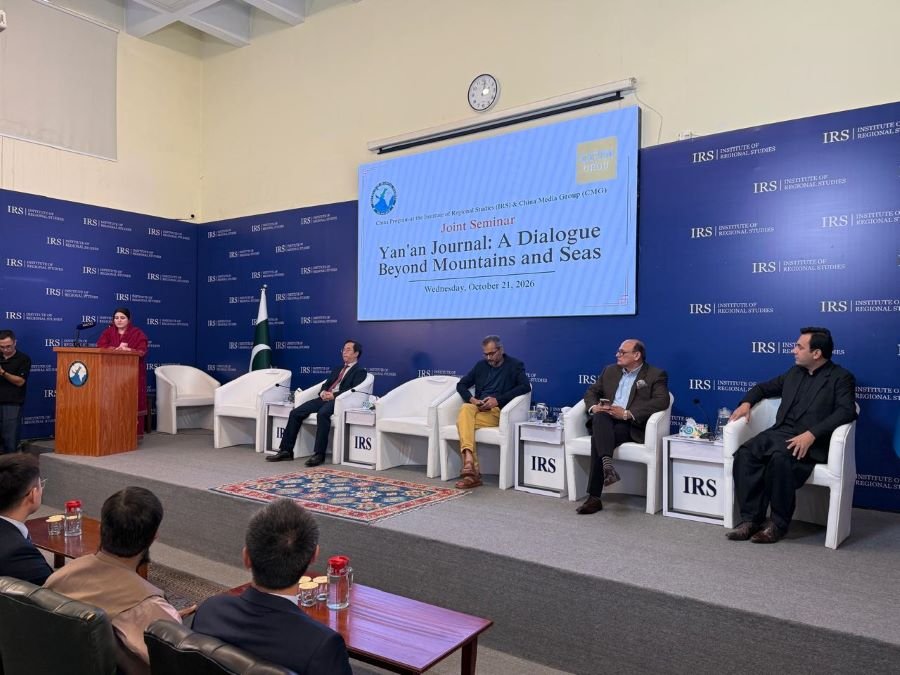
In a message to the event, Federal Minister Aurangzeb Khan Khichi said preserving heritage means more than protecting sites and artefacts: the experiences, stories and values that shape a nation’s identity must also be handed on. Documentaries about events such as the Long March, he said, help convey that history and its spirit of commitment, sacrifice and perseverance to young people.
Ramay said the maxim that every generation has its own Long March reflects real dedication to a cause, the people and the country. Of the 86,000 who set out on the march, he said, only about 6,000 survived. It helped forge a new Communist Party of China, he argued, instilling ideological commitment, fearlessness, equality between leaders and comrades, discipline and a distinct collective identity. He pointed to Chairman Mao Zedong’s rules of conduct for the Red Army, such as speaking politely and paying for anything taken, as examples of a people-centred approach.
Today’s generation, he said, is responsible for building a modern socialist country with Chinese characteristics, advancing national rejuvenation, strengthening ideological commitment and national identity, and promoting a community with a shared future for humankind, which requires sustained work on Party building in the New Era. He also urged Pakistani students in China to learn Chinese.
Dr Butt said dialogue between nations should be frank and open, and that lasting friendship rests on mutual understanding extending beyond official meetings to cultural centres and the media. He attributed China’s transformation in under four decades to pragmatic leadership, policy continuity, a shared public vision and a whole-of-government approach. Development alone cannot guarantee peace, he cautioned, but inclusive development offers a firmer foundation for it. He also stressed the middle class’s role as an engine of growth.
Chen Peng thanked IRS and underlined the Long March’s historical importance. He called the building of the Karakoram Highway in the 1960s another long march, undertaken jointly by the two countries, noting that about 130 Chinese engineers died in its construction and 88 are buried in a cemetery in Gilgit.
He described the China-Pakistan Economic Corridor (CPEC), launched in 2013, as a further stage of the shared journey. Forty-three projects have been completed, drawing roughly US$25 billion in investment. Seventeen energy projects added 8,900 megawatts of generating capacity and created about 200,000 direct jobs. CPEC is now entering a second phase focused on industrial cooperation, modern agriculture, the digital economy and green energy. He added that the Khunjerab Pass stays open all year and that about 36,000 Pakistani students study in China.
Also read: Ball in Putin’s Court as Witkoff Lands in Russia
Asked how Pakistan’s young people can draw inspiration from the Long March, Chen said harmony and peace are central to Chinese culture and that success depends on uniting ordinary people around a shared belief. The panellists urged young people to embrace struggle and hard work and to turn information into knowledge and wisdom. Dr Butt named productivity, long-term policy continuity and skills development as essential, and encouraged Pakistan’s youth to aim for 2047 as a milestone for a more prosperous country.

Sohail Majeed is a Special Correspondent at The Diplomatic Insight. He has twelve plus years of experience in journalism & reporting. He covers International Affairs, Diplomacy, UN, Sports, Climate Change, Economy, Technology, and Health.