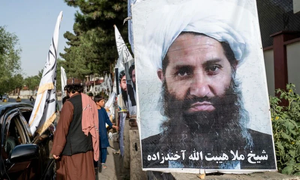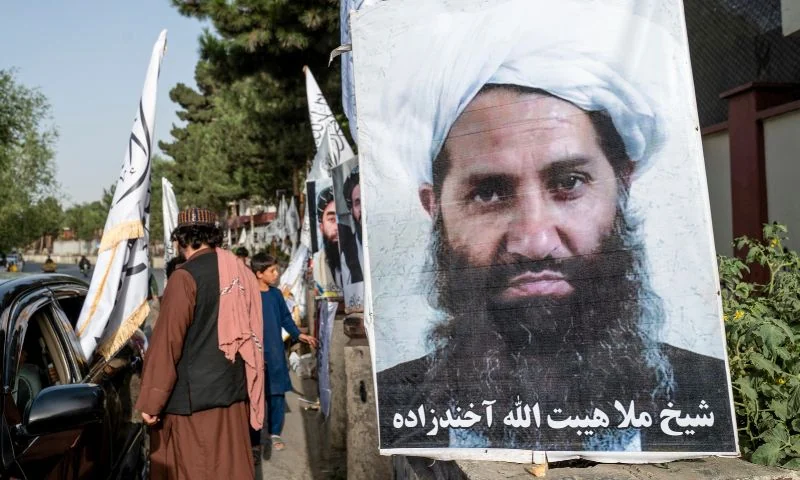
Kabul (GNP): Taliban supreme leader Hibatullah Akhundzada traveled to Kabul on November 17, a rare trip that has put fresh focus on the secretive cleric whose decrees now shape almost every part of Afghan life.
He is based mainly in Kandahar and seldom appears in public. The visit was one of only a few he has made to the capital since he took charge of the movement in 2016, and it came with a heavy security operation around a conference on the impact of his decrees.
Journalists reported snipers on buildings near Kabul University, dozens of Humvees at its gates and intelligence agents posted in the area. Staff and students said the campus had been closed since Sunday, while residents said their homes were searched.
The Ministry of Higher Education said thousands of officials and religious scholars attended. Participants were asked to hold hands and renew their pledge of allegiance before he arrived.
That level of control reflects how power is organized under his leadership. Akhundzada became Taliban leader in May 2016 after the death of Mullah Akhtar Mansour, and he had served the movement as a religious scholar and chief justice rather than a battlefield commander.
Authority is now concentrated among hardline clerics around him in Kandahar. Officials in Kabul who favor international engagement have struggled to influence policy. The International Crisis Group has described this as an internal contest, with women’s rights emerging as a central point of dispute.
The cost of that contest has fallen most heavily on women and girls. Girls have been barred from formal education beyond sixth grade since 2021, and women have been excluded from universities since December 2022. Many jobs are also closed to women, and their ability to travel is limited.
Enforcement has tightened as well. The UN Assistance Mission in Afghanistan (UNAMA) said it verified that at least 52 women and one girl were arrested or detained in Kabul and Herat between July and September 2026 over alleged violations of dress rules. A 2024 law on promoting virtue and preventing vice set out many of these rules on dress, movement and public conduct.
The UN special rapporteur on Afghanistan warned in September 2026 that these policies deprive children of education and curb free expression. The rapporteur described the system as one of institutionalized discrimination, repression and ideological control. The Taliban defend their policies as a stricter reading of Islamic law.
Also Read: PM Seeks Stronger Pak – Türkiye Energy Cooperation
The pressure has also become legal. The International Criminal Court issued an arrest warrant for Akhundzada on July 8, 2025, over the alleged crime against humanity of gender-based persecution. The court said there were reasonable grounds to believe he and chief justice Abdul Hakim Haqqani ordered or induced persecution of women and girls. The allegations are not convictions, and the case remains before the court.
Security concerns add to the scrutiny, particularly in Pakistan. A UN monitoring team reported in February 2026 that the Taliban authorities continued to allow a permissive environment for several terrorist groups, notably Tehrik-e-Taliban Pakistan (TTP). The team also said al-Qaeda benefits from the authorities’ patronage and trains other groups, including the TTP.
Islamabad has repeatedly accused Kabul of letting the TTP operate from Afghan soil, while the Taliban deny that any group uses Afghanistan as a base against other countries. The dispute remains a major source of tension, with militant attacks and cross-border clashes threatening regional stability.
At the conference, Akhundzada urged the audience to make people love the supreme leader so that they would obey and follow his decrees, according to a government live audio feed.

Managing Editor at Global News Pakistan (GNP), with a Bachelor's degree in International Relations from Riphah International University, graduated with a Gold Medal. Reach out at sabahtareengnp@gmail.com