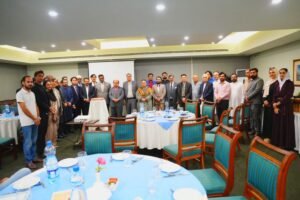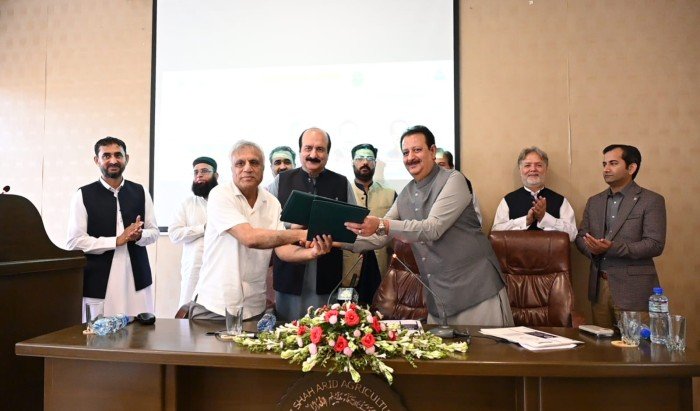
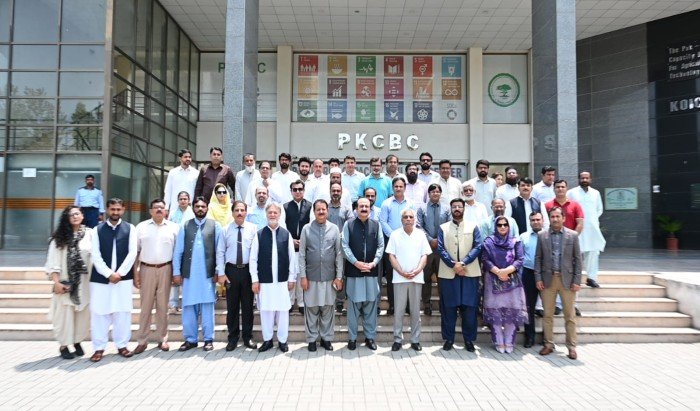
Islamabad (GNP): Prime Minister’s Youth Programme (PMYP) Chairman Rana Mashhood Ahmad Khan attended the launch of the Climate Resilient Peanut Value Chain Development for Rural Enterprise and Economic Graduation Project, marked by the signing of a partnership agreement between the Pakistan Poverty Alleviation Fund (PPAF) and Pir Mehr Ali Shah Arid Agriculture University Rawalpindi (PMAS AAUR).
Addressing the ceremony as chief guest, Rana Mashhood said the government is channelling significant resources into education, technical skills, innovation, and agricultural research with the goal of building a knowledge-driven economy and equipping Pakistani youth for the demands of an increasingly competitive global landscape.
He urged universities to look beyond traditional degree programmes and embed technical qualifications, professional certifications, and industry-oriented skills into their curricula, ensuring graduates remain relevant in fast-evolving international job markets.
On the technical education front, Rana Mashhood said the government, working alongside NAVTTC and prominent Chinese institutions, has rolled out 21 modern technical trades calibrated to meet international industry standards. In parallel, nearly 50 Pakistani universities are being linked with Chinese counterparts to advance research collaboration, technology transfer, and academic exchange.
He announced plans to train up to 10,000 young people in advanced agricultural technologies, adding that a leading Chinese agricultural university would team up with PMAS AAUR and other Pakistani institutions to develop cutting-edge research facilities and drive joint scientific inquiry.
Drawing a parallel with the success story of Pakistan’s olive industry, he said targeted interventions in the peanut sector held similar potential to raise farmer incomes, grow agribusiness, and expand the country’s export base.
He also pointed to expanding employment horizons for Pakistani youth in Japan, South Korea, Europe, the United States, Canada, the UAE, and other global markets.
The project, funded by PPAF and to be implemented with technical support from PMAS AAUR, will initially cover peanut-growing areas in Gujar Khan, Rawalpindi district, and Fateh Jang, Attock district. Over three years, it aims to advance climate-smart agriculture, raise productivity, strengthen value addition, develop rural enterprises, generate employment, and lift farmer incomes through research, innovation, and improved market linkages.
PPAF Chief Executive Officer Nadir Gul Barech, attending as guest of honour, called the agreement the start of a strategic collaboration that brings together research, entrepreneurship, and community development to reshape Pakistan’s rural economy.
Reflecting on PPAF’s track record since its founding in 1997, Barech said the organisation has extended its reach to 150 districts through more than 164 partner organisations. Its achievements include mobilising 2.67 million households, generating close to 2.9 million jobs, disbursing 3.67 million interest-free loans under the Prime Minister’s Interest Free Loan Programme, facilitating 8.4 million microfinance loans, training over 1.19 million individuals, transferring productive assets to more than 206,700 vulnerable households, completing 35,300 community infrastructure projects, implementing 1,450 renewable energy schemes, supporting the education of over 433,300 students, delivering 15.46 million medical consultations, and assisting 1.8 million households through disaster response and climate resilience efforts.
Barech said PPAF’s forthcoming five-year strategy places MSME growth, entrepreneurship, value chain development, and economic inclusion at its core. He also highlighted the EU-funded GRASP programme, which has supported more than 45,000 MSMEs, farmers, and producers, created around 88,341 new jobs, and drawn nearly PKR 3 in private investment for every PKR 1 in grant funding.
He said the peanut value chain project was jointly designed by PPAF and PMAS AAUR following extensive consultations with scientists, farmers, processors, entrepreneurs, and market specialists, producing Pakistan’s first integrated, climate-resilient peanut value chain model.
Over the three-year project period, targets include training around 2,000 farmers, MSMEs, and primary producers; upgrading the university’s peanut processing facility into a demonstration and value addition centre; establishing a certified seed system capable of producing 8 to 12 tonnes of quality seed annually; raising peanut yields from roughly 400 kilograms per acre to nearly 600 kilograms per acre; supporting up to 40 MSMEs including women-led enterprises; ensuring at least 40 percent participation by women and youth; incubating two youth-led agribusiness startups; and improving branding, packaging, financing access, and market connectivity for peanut-based businesses.
Barech said the project’s impact would be gauged through higher rural incomes, stronger startups and MSMEs, greater women’s entrepreneurship, and the development of a replicable model for university-driven innovation and climate-resilient agricultural transformation across Pakistan.
Speakers at the event expressed confidence that the partnership would serve as a blueprint for collaboration among academia, development institutions, and the private sector to accelerate climate-resilient agriculture and drive inclusive rural growth.
Prof. Dr. Qamar-uz-Zaman, Vice Chancellor of PMAS AAUR, welcomed the partnership and reaffirmed the university’s commitment to contributing scientific research, technical knowledge, and innovation to modernise Pakistan’s peanut sector. He said the collaboration would translate research into real-world impact, enabling farmers to adopt smart agricultural practices, raise output, and tap into new market opportunities while supporting sustainable development.
The ceremony concluded with the formal signing and exchange of the partnership agreement between PPAF and PMAS AAUR in the presence of PMYP Chairman Rana Mashhood Ahmad Khan, officially launching a long-term initiative to advance climate-smart agriculture, youth entrepreneurship, and sustainable rural economic transformation across Pakistan.

Sohail Majeed is a Special Correspondent at The Diplomatic Insight. He has twelve plus years of experience in journalism & reporting. He covers International Affairs, Diplomacy, UN, Sports, Climate Change, Economy, Technology, and Health.