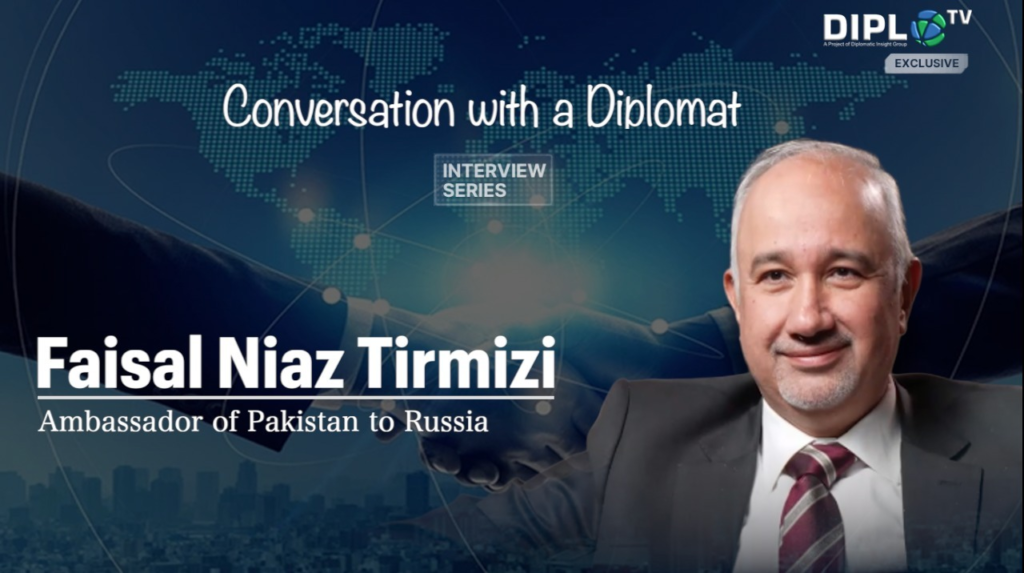
Islamabad (GNP): With more than three decades of distinguished service in Pakistan’s Foreign Service, H.E. Faisal Niaz Tirmizi has represented Pakistan across multiple continents and in some of the world’s most important diplomatic capitals. From serving at the United Nations in Geneva to leading diplomatic missions in Kyrgyzstan, the UAE, and now Russia, his career reflects a deep commitment to diplomacy, international cooperation, and public service.
Ambassador Tirmizi holds a Master’s degree from Quaid-i-Azam University and a second Master’s degree in International Studies and Diplomacy from the University of London. Over the years, he has held several key positions at Pakistan’s Ministry of Foreign Affairs, including Director General and Additional Secretary, while also serving as Consul General in Chicago and Ambassador to Kyrgyzstan.
In this exclusive conversation with The Diplomatic Insight, Ambassador Tirmizi reflects on his personal journey, the realities of diplomatic life, Pakistan-Russia relations, the value of education, and the lessons he has learned through a career spent representing Pakistan around the world.
TDI: Tell us about your personal journey—your upbringing, education, and how it all began.
Ambassador Faisal Niaz Tirmizi: I was born in Rawalpindi and received my schooling, college education, and university education in Rawalpindi and Islamabad. I completed my bachelor’s degree from Government College Rawalpindi and later earned my master’s degree from Quaid-i-Azam University. In 2001–02, I completed a second master’s degree at the University of London.
Because of my father’s profession, I had the opportunity to travel extensively across Pakistan from an early age. Shortly after my birth, my father was posted to East Pakistan, so I have faint memories of our stay in Dhaka. While my father’s assignments took him to different cities, my mother ensured that our education remained uninterrupted by keeping us in one place.
I qualified for the CSS examination in 1992 and joined Pakistan’s Foreign Service. Since then, I have served in Turkmenistan, Geneva, Abu Dhabi, Chicago, Kyrgyzstan, and now Russia. It has been an extraordinary journey.
TDI: You once remarked that the quality of education at Quaid-i-Azam University was better than what you experienced in London. Could you explain why?
Ambassador Faisal Niaz Tirmizi: At Quaid-i-Azam University, I studied under exceptional professors, many of whom had earned their PhDs from leading Ivy League institutions. They were scholars of the highest caliber who chose to serve Pakistan despite opportunities abroad.
While the facilities and libraries in London were undoubtedly superior, I found the quality of teaching at Quaid-i-Azam University to be outstanding. The academic rigor, intellectual depth, and commitment of the faculty were truly remarkable.
TDI: Was diplomacy always your dream career?
Ambassador Faisal Niaz Tirmizi: Interestingly, no. Before joining the Foreign Service, I worked as a journalist for three to four years while I was still a university student, and I genuinely enjoyed the profession.
My mother encouraged me to take the CSS examination. I appeared for it largely because of her insistence, qualified, and eventually joined the Foreign Service. Looking back, it was one of the best decisions I ever made.
That said, the Foreign Service was always my first choice. My early travels to Turkey and Canada through international youth exchange programs sparked my interest in different cultures and international affairs. I knew that if I joined the civil service, it would be the Foreign Service.
TDI: Do you think you would have been successful as a journalist?
Ambassador Faisal Niaz Tirmizi: Possibly. Some of my colleagues from that period went on to become leading names in journalism. A few even advised me not to leave the profession. But life is about choices. Once I committed to the Foreign Service, I never looked back.
TDI: Having spent much of your professional life abroad, do you miss Pakistan?
Ambassador Faisal Niaz Tirmizi: Pakistan is in our blood. No matter where I serve, Pakistan remains home. It is where my family, friends, memories, and roots are.
Whenever I return, I feel as though I am recharging my batteries. The country has changed significantly since my childhood, but the sense of belonging remains the same. Pakistan will always have a powerful emotional connection for me.
TDI: How often do you visit Pakistan, and what do you enjoy most when you return?
Ambassador Faisal Niaz Tirmizi: I try to visit Pakistan at least twice a year. Apart from official engagements, I enjoy hiking in the Margalla Hills, which I have explored since childhood.
I also spend time in Rawalpindi with old friends from school, college, and university. We usually organize gatherings whenever I am back.
And of course, I enjoy Pakistani food. Some of the finest traditional dishes can still be found in the old parts of the city. Visiting those places with family and friends is always a pleasure.
TDI: Diplomatic life offers remarkable opportunities, but what are its challenges?
Ambassador Faisal Niaz Tirmizi: One of the biggest challenges is constant relocation. Every few years, you have to adapt to a new country, language, culture, climate, and way of life. It is not easy for everyone.
Being away from family during important moments can also be difficult, especially when parents grow older or during times of personal loss.
However, the rewards outweigh the challenges. Diplomats are the first line of communication and representation for their countries. We engage not only with governments but also with businesses, academia, and broader society. It is a profession that allows continuous growth through experience.
TDI: Frequent postings can be difficult for diplomats’ children. How did your family adapt?
Ambassador Faisal Niaz Tirmizi: There were certainly challenges. My sons had to move between different educational systems, which affected continuity in their studies.
At the same time, they gained invaluable experiences. They learned multiple languages, adapted to different cultures, and developed a global outlook.
One of my sons embraced that lifestyle and continues to travel extensively, while the other prefers greater stability. Ultimately, our responsibility as parents is to provide a strong identity, sound values, and a good education. Beyond that, we trust them to chart their own paths.
TDI: Can you share a memorable experience from your travels?
Ambassador Faisal Niaz Tirmizi: There have been many.
In Kyrgyzstan, I traveled on horseback with the Deputy Minister of Culture for a week, moving from 7,000 feet to 17,000 feet in altitude alongside thousands of livestock. It was an unforgettable experience.
I have spent nights in the Rub’ al Khali desert with Bedouins, sleeping under the open sky. In Russia, I visited Siberia and regions near the Arctic Circle.
Professionally, I have had the privilege of briefing foreign ministers and heads of state, speaking at prestigious universities, and interacting with some of the brightest minds in the world. Those experiences have been truly enriching.
TDI: You currently serve in Russia. What stands out most about the country and its people?
Ambassador Faisal Niaz Tirmizi: Russia is the largest country in the world by land area and spans eleven time zones. It is a nation with a remarkable history, resilience, and cultural heritage.
My appreciation for Russia began in childhood through literature. I grew up reading authors such as Maxim Gorky, Mikhail Sholokhov, Boris Pasternak, Fyodor Dostoevsky, and Leo Tolstoy.
Russians are highly cultured and hospitable people. While they appear European, many of their social values—particularly their emphasis on family, friendship, and hospitality—are very similar to those found in Asia.
I believe there is tremendous potential for stronger people-to-people, cultural, academic, and business ties between Pakistan and Russia.
TDI: In your view, what is the most important quality a diplomat must possess?
Ambassador Faisal Niaz Tirmizi: A diplomat must be people-oriented. Diplomacy is fundamentally about relationships.
Equally important is integrity. Your word is your currency. You must be truthful, professional, and capable of representing your country with dignity.
Success in diplomacy depends on the trust and respect you earn from your counterparts.
Also Read: Conversation With a Diplomat: An Exclusive Interview With H.E. Syed Haider Ali Shah
TDI: What message would you like to share with young people aspiring to join the Foreign Service or pursue meaningful careers?
Ambassador Faisal Niaz Tirmizi: Be passionate about what you do. If you do not enjoy your work, you will never truly excel at it.
Invest in your education, continuously improve your skills, and strive to be the best version of yourself. Represent yourself and your country with confidence and professionalism.
Read books. Social media may provide information, but wisdom comes from reading. Learn from great authors and thinkers whose ideas have stood the test of time.
Surround yourself with people who challenge and inspire you. Seek the company of those who contribute to your growth and development.
Most importantly, be sincere—to yourself, your family, your friends, your country, and humanity. In the end, we all share the same world, and our responsibility extends beyond ourselves.