Islamabad (GNP): Wang Lei, Representative of China Media Group (CMG), expressed appreciation to the Institute of Strategic Studies Islamabad (ISSI) for co-hosting the event, noting that it took place at a doubly significant moment, the 105th founding anniversary of the Communist Party of China (CPC) and the 75th anniversary of Pakistan-China diplomatic ties. Pointing to China’s sweeping socio-economic progress under CPC leadership, she underscored CMG’s dedication to building an accurate public understanding of China’s development path and fostering closer people-to-people bonds between the two nations.
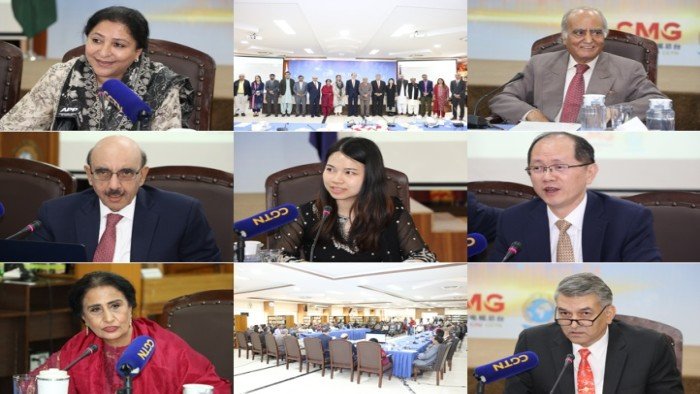
The China-Pakistan Study Centre (CPSC) at ISSI, in partnership with CMG, organised a commemorative seminar under the theme “CPC 105 Years: Achievements, Experiences, and the China-Pakistan Community with a Shared Future.” The event drew senior officials, diplomats, academics, scholars, media professionals, and students to reflect on China’s extraordinary progress under CPC leadership and its implications for Pakistan-China relations and their evolving All-Weather Strategic Cooperative Partnership.
Opening the seminar, Ambassador Khalid Mahmood, Chairman of ISSI’s Board of Governors, called the CPC’s 105-year trajectory a compelling story of far-sighted leadership, disciplined reform, and enduring institutional strength. He pointed to China’s record-breaking gains in economic growth, poverty reduction, technological progress, and modernisation, arguing that these carry instructive lessons for developing nations. He noted that Pakistan, whose partnership with China continues to evolve well beyond its traditional political and strategic dimensions, stands to benefit as cooperation extends into areas such as the digital economy, artificial intelligence, green development, agricultural modernisation, and human resource development under the expanding CPEC framework.
Chief Guest Wajiha Qamar, Minister of State for Federal Education and Professional Training, characterised the CPC’s journey as a powerful model of national renewal built on purposeful leadership and governance rooted in the needs of the people. She observed that China’s modernisation path underscores the value of tailoring development to a country’s own conditions while prioritising education, technology, and human capital. Reaffirming Pakistan’s commitment to the bilateral partnership, she called for the next chapter of Pakistan-China cooperation to place greater emphasis on education, scientific exchange, skills development, innovation, youth engagement, and closer ties among universities, think tanks, and research bodies.
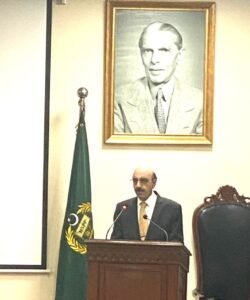
In his keynote address, Ambassador Masood Khan, former Pakistani Ambassador to China, reflected on the CPC’s central role in driving China’s economic rise, technological leap, and historic success in lifting its population out of poverty. He described the Belt and Road Initiative as a powerful vehicle for international cooperation and reiterated Pakistan’s firm support for CPEC as the initiative’s flagship. He noted that CPEC 2.0 is broadening its scope to cover industrial growth, agriculture, emerging technologies, and vocational training, while highlighting the relevance of China’s governance approach to strategic planning and long-term policy consistency.
Ambassador Naela Chohan, former High Commissioner of Pakistan to Australia, described China’s ascent as one of the defining development stories of our time, grounded in mutual respect, sovereign equality, and deep historical and civilisational ties with Pakistan. She pointed to expanding collaboration in artificial intelligence, the digital economy, education, healthcare, tourism, and youth exchanges, while stressing the need to nurture stronger academic, media, and people-to-people connections.
Dr. Abdul Wahid, Head of Department and Assistant Professor at the National University of Modern Languages (NUML), identified sustained strategic planning, ongoing reform, and investment in people as the core drivers behind China’s development model. He noted that consistent spending in education, healthcare, agriculture, and infrastructure, paired with meaningful grassroots engagement, has produced substantial gains in China’s productivity and human capital.
Guest of Honour Shi Yuanqiang, Deputy Head of Mission at the Chinese Embassy in Pakistan, highlighted China’s sweeping achievements under CPC leadership spanning economic development, poverty alleviation, education, and national renewal. Describing CPEC as the Belt and Road Initiative’s centrepiece, he reaffirmed China’s resolve to advance high-quality CPEC cooperation, implement the Action Plan for an Even Closer China-Pakistan Community with a Shared Future, and deepen collaboration through the Global Development, Global Security, Global Civilization, and Global Governance Initiatives.
Dr. Jibran Hussain Raza, Assistant Professor at the Public Policy Institute, approached China’s development through the lens of institutional evolution and economic governance, arguing that China’s transformation was the product of decades of deliberate planning, institution-building, industrial growth, and pragmatic reform. He stressed that Pakistan must strengthen its own institutional and industrial foundations to fully capture the opportunities that CPEC 2.0 presents.
Also Read: Women’s empowerment is a key priority of PMYP, Rana
In his opening remarks, Dr. Talat Shabbir, Director of CPSC at ISSI, traced the CPC’s pivotal contribution to making China a global leader in both economic output and technological capability, crediting this to sustained strategic vision, uninterrupted reform, strong institutions, and governance that keeps people at its centre.
The seminar wrapped up with a wide-ranging interactive discussion covering China’s modernisation experience, the CPC’s governance philosophy, and the road ahead for Pakistan-China cooperation.

Sohail Majeed is a Special Correspondent at The Diplomatic Insight. He has twelve plus years of experience in journalism & reporting. He covers International Affairs, Diplomacy, UN, Sports, Climate Change, Economy, Technology, and Health.